Robert Simon collection; purchased November 2013, with subsidiary dial (TCW 1029).
Overview
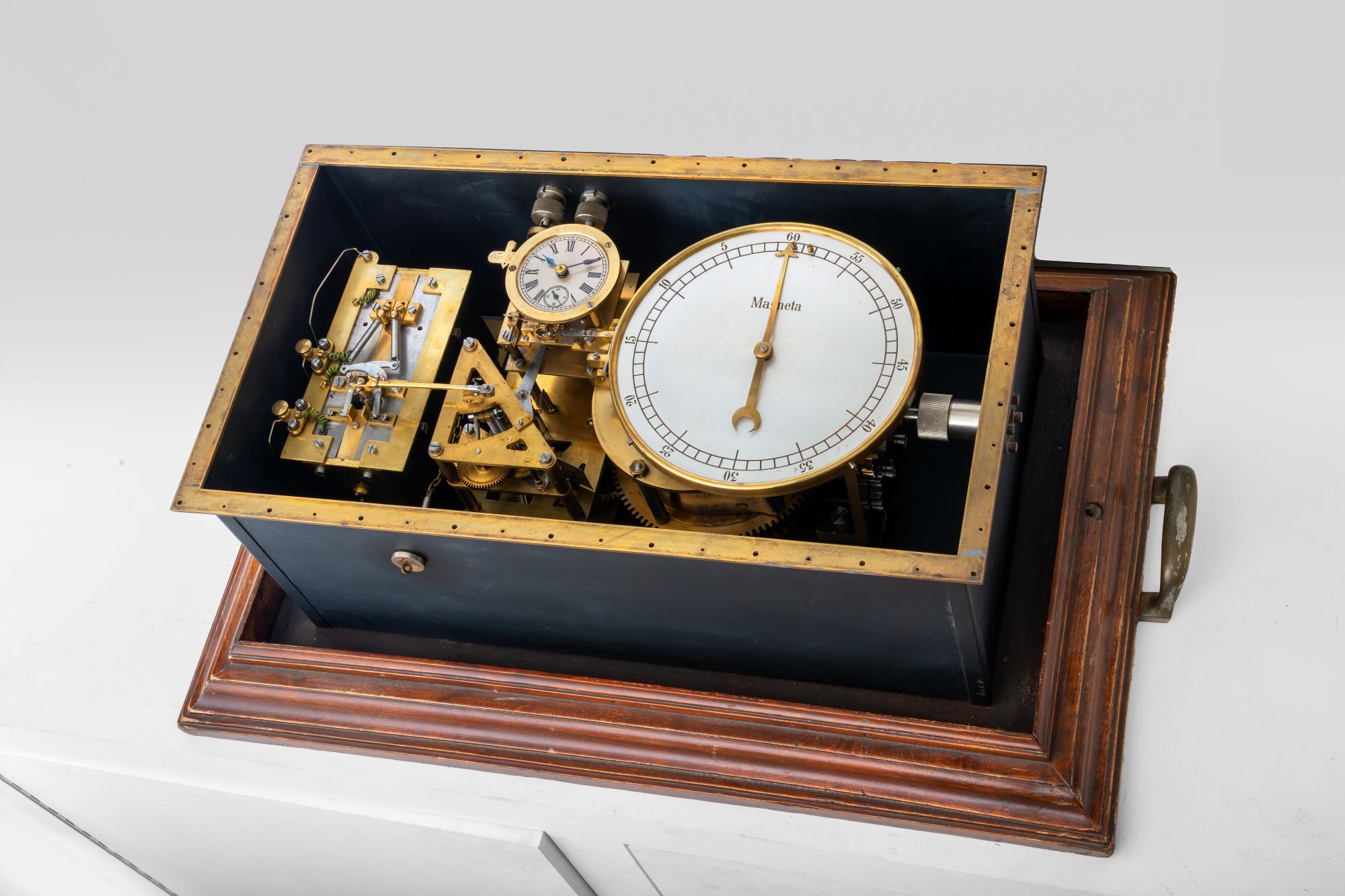
First documented in 1908, this may be the first successful timekeeping system for ocean liners. It could control up to 25 subsidiary clocks across a large vessel, and adjust them as the ship moved through time zones. On a westward crossing, the large dial counted down the minutes (up to 55) for ‘setting back’. Going east, hands were advanced by pulling the chain protruding from the damp-proof case. Possibly as few as 20 were manufactured; two were a celebrated technological centrepiece on the RMS Titanic.
In depth
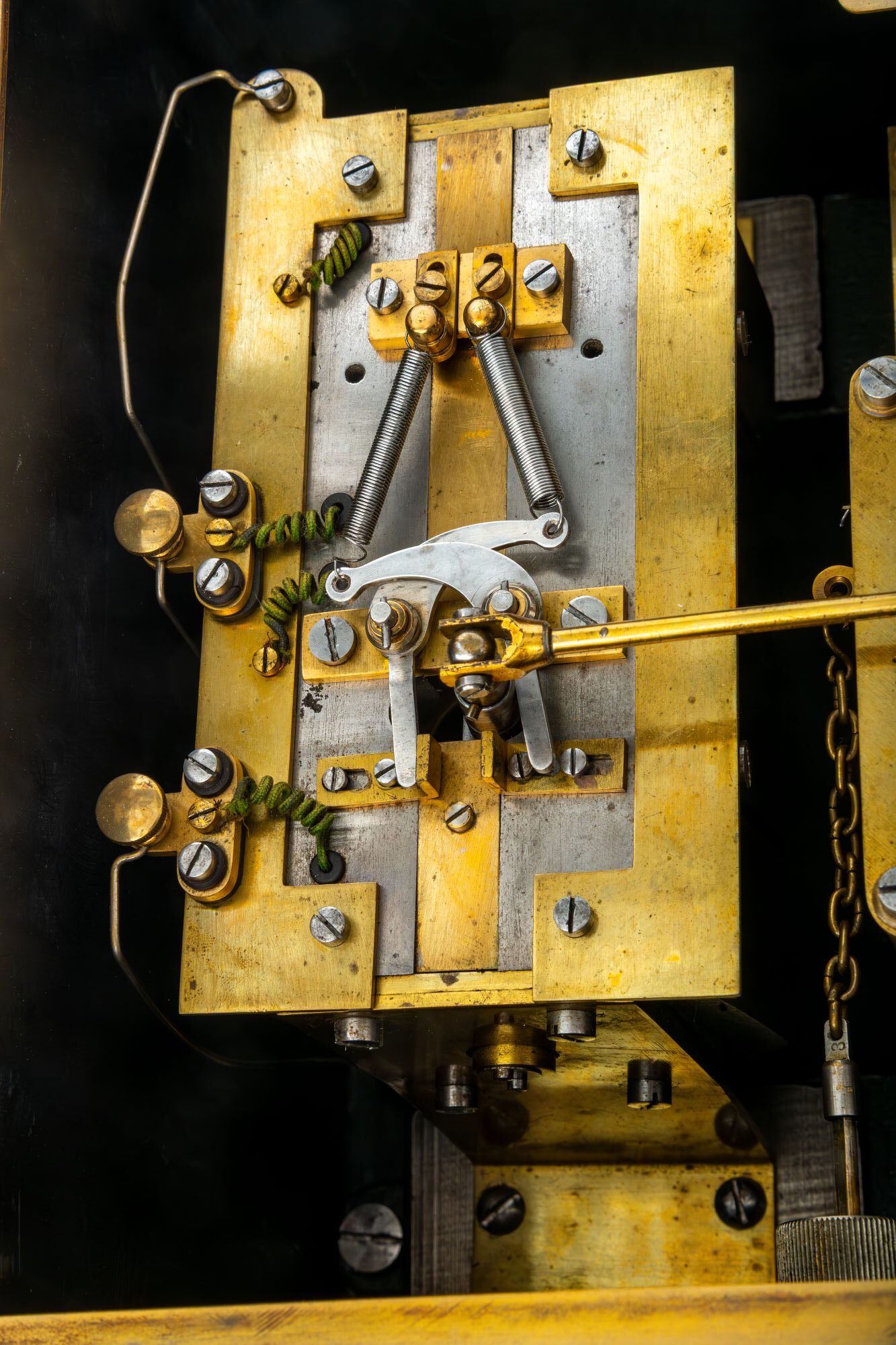
First documented in 1908, this may be the earliest successful timekeeping system for ocean liners. Capable of controlling up to 25 ‘subsidiary’ clocks across a large vessel, Magneta’s marine impulse transmitter uses the Swiss firm’s patented battery-free system. Every minute a mechanical unit releases a powerful spring which drive the rotation of an armature within the magnetic field generated by a group of permanent horseshoe magnets at the left. This creates a powerful alternating polarity electrical pulse, sending a short impulse through the whole circuit and advancing the hands of the clocks connected to it by one minute. The power required to bring this about is supplied by a large 2” mainspring, which is rewound with a large crank approximately every two days.
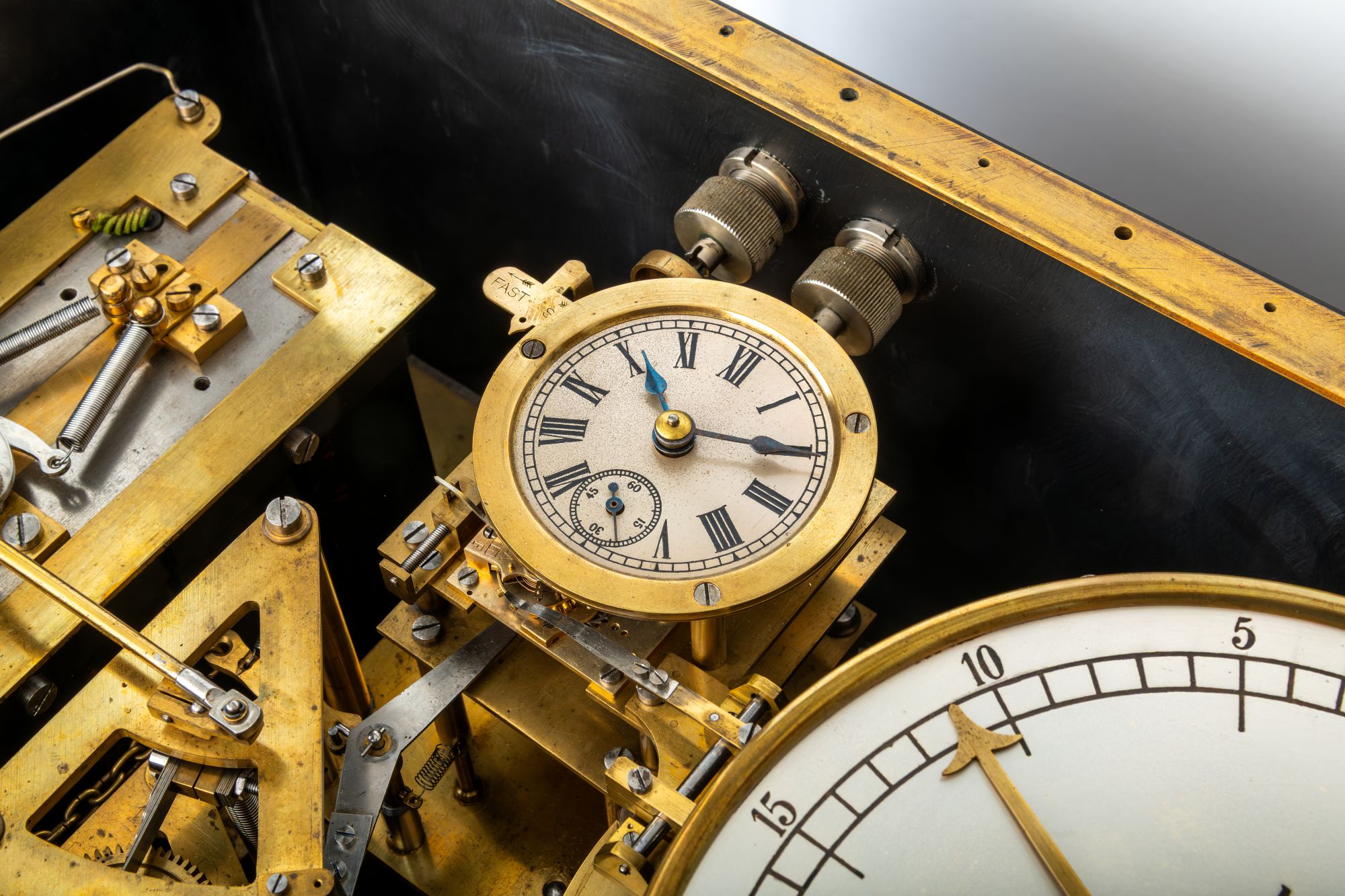
However, this clock also has maritime adaptations – most obviously, the horizontal platform escapement and (supposedly) watertight case, which comprises a zinc chest with sealed bevelled glass top, contained within an oak frame with brass carry handles. As the ship travelled east to west or west to east, it would move through time zones, and this time transmitter allows the operator to adjust the time on subsidiary clocks by their desired amounts. On an eastbound crossing, they could pull a small chain connected to the release mechanism to advance the subsidiary clocks (and the pilot dial) by several minutes at a time. Travelling west, the ‘retard’ unit was set with a key through the glass; the setting hand was rotated to the time desired (up to 55 minutes) and a second escapement – a small watch movement spring – would drop a lever spring directly onto the balance on the main clock, stopping all pulses, and effectively taking subsidiary clocks out of the circuit while it counted down the selected time for ‘setting back’. At the end of the counted period, the balance brake on the main movement platform escapement would be released and it would resume timekeeping duties.
In the 1960s, the Magneta company (by then managed by The Goblin Ltd. of Leatherhead) estimated that only about 20 of these marine transmitters had ever been made, production having definitively stopped by the 1930s – by which point more successful systems by Gent, Synchronome and Mercer had also entered the market. The Magneta system’s heyday therefore seems to have been the period up until the First World War, when examples were installed on the Cunard Line’s ‘Atlantic Greyhounds’, SS Mauritania and Lusitania (both 1906), as well as on the White Star Line’s RMS Olympic (1911-35) and Titanic (1911). The system was in fact described with reference to the Titanic in The Electrician
for 4 August 1911 and a special commemorative edition of The Shipbuilder. The latter specified that Titanic and Olympic had two marine ‘Master Clocks’ supplied by the ‘Magneta Time Co. Ltd.’ installed in the chart room, running on a system ‘which obviates the use of galvanic batteries’. A Magneta subsidiary clock controlled by this system was a famous centrepiece of the forward Grand Staircase of both Titanic and Olympic, set into the centre of a carved allegorical representation of ‘Honour and Glory Crowning Time’.
This clock was acquired along with a Magneta ‘sunburst’ subsidiary dial (TCW 1029) in 2013, from American clock collector Robert Simon.
Dimensions
uncased: 52.5 x 30 x 21 cm
Inventory number
TCW 1032
Date
c.1908-1920
Bibliography
‘The Electrical Equipment of the SS Olympic and Titanic’, The Electrician, 28 July and 4 August 1911
Samuel Halpern, ‘Titanic’s Master of Time’ [https://www.titanicology.com/Titanica/TitanicsMasterOfTime.pdf]
Charles Miller, Maritime and Scientific Models, Instruments and Art, 25 April 2023, lot no. 108
G. Rogora, letter to C. H. Rycroft, 6 April 1964 (The Clockworks object file)
The Shipbuilder: Mauretania, Olympic and Titanic Souvenir numbers, Newcastle-upon-Tyne: The Shipbuilder Press, 1911, p.117
Robert Simon, ‘The Marine Master Clock’, National Association of Watch and Clock Collectors, NAWCC Bulletin (April 2008), 50:2, no. 373, pp.161-174
Robert Simon, private correspondence