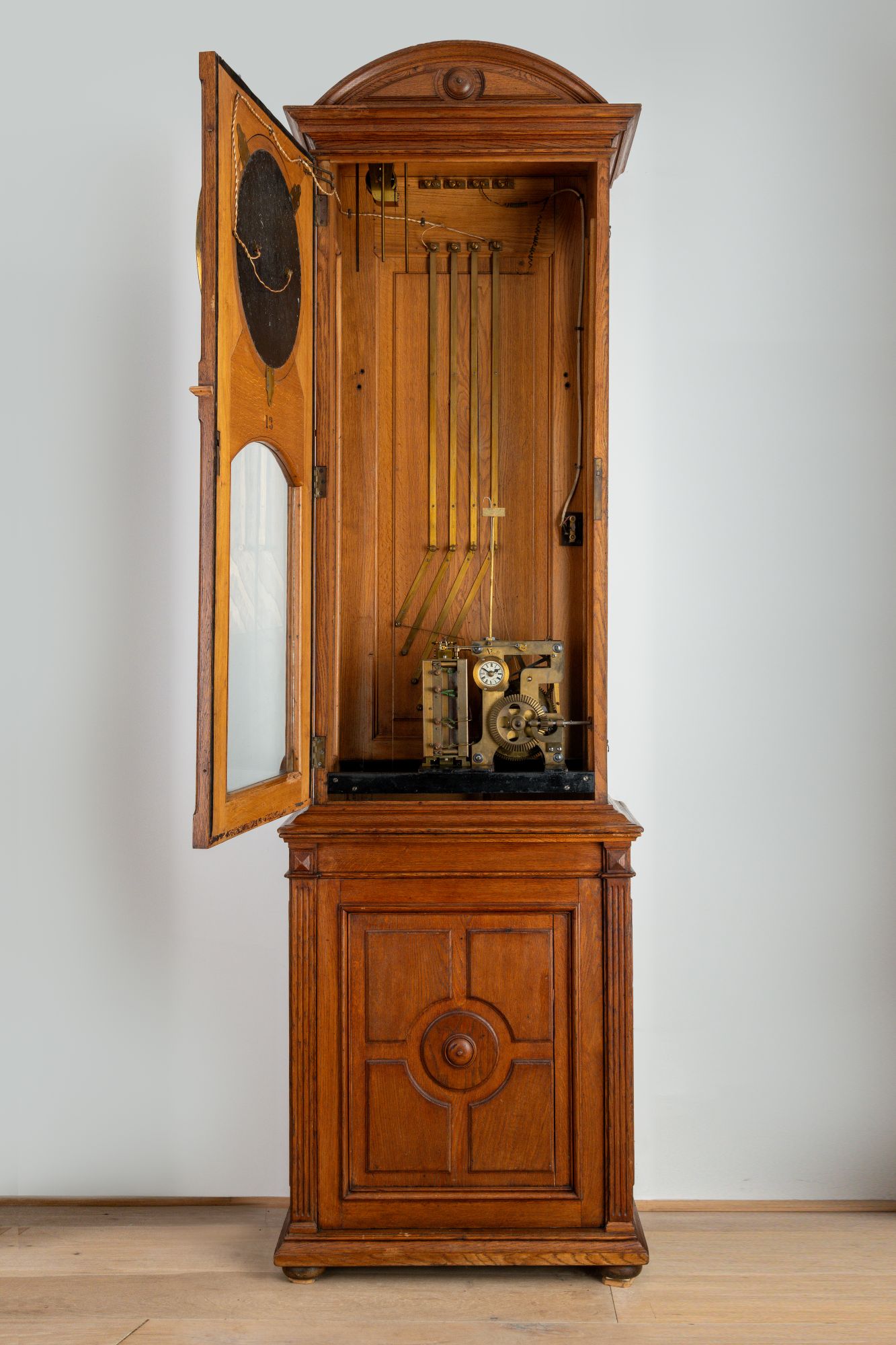
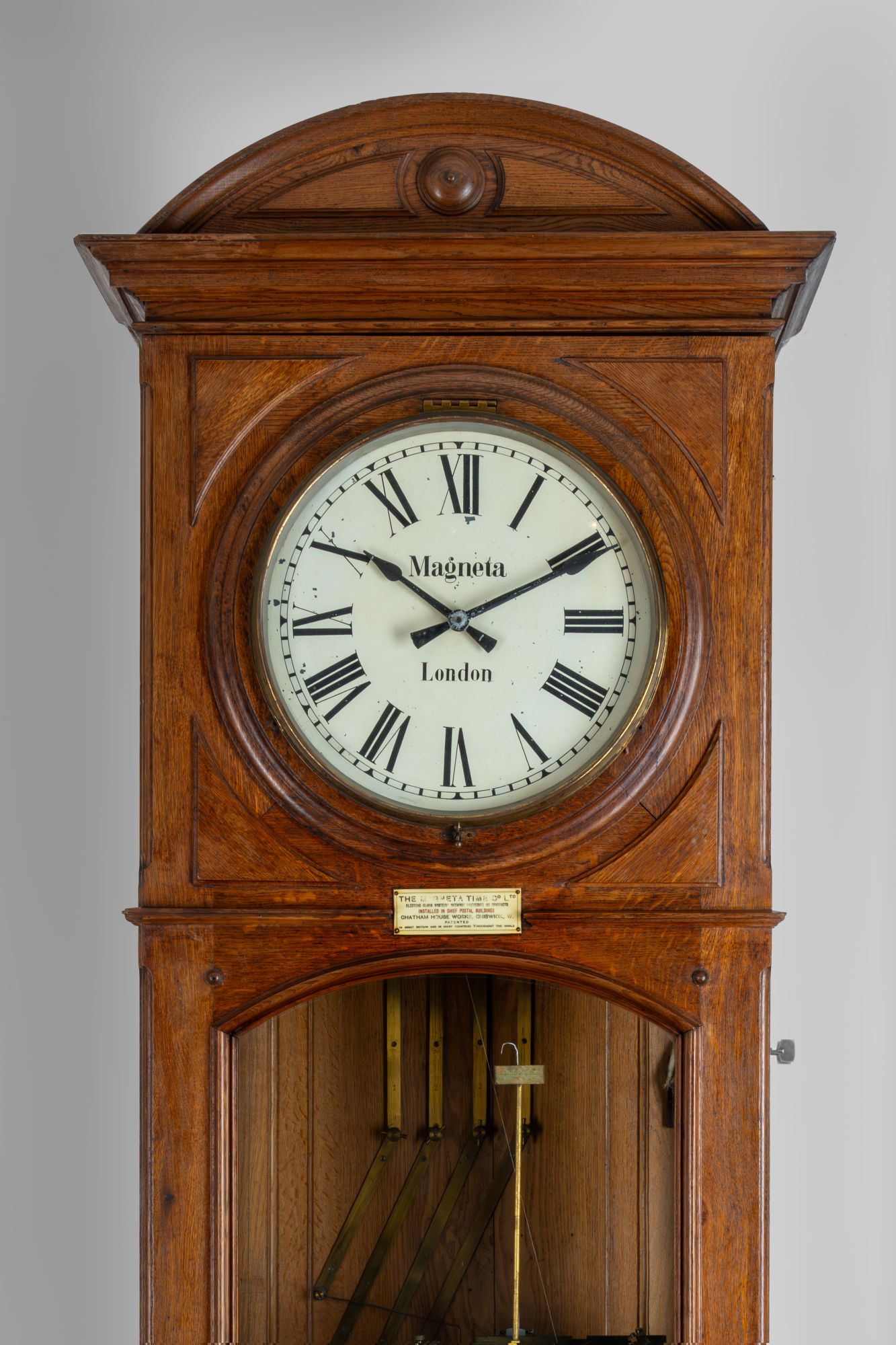
On dial: 'Magneta | London'. Plaque on front of case: 'THE MAGNETA TIME CO. LTD. | ELECTRIC CLOCK SYSTEM WITHOUT BATTERIES OR CONTACTS | INSTALLED IN CHIEF POSTAL BUILDINGS | CHATHAM HOUSE WORKS, CHISWICK, W. | PATENTED | IN GREAT BRITAIN AND CHIEF COUNTRIES THROUGHOUT THE WORLD' On inside door: 13. On plate, in two places: 11 Handwritten beat scale label, running 1—9.
Overview
Devised by Martin Fischer of Zurich, the Magneta system promised ‘electric clock systems without batteries or contacts’. Instead of relying on erratic external power sources, this clock made its own electricity, using a dynamo activated by the falling of a large weight. Each time an alternator in the dynamo turned, the hands on up to 100 subsidiary clocks would advance by one minute. Magneta clocks were installed across the General Post Office network throughout the Edwardian era.
In depth
The Magneta System proudly advertised ‘electric clock systems without batteries or contacts’ – an allusion to two problems that bedevilled early electrical horology. The system – devised by Martin Fischer of Zurich and recognised in two Swiss patents of December 1899 (CH19701 and CH19715) – promised total independence: there was no need to clean the contacts or change the batteries, and the clock required no ongoing maintenance. Instead, a weight-driven controlling clock system used a dynamo to power a large network of subsidiary dials.
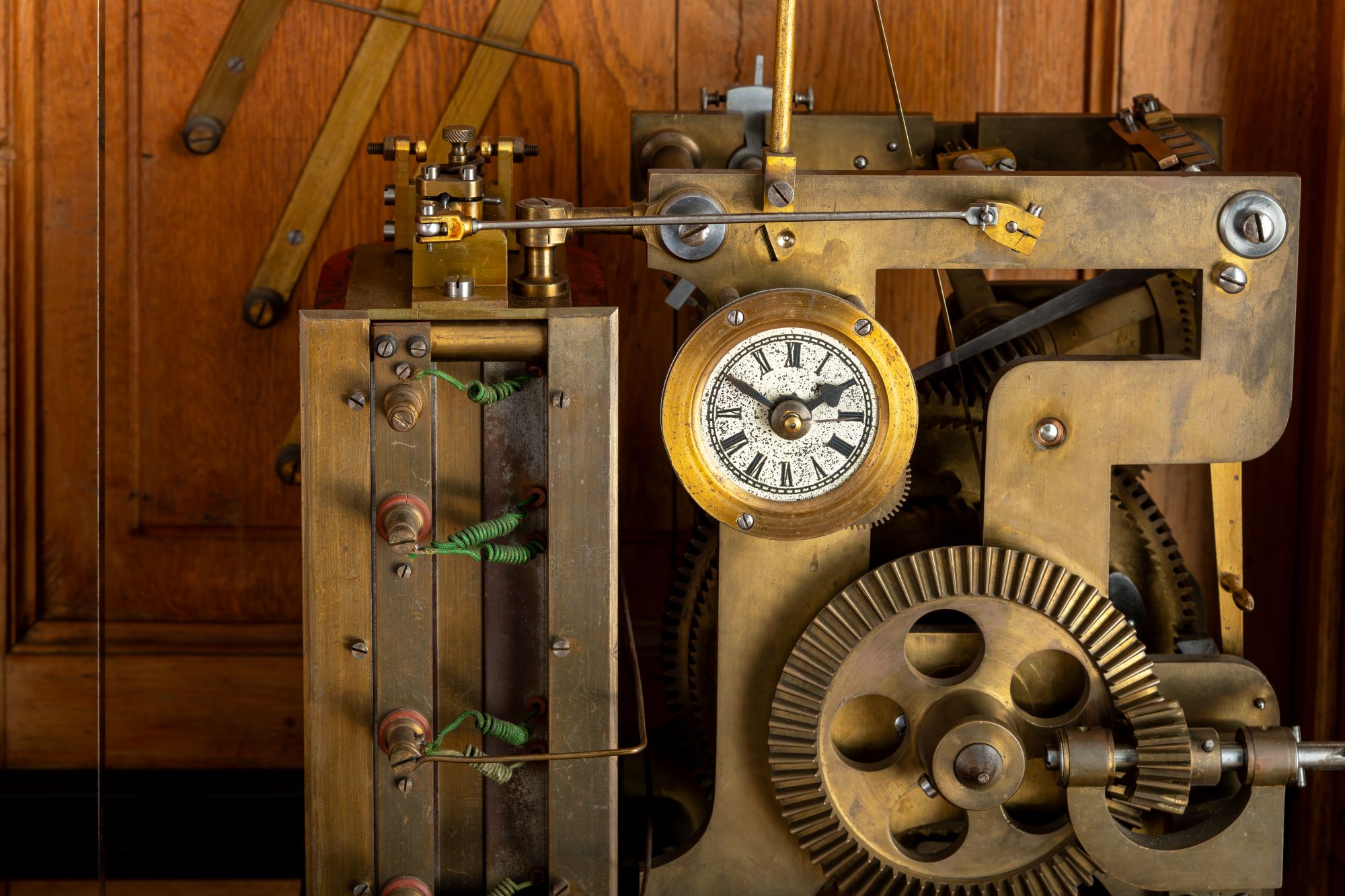
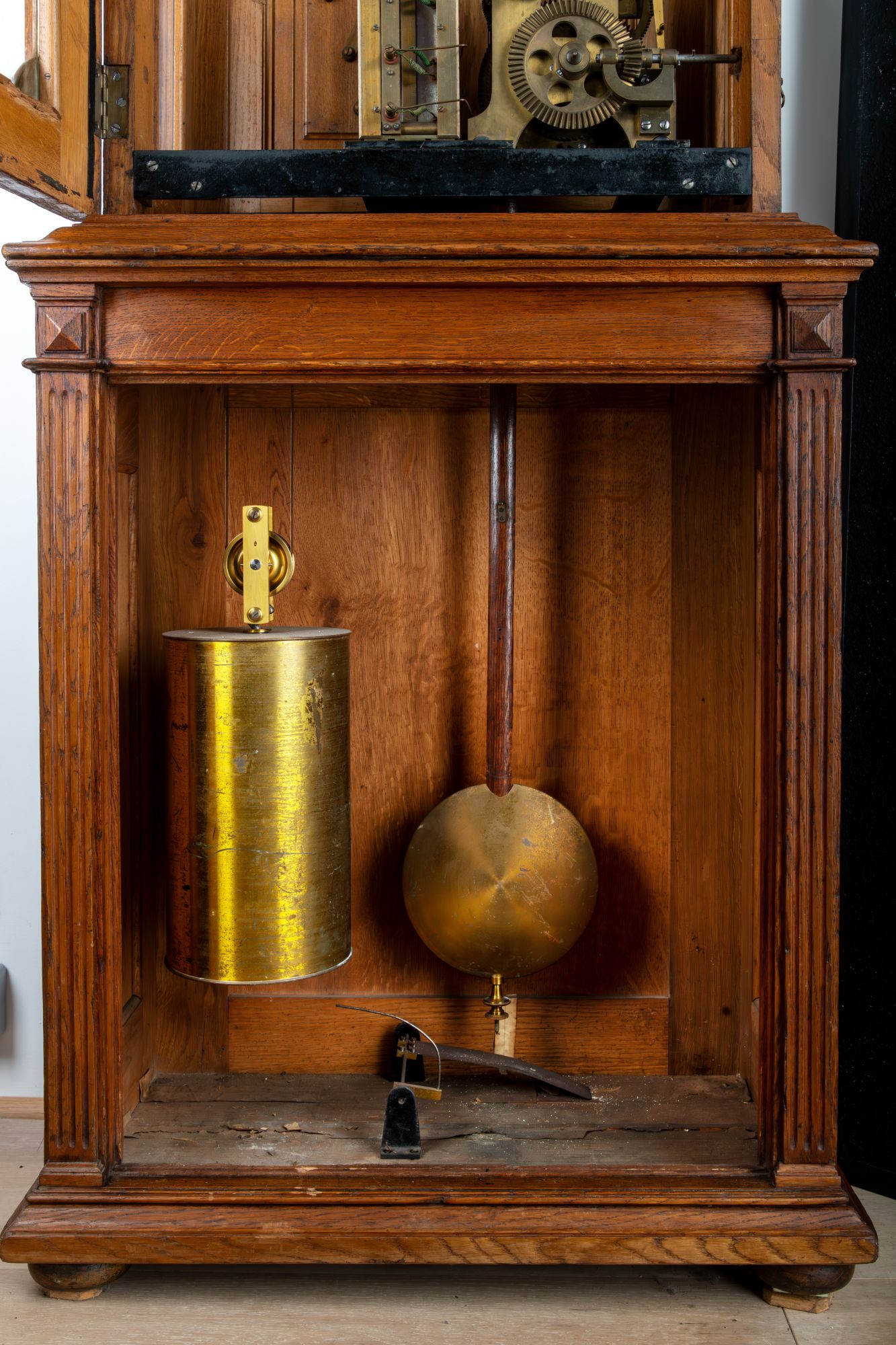
This clock is a Magneta ‘F2’ regulator, in an oak case, capable of controlling up to 100 dials (the D type controlled up to 60; the C up to 35). In common with Magneta’s standard specification, it has an Invar steel pendulum with elliptical bob, Graham dead-beat escapement and Harrison’s maintaining power. It is the slow, incremental falling of the weight – so large it has to be supported by flat steel bands, rather than the traditional gut-line – that generates the power required to turn the armature of a large dynamo once a minute, in a rapid action of relatively limited travel, when it is released by the going train. The rapid action is also used to rewind the remontoir spring in the going train (thus maintaining the pendulum’s arc) and the electrical pulse generated by the dynamo advances the hands on all the subsidiary dials. These subsidiaries are advanced by means of a rocking armature of reversing polarity, which ensures there is no sudden increase in electrical current (see TCW 1029). A simple, but effective, automatic break system is in place at the bottom of the case, to prevent damage to the escapement by the continued when the weight reaches the bottom of the case at the end of the wind.
The clock is identified by a plaque on the case as having originated at ‘Chatham House Works, Chiswick’, Magneta’s factory in Turnham Green, West London. This provides an indication of possible date, since Magneta bought these premises in 1908 – though the company seem to have initially continued making parts and possibly whole movements in Switzerland, using the UK factory primarily for assembly, casing and marketing.
Clocks made to Fischer’s design were very successful throughout the Edwardian period: famously, a Magneta System was installed across the UK’s General Post Office network, and clocks of the same type, though in more ornate cases, were installed in high-profile public buildings across Europe and the USA – notably the Westin St Francis Hotel in San Francisco. Ultimately, however, improvements in the battery and contact technology Fischer had scorned gradually made his invention redundant, and clocks using this system eventually retired from the market.
Inventory number
TCW 1031
Date
c.1908
Bibliography
Clockworks company file on the Magneta Company.
GPO Technical Instruction XI (1927), ‘Clocks and Time Distribution’, Paragraphs 19-20, accessed at https://www.lightstraw.uk/gpo/clocksystems/pages/TI%20XI%2019-20.html [10.12.2025]
Frank Hope-Jones, Electrical Timekeeping (London: N.A.G. Press, 1940, rev. edn. 1976), pp.15-17
Magneta (New York), ‘Magneta Co. New York: Electric Clock Systems Without Batteries or Contacts’, New York, c.1908.
Magneta (Old Broad Street, London), ‘The Magneta Company: Electric Clock Systems Without Batteries or Contacts’, 1920
The Magneta Time Company (Carteret Street, Westminster), ‘Illustrated Catalogue of “Magneta” Electric Clocks’, c.1926