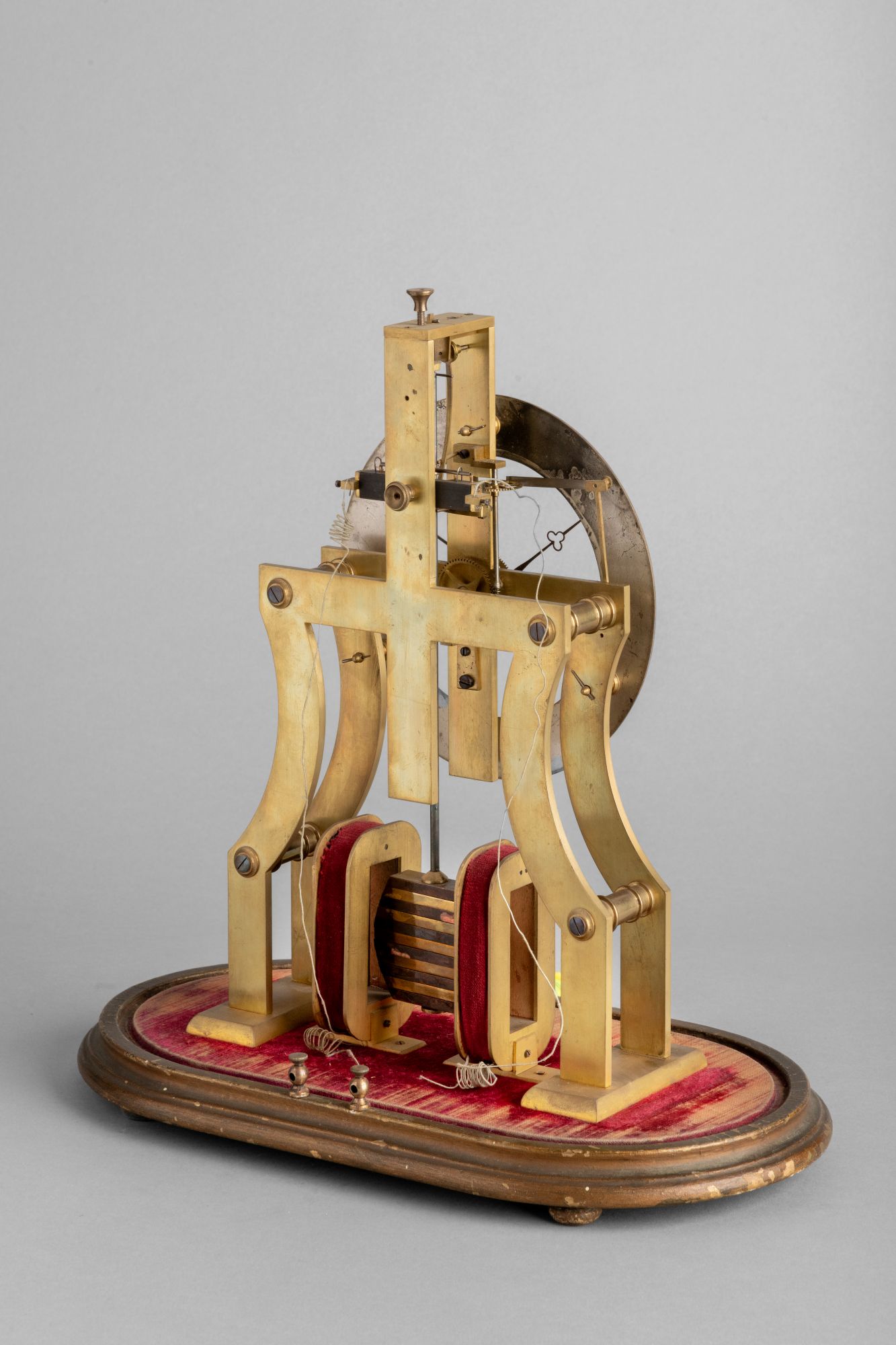
A skeletonised mantel clock with an electromagnetically impulsed pendulum, with a crossed out Roman silvered dial, and red velvet-covered electromagnets either side of a striped pendulum bob. Having applied for his first electrical patent in 1840, Scottish inventor Alexander Bain is often dubbed ‘the father of electrical horology’ (see TCW 1000) and this is a rare example of a mantel or table clock with ‘A. BAIN’ on the dial, very close in style and mechanism to another clock exhibited at the Science Museum in 1977. Bain’s Short History of the Electric Clocks (1852) reproduces several images of ‘mantelpiece and sideboard clocks’, which he proposed to power from voltaic plates in matching vases or large pedestals, though it is not clear how many of these were actually realised.
Dimensions
35 x 19 x 36 cm (uncased)
Inventory number
TCW 3001
Date
c.1850-60
Bibliography
Alexander Bain, A Short History of the Electric Clocks, with Explanations of their Principles and Mechanism (London: Chapman and Hall, 1852), pp.18-19, figs. 9-11.
Charles K Aked, Electrifying Time (London: Antiquarian Horological Society, 1977), cat. no. 2, pp.42-43
Alan and Rita Shenton, The Price Guide to Collectable Clocks, 1840-1940 (Woodbridge: Antique Collectors Club, 1985), p.352