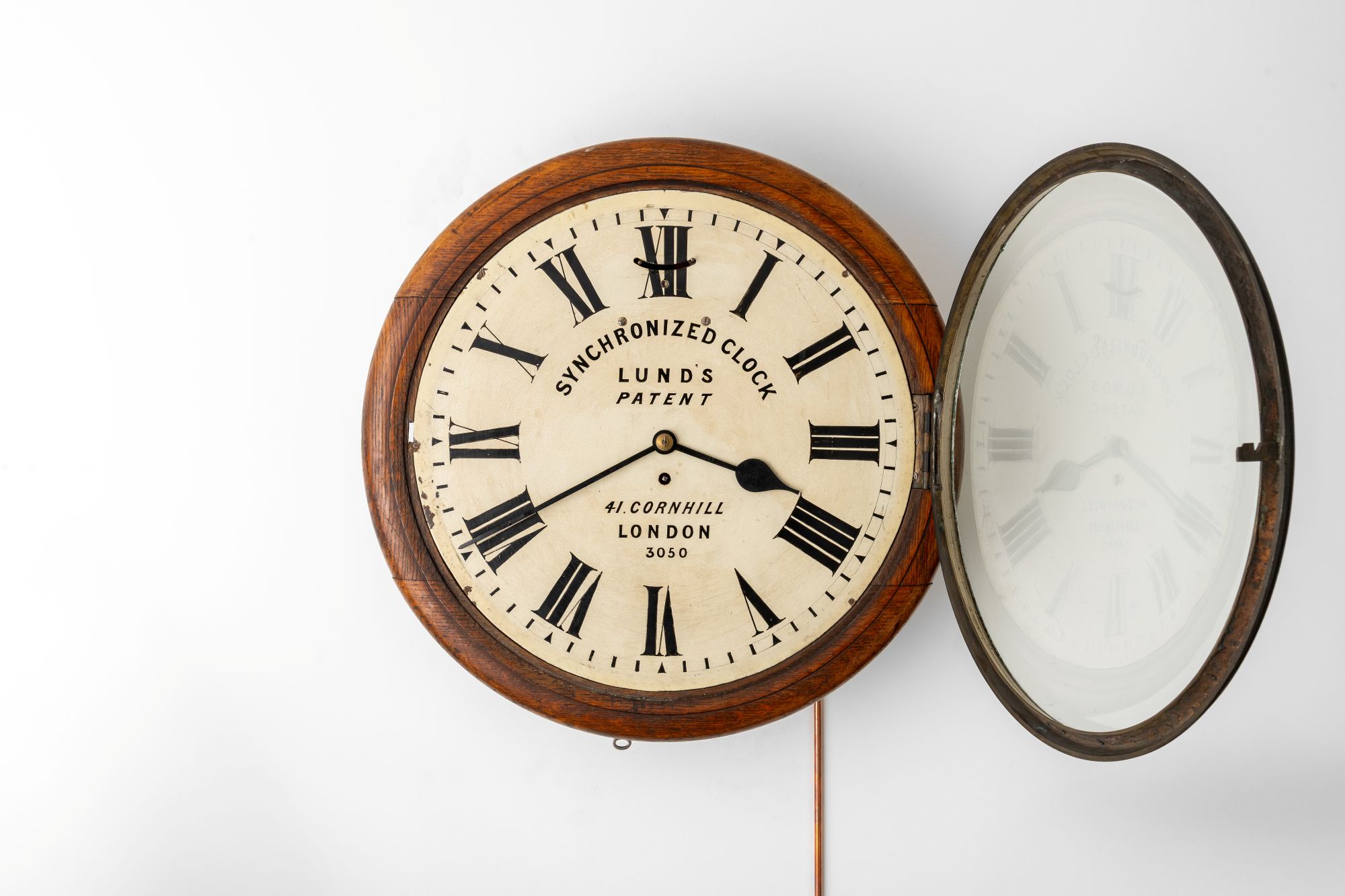
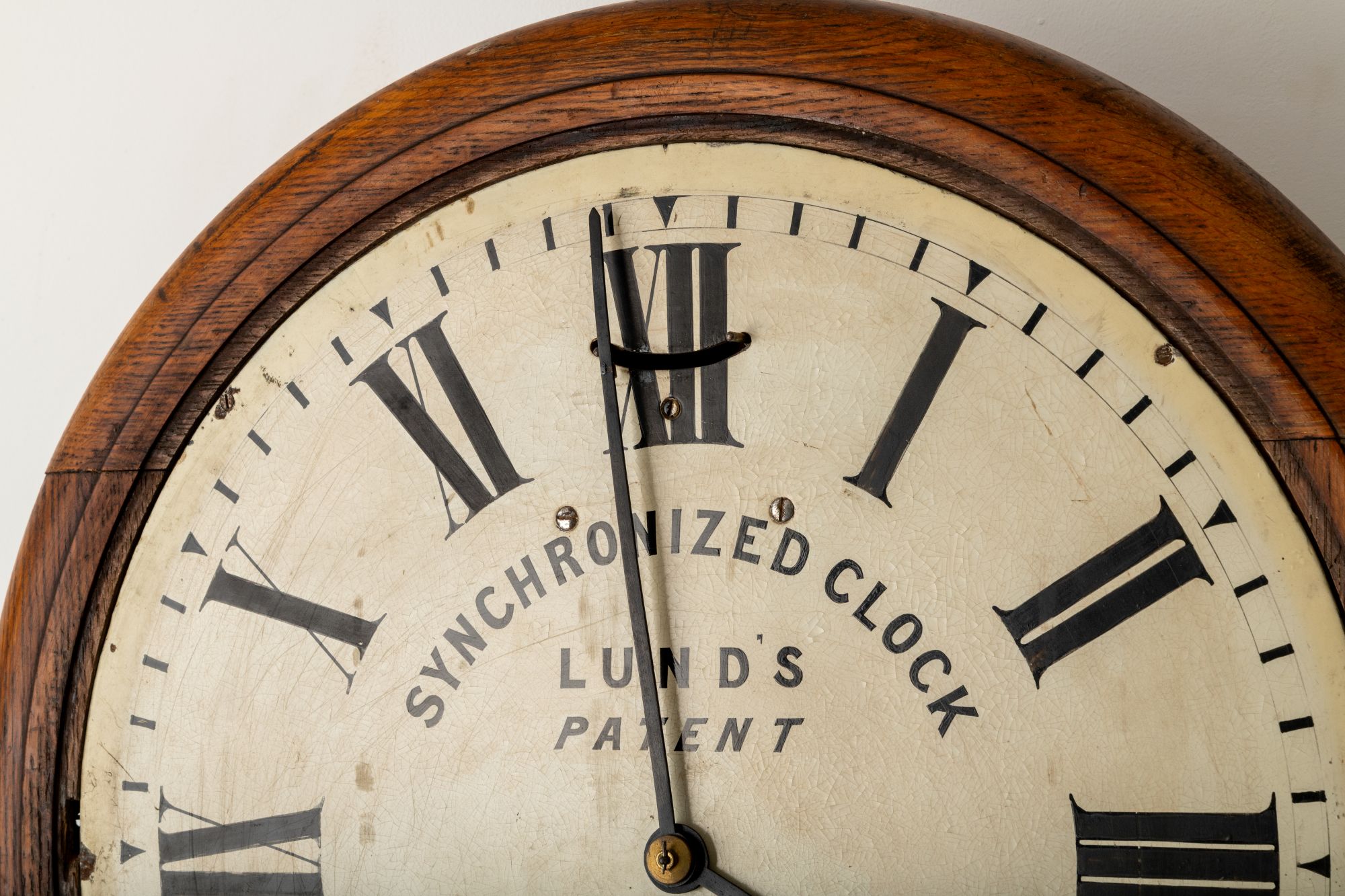
Standard Time Company, Synchronised English dial clock, TCW 2003. Image available for non-commercial use via Creative Commons under a CC BY-NC 4.0 license.
TCW_2003_01
Standard Time Company, Synchronised English dial clock, TCW 2003. Image available for non-commercial use via Creative Commons under a CC BY-NC 4.0 license.
TCW_2003_02
Standard Time Company, Synchronised English dial clock, TCW 2003. Image available for non-commercial use via Creative Commons under a CC BY-NC 4.0 license.
TCW_2003_01
Standard Time Company, Synchronised English dial clock, TCW 2003. Image available for non-commercial use via Creative Commons under a CC BY-NC 4.0 license.
TCW_2003_02
Standard Time Company, Synchronised English dial clock, TCW 2003.
TCW_2003_03
on dial: SYNCHRONIZED CLOCK | LUND'S | PATENT | 41 CORNHILL | LONDON | 3050
Overview
This is an ‘English dial’ clock – a practical mechanical timekeeper regularly installed in public spaces from the late eighteenth century onwards. Unusually, it has been fitted with a synchroniser, allowing it to be forcibly re-set to time on the hour, every hour, via an electric pulse. Both were provided by the Standard Time Company under the leadership of John Alexander Lund, who recognised a growing need for standardised time across a client base including banks, factories, department stores and pubs.
In depth
This is in a standard mechanical clock of the type often called ‘English dial’, which emerged in the late eighteenth century as a simple and practical timekeeper for public and institutional locations, such as banks, insurance offices, factories, coffee houses, and – later – railways. The wooden case conceals an approximately 8-inch pendulum with a lenticular bob complete with rating nut; the fusee movement is spring-wound with a recoil anchor escapement, and the simple 12-inch white painted dial is easy to read from a distance.
More unusually, this clock has been fitted with an electric synchroniser, which the dial identifies as ‘Lund’s Patent’. The reference is to the firm of Barraud & Lund, who from their beginnings as chronometer makers, had moved into time synchronisation under the leadership of John Alexander Lund from 1868. Lund’s synchronised clocks had a slot cut through the dial at the ‘12’ position, and two solenoids fitted onto the reverse. This would have allowed the clock to receive hourly time signals – either directly from Barraud & Lund themselves, over wires rented from the Post Office Telegraph Department, or through a third party ‘local accredited time-keeper’, again over Post Office wires. The electric signal, for which clients paid an annual subscription of £5 5s 0d, would activate the electromagnets, in turn attracting the soft iron armature above, arranged to move cranked levers carrying two pins which emerge through a sector in the dial, either side of the minute hand, allowing forcible correction of the hands – ‘zeroing’ them to the hour.
The address on this dial – ‘41 Cornhill’ – was the business premises of Barraud & Lund until 1882, when the newly renamed ‘Standard Time and Telephone Company’ took up offices at 19 & 21 Queen Victoria Street. This may suggest an indicative date for this clock between 1878-1882. Though Lund’s successors floated the Standard Time Company (as it had become) on the stock market in 1886, the company never reached critical mass, though it continued providing a time service in various permutations until the middle of the twentieth century. The synchroniser on the reverse of this clock therefore testifies to an early, but ultimately abandoned, innovation in the development of networked time.
Inventory number
TCW 2003
Date
c.1878-82
Bibliography
James Nye and David Rooney, ‘“Such Great Inventors as the Late Mr Lund”: An introduction to the Standard Time Company, 1870-1970’, Antiquarian Horology, 30:4 (December 2007), pp.501-523
Ronald E. Rose, English Dial Clocks (Woodbridge: Antique Collectors’ Club, 1978)