
-
 Arnold & Lewis, Regulator, TCW1001. Image available for non-commercial use via Creative Commons under a CC BY-NC 4.0 license. TCW_1001_02Download
 -
 Arnold & Lewis, Regulator, TCW1001. Image available for non-commercial use via Creative Commons under a CC BY-NC 4.0 license. TCW_1001_02Download
 -
 Arnold & Lewis, Regulator, TCW1001. Image available for non-commercial use via Creative Commons under a CC BY-NC 4.0 license. TCW_1001_05Download
 -
 Arnold & Lewis, Regulator, TCW1001. Image available for non-commercial use via Creative Commons under a CC BY-NC 4.0 license. TCW_1001_06Download
 -
 Arnold & Lewis, Regulator, TCW1001. Image available for non-commercial use via Creative Commons under a CC BY-NC 4.0 license. TCW_1001_07Download


-
 Arnold & Lewis, Regulator, TCW1001. Image available for non-commercial use via Creative Commons under a CC BY-NC 4.0 license. TCW_1001_02
 -
 Arnold & Lewis, Regulator, TCW1001. Image available for non-commercial use via Creative Commons under a CC BY-NC 4.0 license. TCW_1001_02
 -
 Arnold & Lewis, Regulator, TCW1001. TCW_1001_04
 -
 Arnold & Lewis, Regulator, TCW1001. Image available for non-commercial use via Creative Commons under a CC BY-NC 4.0 license. TCW_1001_05
 -
 Arnold & Lewis, Regulator, TCW1001. Image available for non-commercial use via Creative Commons under a CC BY-NC 4.0 license. TCW_1001_06
 -
 Arnold & Lewis, Regulator, TCW1001. Image available for non-commercial use via Creative Commons under a CC BY-NC 4.0 license. TCW_1001_07
Creator
Arnold & Lewis
Title
Regulator
Category
Inscriptions and markings
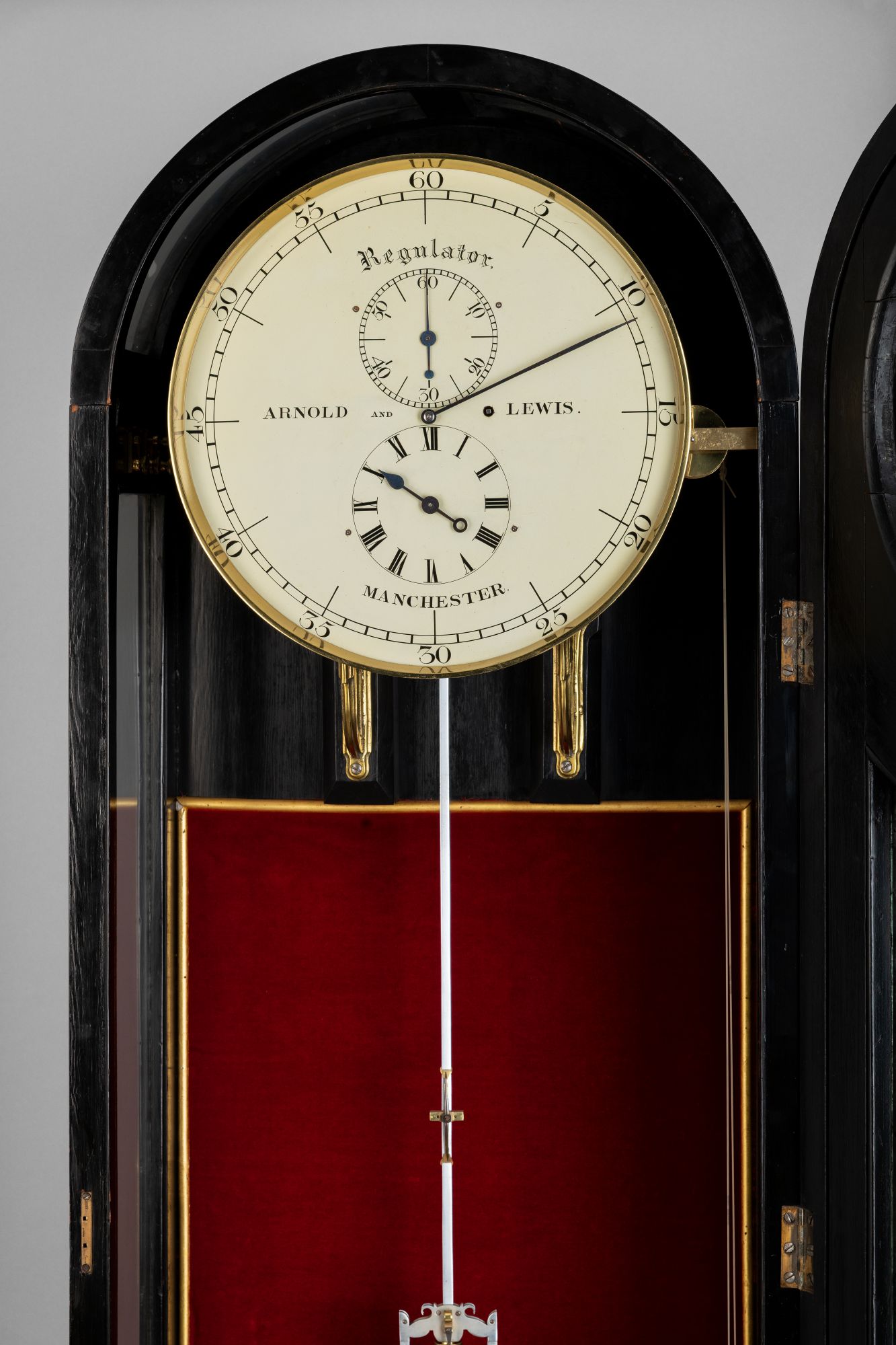
On dial: 'Regulator. | ARNOLD AND LEWIS.| MANCHESTER.' 'ARNOLD & LEWIS | GREENWICH | MEAN TIME'. On clock case: 'ARNOLD & LEWIS | WATCH & CLOCK | MANUFACTURERS.'
Provenance
Arnold & Lewis, 7 St Ann’s Square, Manchester from July 1872; Stuart Hall Collection at the Last Drop Village by 1982; Selwyn Demmy Collection, sold at Dreweatt’s, Donnington Priory, 6 October 2021, lot number 187.
Overview
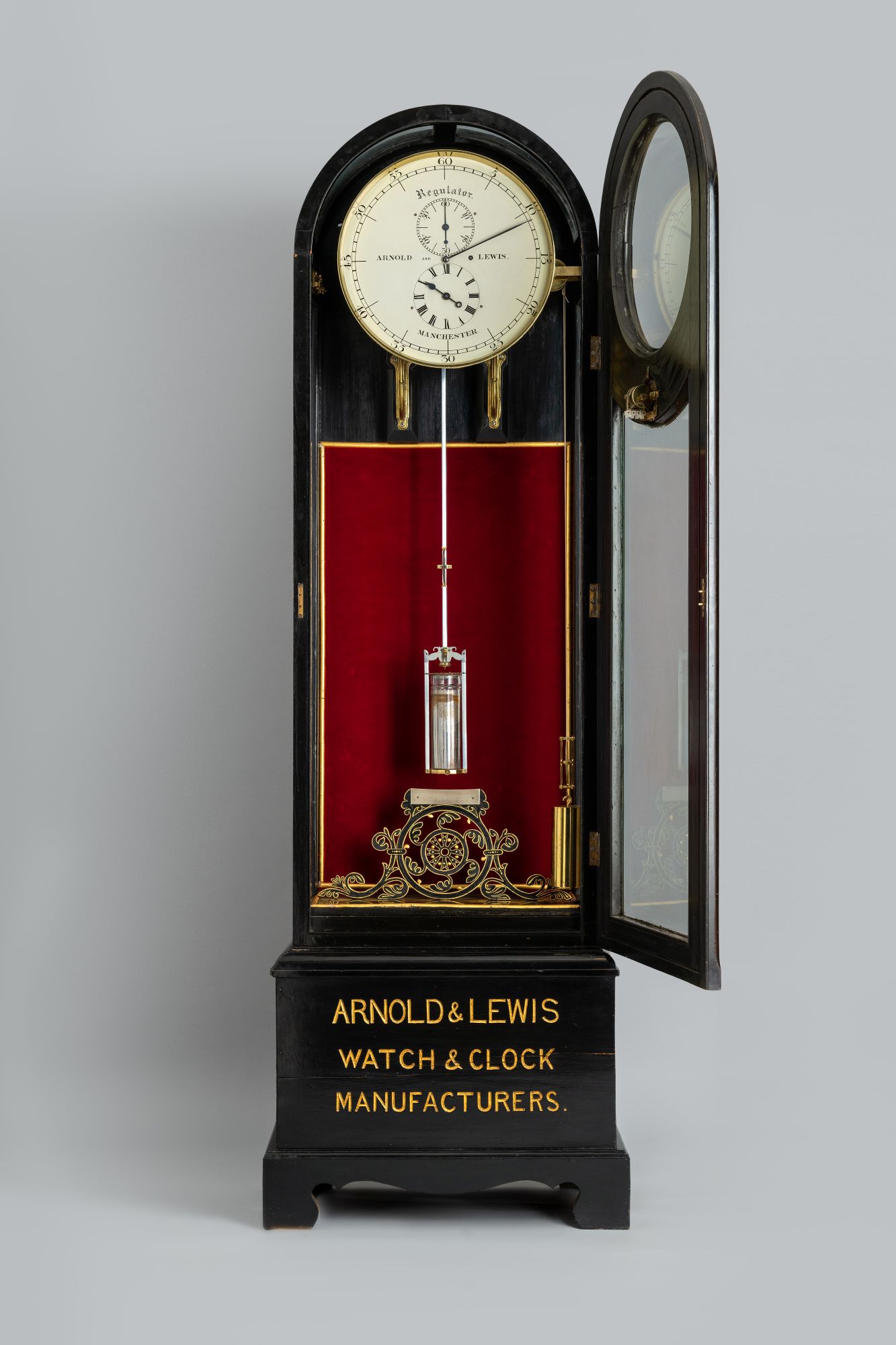
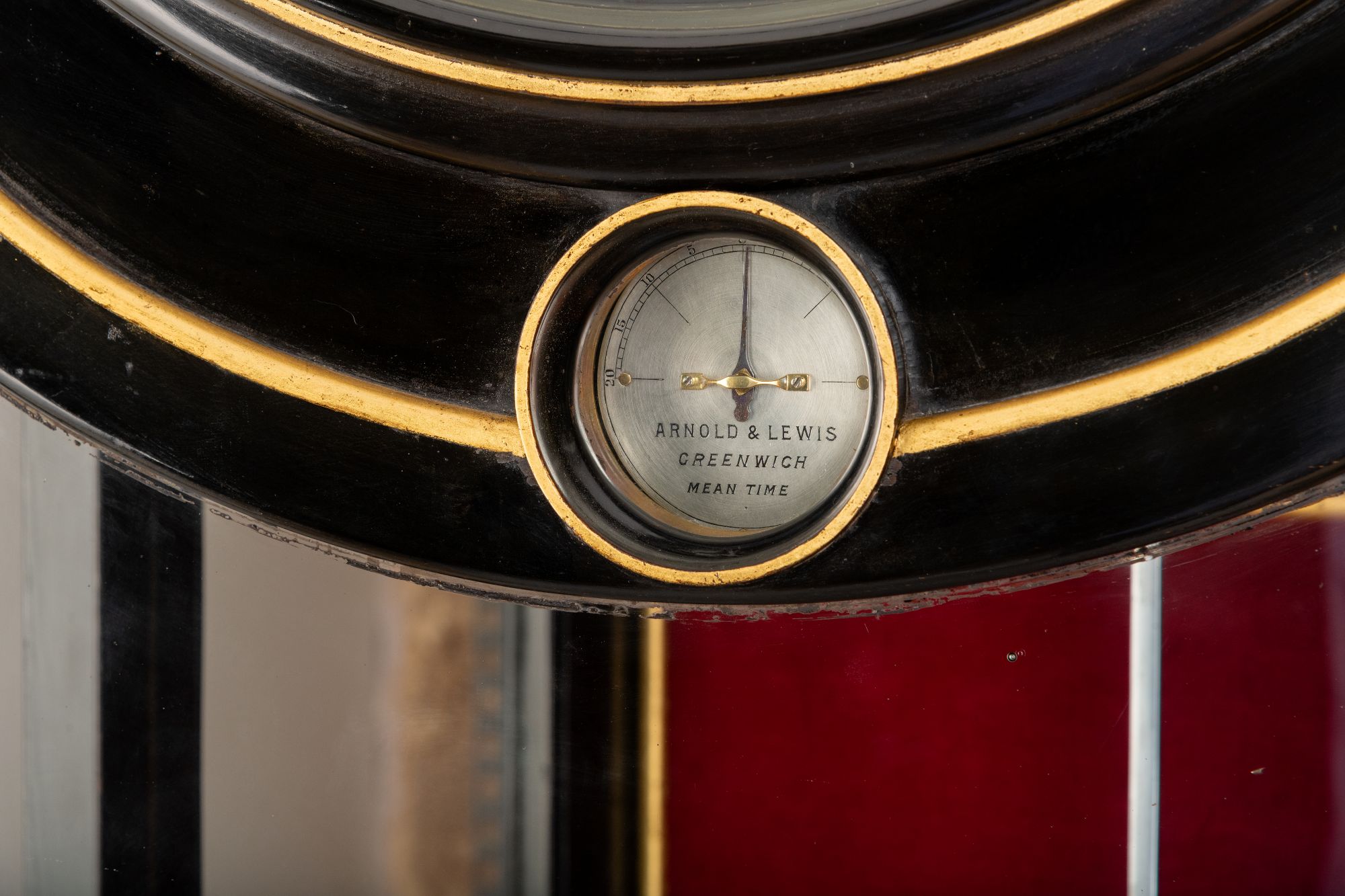
Manchester jewellers Arnold & Lewis installed this prominently branded regulator on their shop floor in 1872. A galvanometer dial allowed it to be checked, daily, against the 10am time signal from Greenwich. Later, this regulator in turn ‘sent the time’ to a subsidiary clock and time ball in the street. As legislation on factory hours and uniform time across rail networks made standardisation increasingly essential, this clever marketing ploy ensured Manchester time was Arnold & Lewis time.
In depth
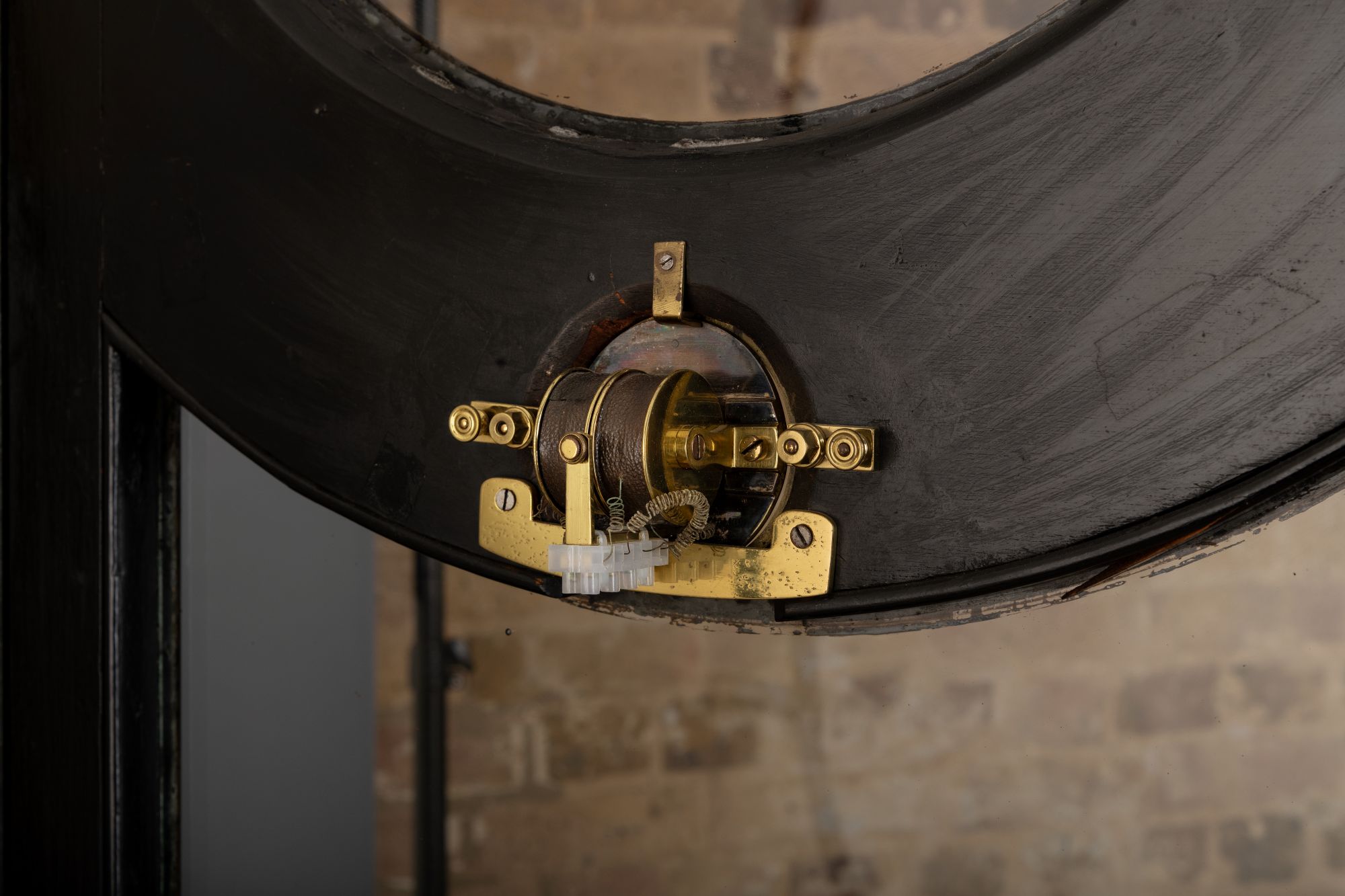
The jewellers Arnold & Lewis took over the fashionable address of 7 St. Ann's Square, in the heart of Manchester, after the jeweller Isaac Simmons retired in 1870. Two years later, they installed an elaborately decorated clock above their shopfront. This was surmounted by a time ball, which dropped every day at 1pm precisely, in the process providing accurate time to passers-by. Both the public clock and the time ball were connected to this highly decorated shop regulator which, in turn, was fitted with a galvanometer to receive the daily time signal from Greenwich. When the signal came through at 10am, shop staff could adjust the regulator manually to ensure it remained perfectly synchronised with GMT.
The number of public clocks increased dramatically in Manchester over the course of the nineteenth century, especially after the passage of the 1844 Factory Act, which (among other things) regulated working hours in the nearby cotton mills. The provision of synchronised ‘Greenwich Time’ therefore became increasingly desirable, and Arnold & Lewis seized on the opportunity: from the mid-1870s, they had adopted the strapline ‘The City Clock and Time Ball’ in their advertising. It is clear from the elaborately gilt pierced scroll-form beat scale, velvet-lined piano black case and prominent branding that this ‘city clock’ was intended to function in some sense as a public resource, as well as a powerful indicator of the reliability and precision of the company who owned and maintained it.
Although Arnold & Lewis continued trading into the 1930s (moving in 1906 to number 21), the time ball had disappeared from the shopfront of Number 7 St. Ann’s Square by the first decade of the twentieth century. It is not certainly known what became of the regulator between this period and 1982, when it was recorded by Clocks magazine in the collection of antique timepieces assembled by broadcaster Stuart Hall. The Stuart Hall collection was initially displayed in the Last Drop Village, near Bolton, but moved to St George’s Craft Centre in 1983; it is presumed to have been dispersed in 2014, shortly before Hall left prison after his high-profile conviction. By 2021, the regulator had moved to the collection of the Manchester-based bookmaker and animal rights campaigner Selwyn Demmy, who, from the 1990s, assembled a significant collection of timekeepers alongside paintings of local Manchester scenes by L. S. Lowry (1887–1976) and Arthur Delaney (1927–87). Given the Mancunian focus of his collection, Demmy is likely to have appreciated the prominent appearance of ‘MANCHESTER’ on the clock’s white regulator-presentation dial, which identifies this clock as a proud and prominent part of Manchester’s timekeeping heritage.
Technical description
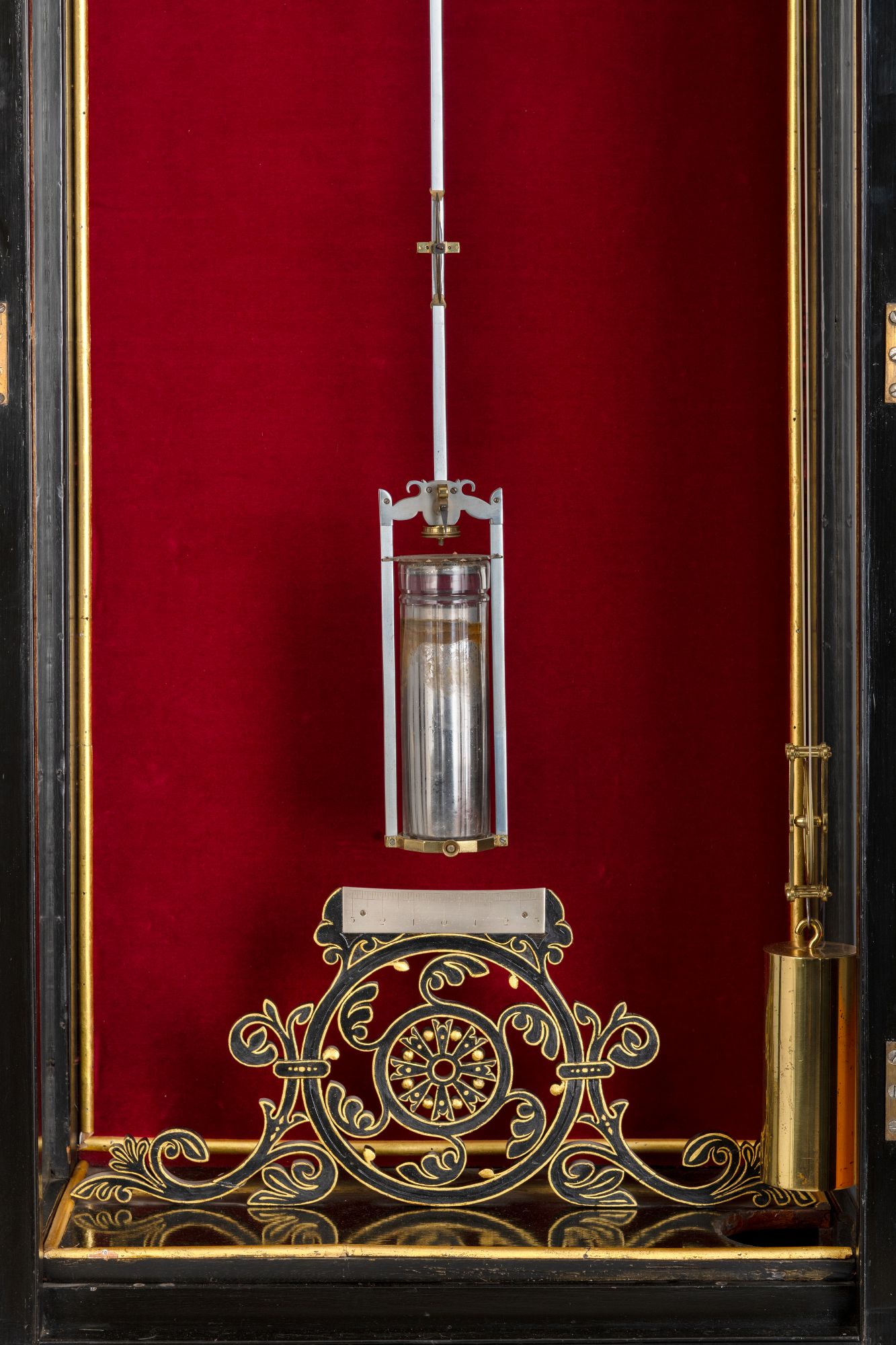
Eight-day movement constructed with six double-screwed, finned, columnar pillars; plates measuring 9 × 5.125 in. The wheel train has high wheel teeth and pinion counts, with six-spoke crossings throughout. Equipped with Harrison’s maintaining power and a deadbeat escapement with jewelled pallets. The clock is regulated by a mercury jar compensated seconds pendulum, suspended from a brass bracket attached to the case backboard. The dial is circular, of 16 in. diameter, cream-painted, with subsidiary seconds at XII. The chapter ring has Roman numerals for the hours and an outer Arabic minute track, with blued-steel hands and a canted brass bezel. Below the main dial is a small, silvered galvanometer dial, with a single hand moving over a 180-degree sector marked 20–0–20. This is driven by an electric coil mounted within a brass frame.
Dimensions
210 x 685 x 38 cm
Inventory number
TCW 1001
Date
c.1872
Bibliography
Dreweatts, Fine Clocks, Barometers and Scientific Instruments, Donnington Priory, 6 October 2021
Manchester Guardian, 13 July 1872, p.9
Manchester Guardian, 16 July 1872, p.2
Manchester Guardian, 19 July 1872, p.3
Manchester Guardian, 23 July 1872, p.3
Manchester Weekly Times, 20 July 1872, p.6
Howard Bloch, 'Greenwich Time in Manchester’, Vistas in Astronomy, vol. 28 (1985), pp.371-72
Edmund Davies, Clocks and Clockmakers in Manchester (Mayfield: Mayfield Books, 2007), pp.52-57, p.97
John Hunter and Alan Smith, 'The Last Drop / The Village Collection', Clocks Magazine, June 1982, pp.33-37
Terry Wyke, 'Telling the Time in Industrial Manchester and Salford', Manchester Memoirs (Memoirs and Proceedings of the Manchester Literary & Philosophical Society), vol. 157 (2018-2019), n.p.