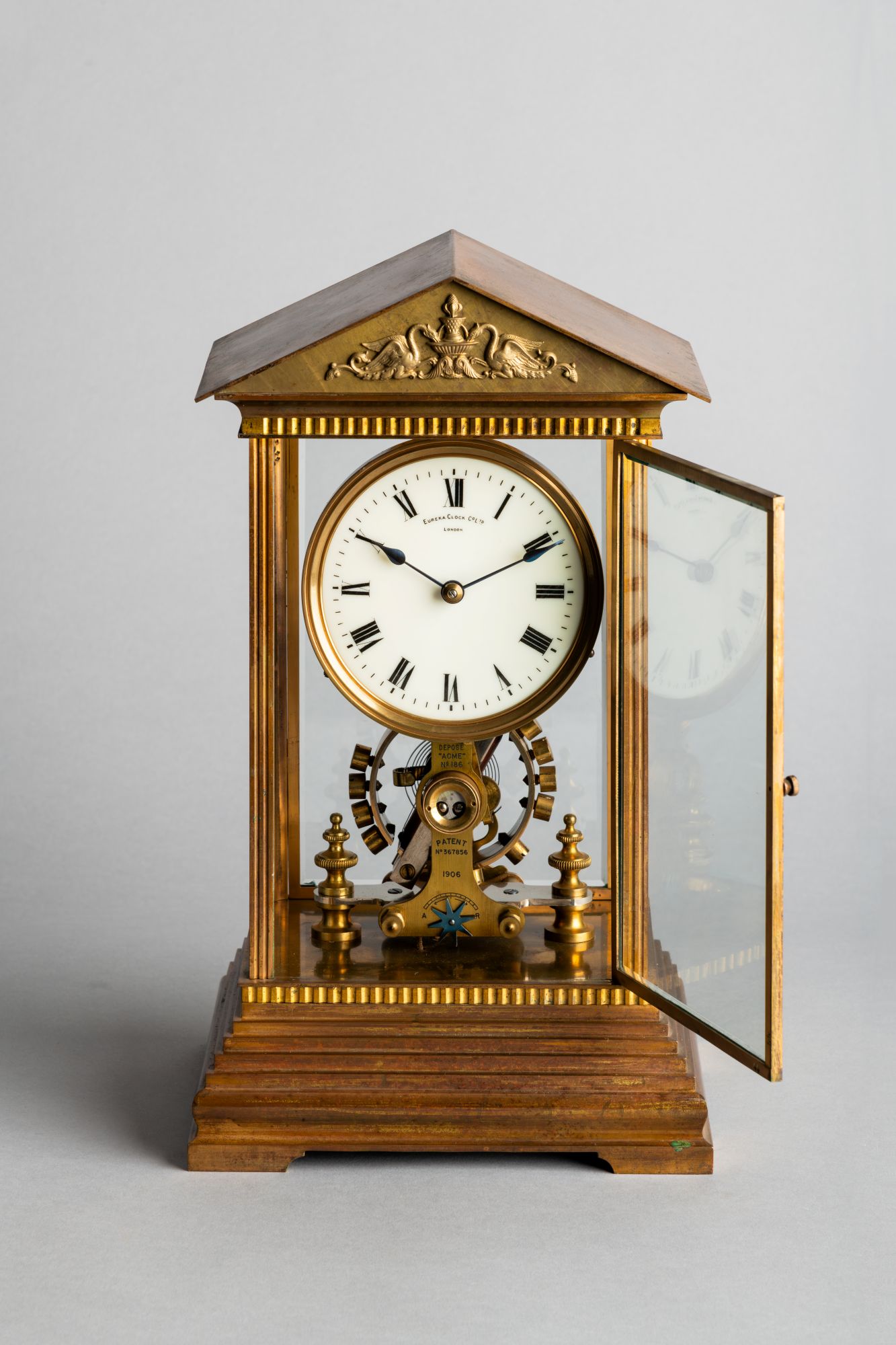
On dial: EUREKA CLOCK CO L.TD. | LONDON. On front plate: MARQUE DEPOSÉ | “ACME” | No. 186 | PATENT | No. 367856 | 1906 Regulation: A | R
Provenance
David Harriman collection.
Overview
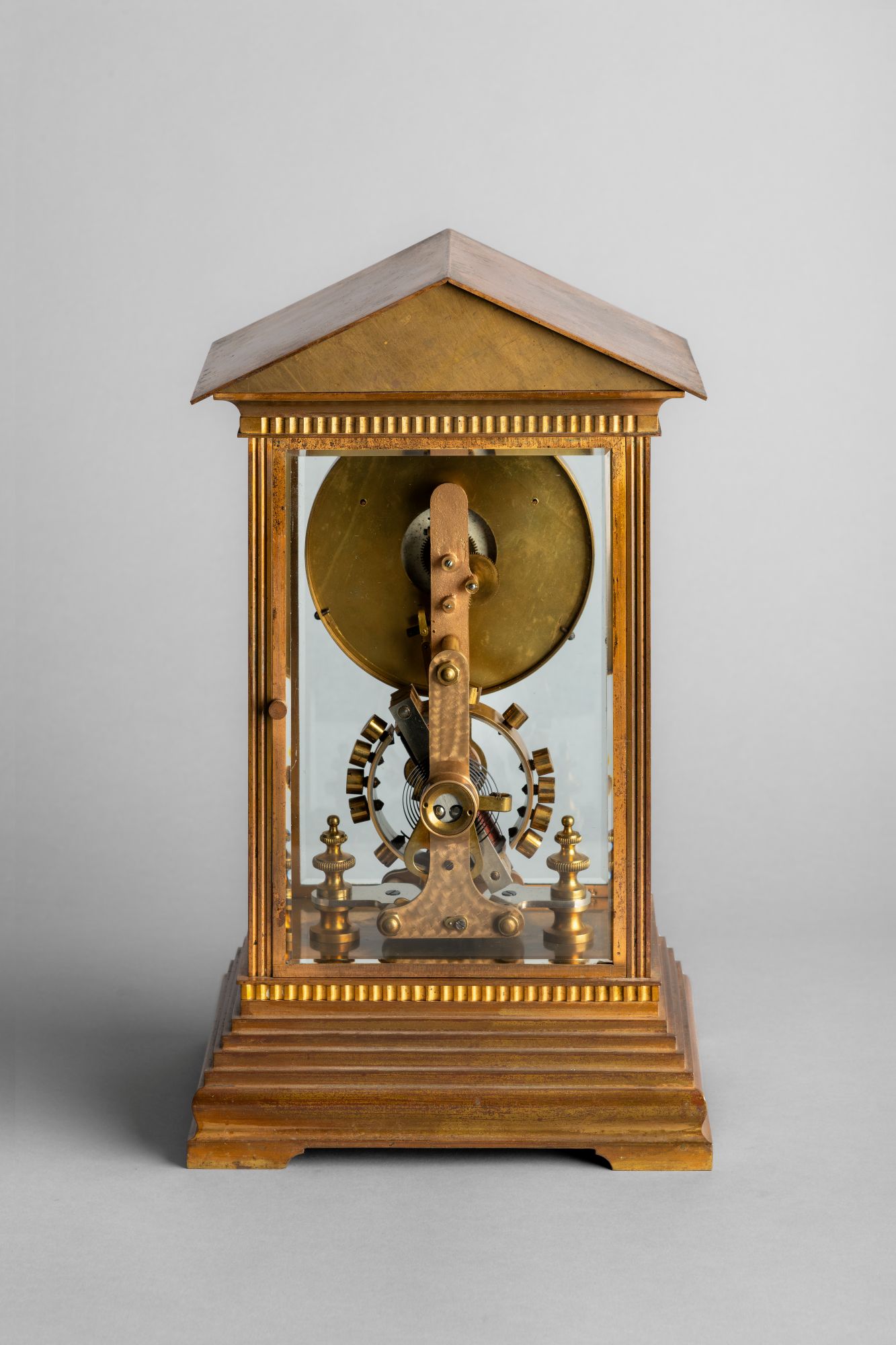
Marketed as ‘the 1,000 day clock’, in reference to the lifespan of the dry cell battery that powered it, the Eureka clock was characterised by the ‘lazy’ motion of its oscillating wheel, sustained by the periodic attraction of a solenoid to an iron plate. This example is in the bronze-gilt four-glass ‘Madeleine’ case, inspired by the church of the same name in Paris: a fusion of new technology with European architectural heritage.
In depth
The Eureka clock was among the first electrical timekeepers to enter the domestic market – marketed as the ‘wonderful 1,000 day clock’, in reference to the lifespan of the dry cell battery that powered it. The clock’s distinctive feature was the ‘lazy’ motion of its large oscillating wheel, reminiscent of a watch balance, and many examples were sold in four- or five-glass cases to allow this movement to be seen. This is the so-called ‘tall’ model, with the wheel set slightly below the dial (in ‘short’ models, the wheel is positioned behind).
The clock’s inventor was American electrical engineer Timothy Bernard Powers, who patented it with the support of the Kutnow Brothers in 1906. The Eureka Clock Company was established to bring the design to market in 1908, but wound down due to financial difficulties in 1914. During their brief production period, Eureka clocks were sold across the USA, UK and Europe. The plate on this example was clearly retailed in France, since the plate is inscribed in French and bears the number of the French patent (367856). However, since it bears the legend ‘Eureka Clock Co. London’ on the dial, it is likely that (as with most Eureka clocks) the movement was made in Britain – and then ‘customised’ on export to France. It is in the company’s bronze-gilt ‘Madeleine’ case, with a stepped plinth base, bracket feet and pedimented top reminiscent of the Neoclassical church of the same name in Paris’s 8th arrondissement (completed 1842). However, in place of the Last Judgement that tops the pediment of the full-size ‘La Madeleine’, the casemaker has substituted a pair of swans drinking from a fountain, an established eighteenth-century French decorative motif, and a much gentler choice for a high-end domestic clock. The ‘Madeleine’ was Eureka’s second most expensive model (behind only the ‘Cromwellian’), retailing in a contemporary Asprey catalogue for £8 18 6.
The motive power of a Eureka clock is its large oscillating balance wheel, which is kept in motion by a solenoid mounted on an iron bar passing across the centre. There is a contact pin on the wheel composed half of metal and half of insulating material. This makes periodic contact with a contact spring mounted to a stationary iron plate at the base of the movement. As the balance wheel oscillates, the first swing anticlockwise carries the contact pin past the spring with its insulated portion outwards; on the clockwise return, the pin again touches but this time on the metallic side, energising the electromagnet just as it approaches the iron plate. The electromagnet is immediately thereby attracted to the centre of the plate, but contact between the spring and pin has been broken by the time it reaches it. The balance wheel now continues to move under its own inertia until the circuit is completed again.
Dimensions
37.5 (h) x 22 (w) x 17.5 cm (d)
Inventory number
TCW 3010
Date
c.1910
Bibliography
The Antiquarian Horological Society EHG ‘Eureka Clock Survey’
AHS EHG Technical Paper no. 73
F. G. Alan Shenton, The Eureka Clock (Rita Shenton Horological Bookseller, rev. edn., 1999)