
-
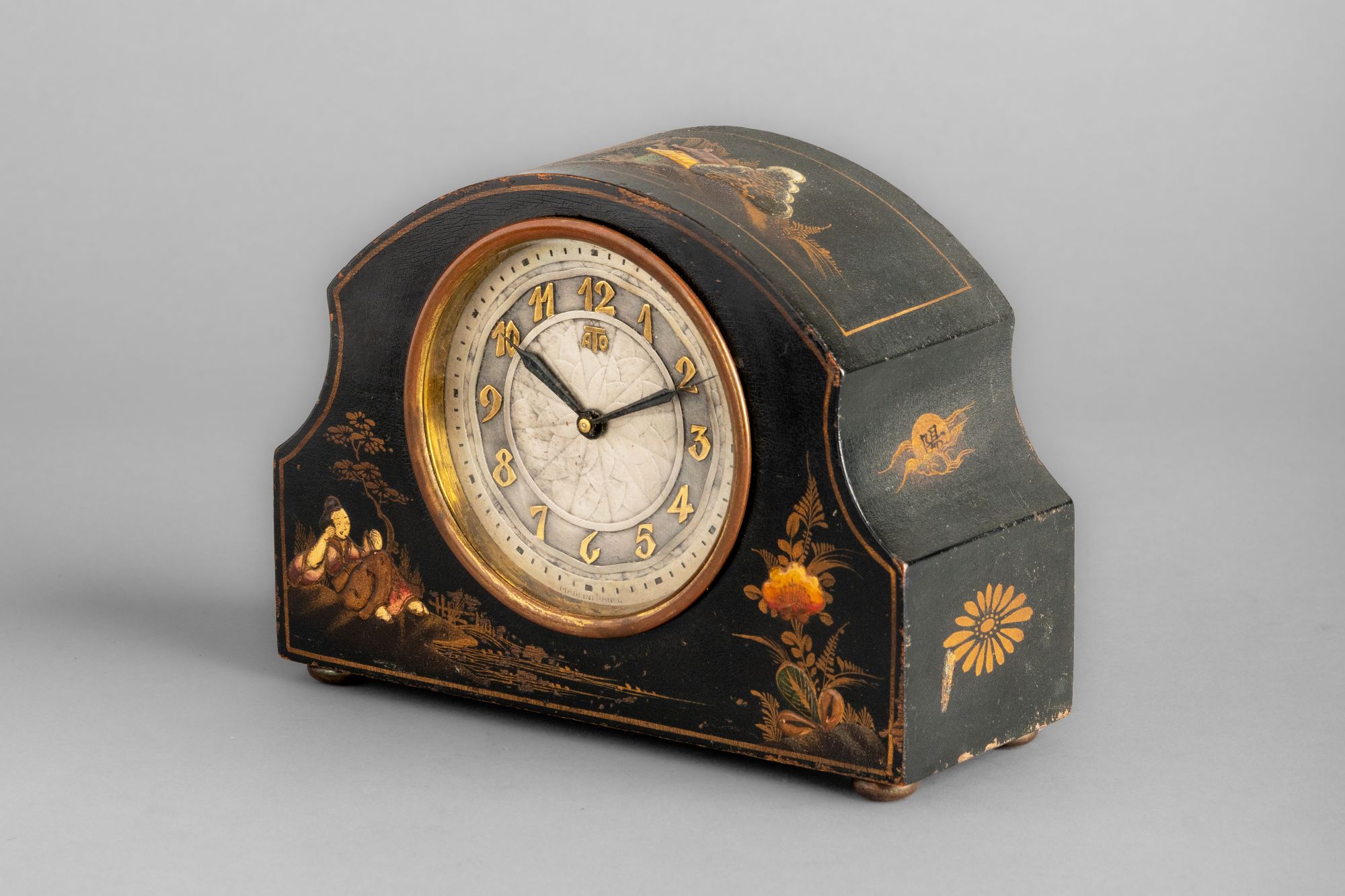
 ATO, Mantel clock, TCW 3003. Image available for non-commercial use via Creative Commons under a CC BY-NC 4.0 license. TCW_3003_01Download
 -
 ATO, Mantel clock, TCW 3003. Image available for non-commercial use via Creative Commons under a CC BY-NC 4.0 license. TCW_3003_02Download


-
 ATO, Mantel clock, TCW 3003. Image available for non-commercial use via Creative Commons under a CC BY-NC 4.0 license. TCW_3003_01
 -
 ATO, Mantel clock, TCW 3003. Image available for non-commercial use via Creative Commons under a CC BY-NC 4.0 license. TCW_3003_02
Creator
ATO
Title
Mantel clock
Category
Inscriptions and markings
On dial: 'ATO | MADE IN FRANCE'. On movement: STE AME DES ETTS | LEON HATOT | FABRICANTS | PARIS FRANCE
Overview
By the early twentieth century, electricity had advanced sufficiently to enter domestic markets. Capitalising on this, in 1920, French clockmaker Léon Hatot founded the ‘ATO’ company, and was soon selling battery-powered pendulum clocks. His range included small mantel clocks like this, offered in a range of appealing cases. This example has a black lacquer ‘chinoiserie’ design: a generic Western vision of ‘the East’ which had come to France via Dutch traders in the seventeenth century but experienced a revival in the 1920s.
In depth
This mantel clock was made by the French firm of ATO, and intended for the growing market of middle-class purchasers interested in electric clocks during the first decades of the twentieth century. The movement, which includes a small pendulum, is set into a black wooden case sitting on four bun feet, and decorated with a ‘chinoiserie’ design, a style imported to France via Dutch traders in the seventeenth century. Conjuring a fantasy vision of a generic ‘East’ drawing on elements of Chinese and Japanese design, chinoiserie was popular throughout the eighteenth century. It experienced a revival in the 1920s, often associated with nostalgia for a supposedly simpler pre-industrialised world. ATO produced several clock cases in chinoiserie style during the 1920s, along with other contemporary idioms such as art nouveau and art deco.
By the early twentieth century, electricity technology had advanced sufficiently for the public to take an interest in electrically powered clocks for domestic purposes. However, since mains electricity remained in its infancy, these clocks were almost invariably battery-powered. ATO, the company founded by Léon Hatot in 1920, pioneered battery clock technology (along with their great rivals, Bulle), and soon became known for high-quality ‘regulator’ clocks as well as small, covetable timekeepers like this, presented in a range of imaginative cases that drew on contemporary design sensibilities. This movement is typical of the smaller standard ATO production: there is a magnet on the end of a a 6cm pendulum mounted behind a 1cm dial. This pendulum is impulsed electromagnetically, at the centre of the swing, by a solenoid. The contacts are closed by a ‘rocker’ at the top of the pendulum. A copper cylinder at one side acts as a damping system, opposing the motion of the magnet as it swings to the left. In addition to selling the clocks, ATO also retailed proprietary batteries, typically providing 1.5 volts.
The peak of the company’s case production – and a probable indicative date for this clock – was 1924–-1940; from 4 models of case in 1924, there were over 50 by 1939. Materials ranged from veneered wood (as here), marble and Bakelite, to cast or acid-etched glass, and the range of styles available speaks to Hatot’s conviction that an electric clock could and should be an essential part of a contemporary interior scheme, though often – as with this clock, which has a plain brass cover over its movement – the power source was concealed or understated. This may reflect a perceived snobbishness towards battery clocks in some sections of the market, but many interior magazines of the time were uncertain about displaying technology in the home, recommending hiding telephones, wires and gramophone records in cabinets, cases and even pouffes, so as not to disrupt the historic sensibilities that were in vogue at the time.
Though its black lacquer must originally have been highly polished, the surface of this case has suffered, possibly from prolonged exposure to a gas fire in its later years, and the movement no longer runs.
Dimensions
8 x 13 x 7 cm
Inventory number
TCW 3003
Date
c.1924-39
Bibliography
Sarah Cheang, ‘What’s in a Chinese Room? 20th-century Chinoiserie, Modernity and Femininity’, in Chinese Whispers: Chinoiserie in Britain 1650-1930 (Brighton & Hove: The Royal Pavilion and Museums, 2012), pp.74-81.
Edward Hanson, ‘The Electric Clocks of Leon Hatot’, Clocks Magazine, 14:6 November 1991, pp.24-29
Mel Kaye, ‘The ATO clock’, NAWCC Bulletin, 45:3 No.344 (June 2003) 333-347
John D. I. Locke, ‘The “ATO” Battery Electric Clock’, AHS EHG Technical Paper No. 28 (1981)