
-
 William Hamilton Shortt, Free Pendulum No. 45, TCW 1073. Image available for non-commercial use via Creative Commons under a CC BY-NC 4.0 license. TCW_1073_1073A_03Download
 -
 William Hamilton Shortt, Free Pendulum No. 45, TCW 1073. Image available for non-commercial use via Creative Commons under a CC BY-NC 4.0 license. TCW_1073_02Download
 -
 William Hamilton Shortt, Free Pendulum No. 45, TCW 1073. Image available for non-commercial use via Creative Commons under a CC BY-NC 4.0 license. TCW_1073_11Download
 -
 William Hamilton Shortt, Free Pendulum No. 45, TCW 1073. Image available for non-commercial use via Creative Commons under a CC BY-NC 4.0 license. TCW_1073_15Download
 -
 William Hamilton Shortt, Free Pendulum No. 45, TCW 1073. Image available for non-commercial use via Creative Commons under a CC BY-NC 4.0 license. TCW_1073_20Download
 -
 William Hamilton Shortt, Free Pendulum No. 45, TCW 1073. Image available for non-commercial use via Creative Commons under a CC BY-NC 4.0 license. TCW_1073A_06Download
 -
 William Hamilton Shortt, Free Pendulum No. 45, TCW 1073. Image available for non-commercial use via Creative Commons under a CC BY-NC 4.0 license. TCW_1073A_12Download
 -
 William Hamilton Shortt, Free Pendulum No. 45, TCW 1073. Image available for non-commercial use via Creative Commons under a CC BY-NC 4.0 license. TCW_1073A_14Download
 -
 William Hamilton Shortt, Free Pendulum No. 45, TCW 1073. Image available for non-commercial use via Creative Commons under a CC BY-NC 4.0 license. TCW_1073A_15Download


-
 William Hamilton Shortt, Free Pendulum No. 45, TCW 1073. Image available for non-commercial use via Creative Commons under a CC BY-NC 4.0 license. TCW_1073_1073A_03
 -
 William Hamilton Shortt, Free Pendulum No. 45, TCW 1073. Image available for non-commercial use via Creative Commons under a CC BY-NC 4.0 license. TCW_1073_02
 -
 William Hamilton Shortt, Free Pendulum No. 45, TCW 1073. Image available for non-commercial use via Creative Commons under a CC BY-NC 4.0 license. TCW_1073_11
 -
 William Hamilton Shortt, Free Pendulum No. 45, TCW 1073. Image available for non-commercial use via Creative Commons under a CC BY-NC 4.0 license. TCW_1073_15
 -
 William Hamilton Shortt, Free Pendulum No. 45, TCW 1073. Image available for non-commercial use via Creative Commons under a CC BY-NC 4.0 license. TCW_1073_20
 -
 William Hamilton Shortt, Free Pendulum No. 45, TCW 1073. Image available for non-commercial use via Creative Commons under a CC BY-NC 4.0 license. TCW_1073A_06
 -
 William Hamilton Shortt, Free Pendulum No. 45, TCW 1073. Image available for non-commercial use via Creative Commons under a CC BY-NC 4.0 license. TCW_1073A_12
 -
 William Hamilton Shortt, Free Pendulum No. 45, TCW 1073. Image available for non-commercial use via Creative Commons under a CC BY-NC 4.0 license. TCW_1073A_14
 -
 William Hamilton Shortt, Free Pendulum No. 45, TCW 1073. Image available for non-commercial use via Creative Commons under a CC BY-NC 4.0 license. TCW_1073A_15
Creator
William Hamilton Shortt / Synchronome
Title
Free pendulum and subsidiary, no. 47
Category
Inscriptions and markings
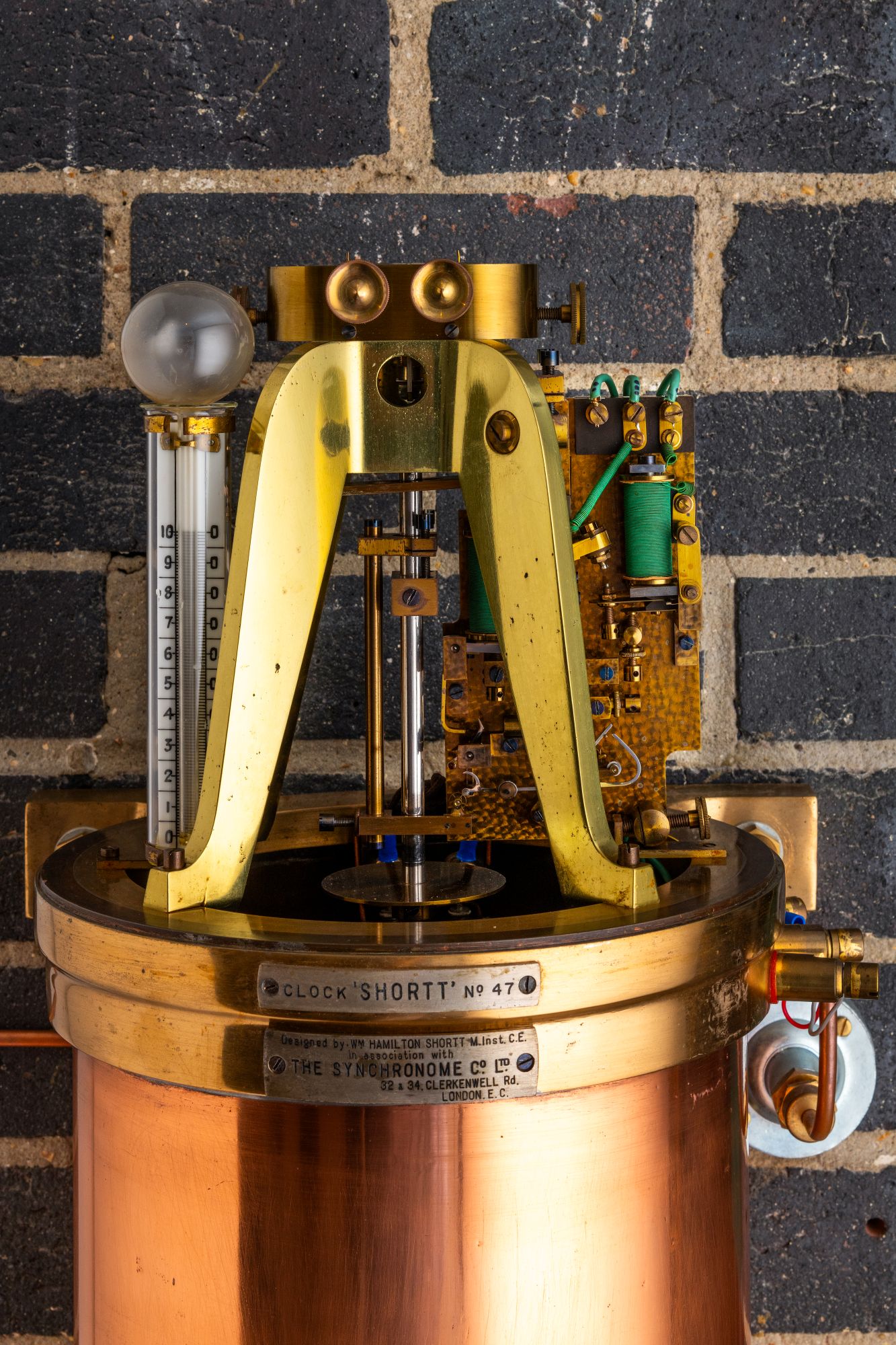
on tank: plaque, ‘CLOCK “SHORTT” NO. 47’ | ‘Designed by WM. HAMILTON SHORTT M. Inst. C.E. | in association with | THE SYNCHRONOME CO. LTD. | 32 & 34, CLERKENWELL Rd. | LONDON. E. C.’ on subsidiary clock: on dial ‘SYNCHRONOME PATENT NO. 187814’ | two dials labelled ‘FREE P’ and ‘SLAVE’. On plate inside case: ‘ENGLISH MADE | Patented’. Serial number on plate: 4210
Provenance
Dispatched by Synchronome to the Sternberg Astronomical Institute, Moscow (‘GAISh’), c.1930-39; purchased from the Institute in the 1990s by William Scolnik. Purchased for The Clockworks with the Scolnik collection in 2011.
Overview
This clock was the first to realise the horology goal of the ‘free pendulum’; a timekeeper unencumbered by interference from the clock escapement. Its inventor, William Hamilton Shortt, devised a complex synchronisation between his ‘free pendulum’ – in a vacuum tank – and a subsidiary clock presenting the time. Sufficiently accurate to reveal discrepancies in the tides, the ‘Shortt Free Pendulum’ was manufactured by the Synchronome Company for many of the world’s observatories. This one was formerly in the Sternberg Astronomical Institute in Moscow.
In depth
On Christmas Day 1657, Christiaan Huygens first coupled a pendulum to a clock. His innovation brought clocks into previously unimaginable realms of accuracy, an oscillating pendulum being one of the most reliable methods then available to measure time. However, as soon as a pendulum is coupled to a gear train – essential if it is to release the escapement, receive further impulses and allow time to be shown on the dial – it is subject to varying amounts of interference, and loses a small, but significant, amount of accuracy. For this reason, almost from the pendulum clock’s inception, horologists dreamed of a ‘free pendulum’ that (the impossibility of perpetual motion notwithstanding) could be allowed to swing and keep time in maximum isolation from the clock movement.
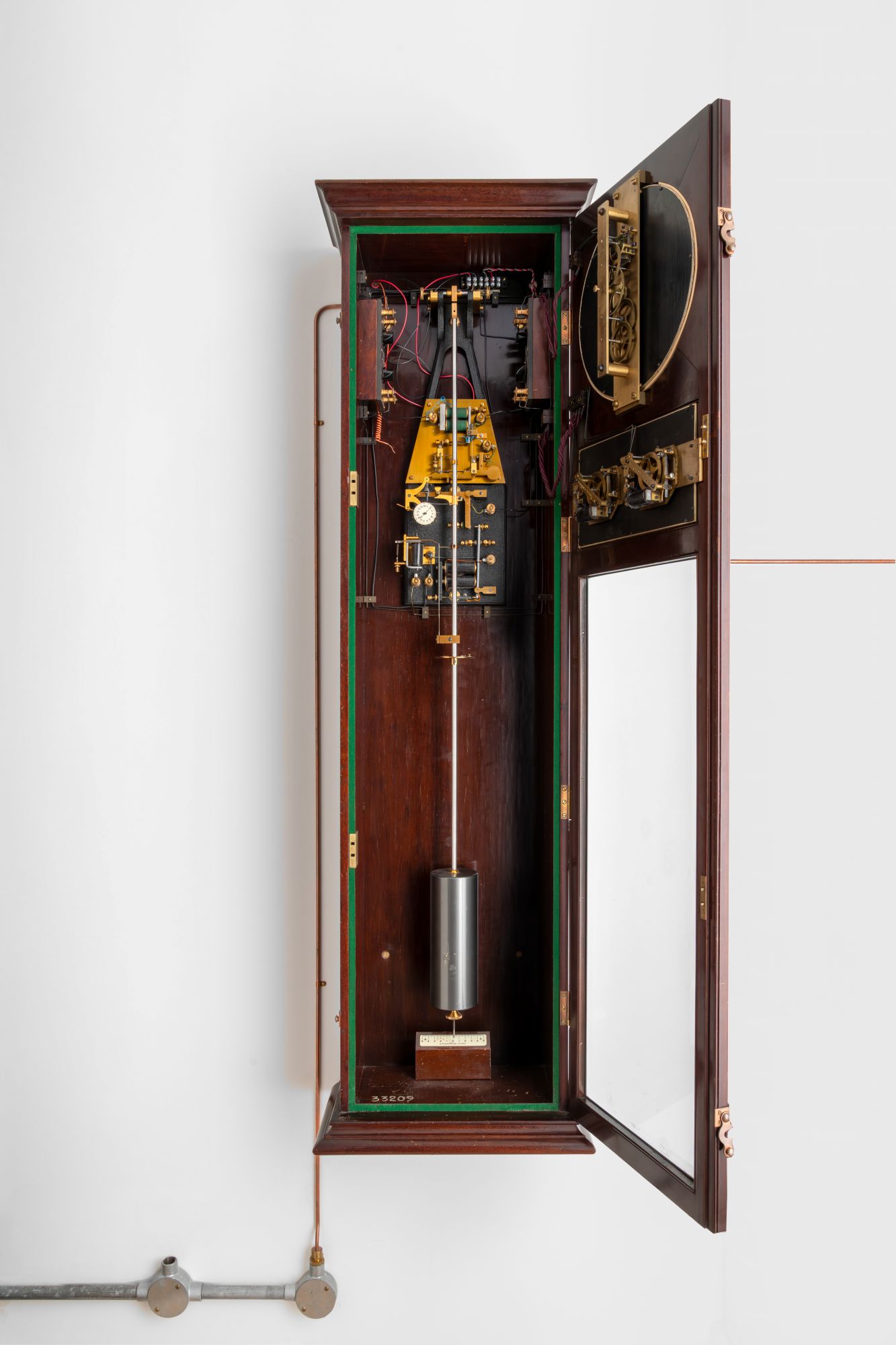
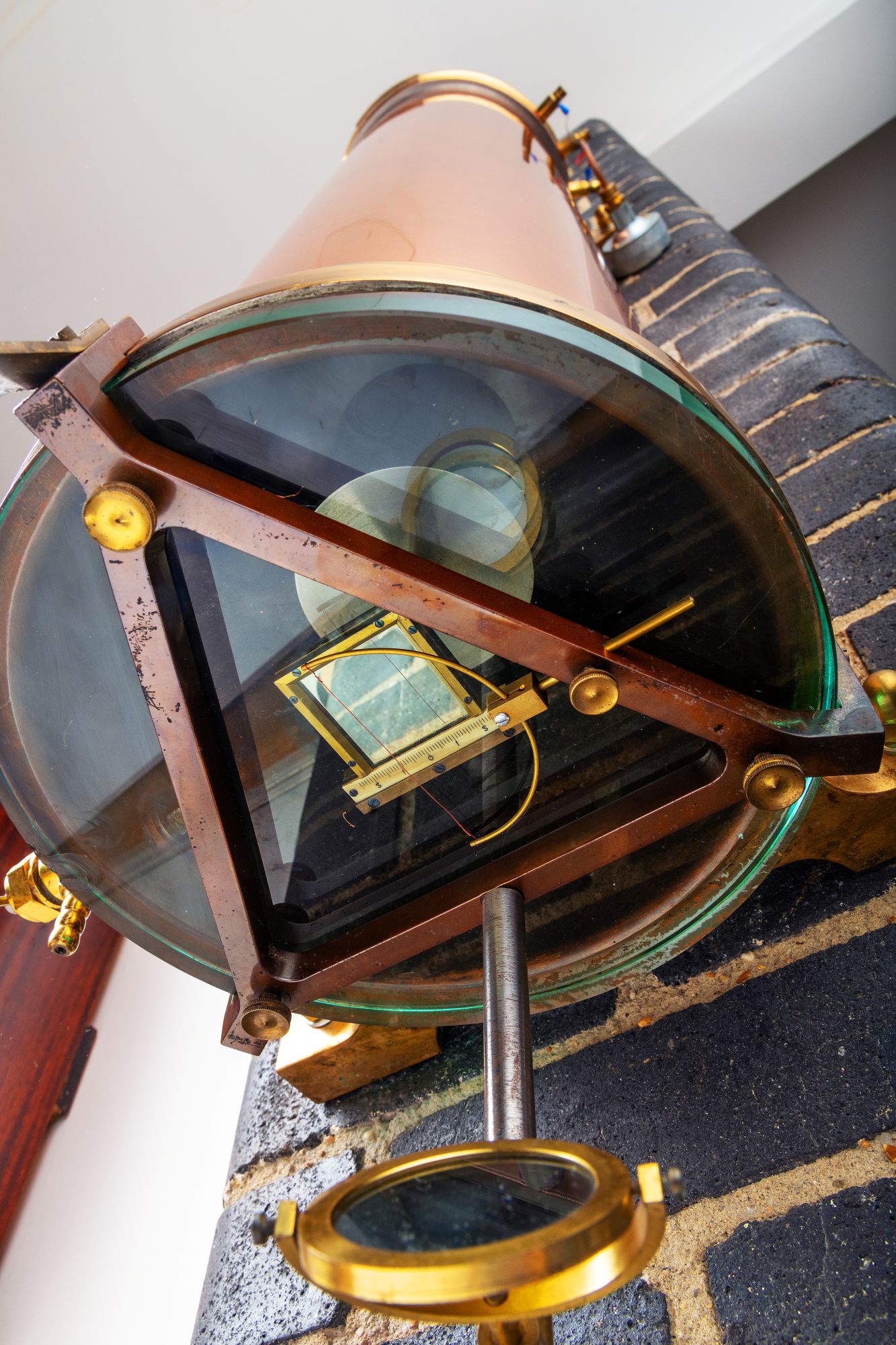
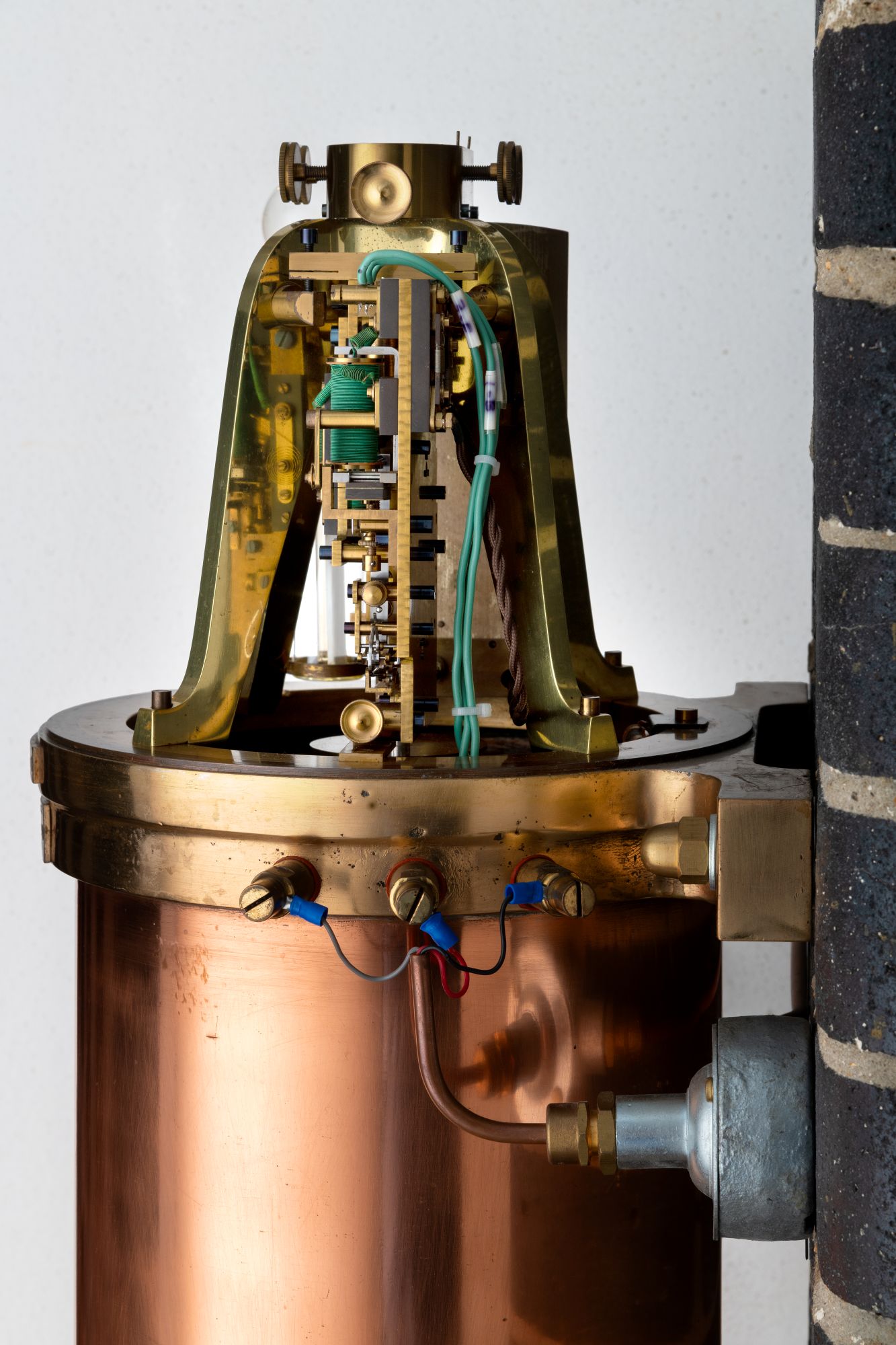
The goal of the ‘free pendulum’ was effectively achieved in 1921, with this clock, designed by Wimbledon-born railway engineer William Hamilton Shortt. At a rate of a second a year, Shortt’s clock was (at the time) the most accurate pendulum clock ever commercially produced – capable of measuring small fluctuations in the earth’s rotation, as well as plotting star transits – and it remained a widely used time standard until the 1950s. Shortt’s innovation was to divide the requisite tasks of a clock between two pendulums that were separate but connected. One, dubbed the ‘master’, was the fabled free pendulum, swinging solitary and undisturbed in a cylindrical copper case sealed by a glass bell jar at the top, and a disk of plate glass at the bottom. This was the timekeeper, and the mechanism contains no countwheel – instead the pendulum is impulsed each thirty seconds using an electrically reset gravity arm. Crucially, the master clock does not initiate this impulsing process. It is the other clock, named the ‘slave’, which sets each thirty-second cycle in train, and it was the subtle and complex synchronisation between the two – facilitated by Shortt’s so-called ‘hit and miss synchroniser’ – that ultimately presented the time.
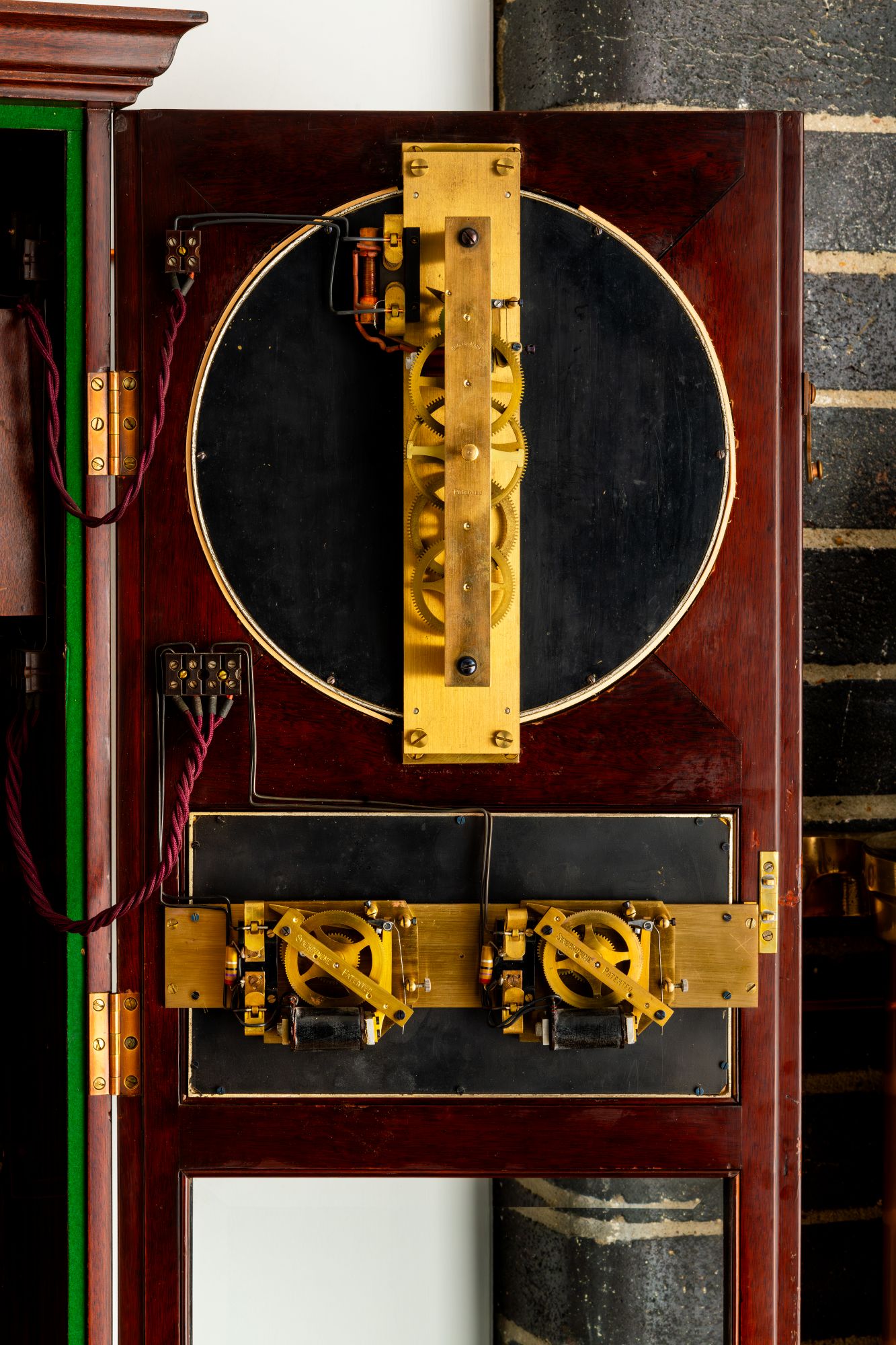
This clock is Shortt No. 47, one of 100 that are thought to have been manufactured between 1922-1956. All Shortt’s ‘free pendulums’ (apart from the test clock, Shortt No. 0) were manufactured by the Synchronome Company, headed by the electrical horology pioneer Frank Hope-Jones, who had provided use of the firm’s Clerkenwell offices for Shortt’s early experiments. The ‘slave’ clock is a standard Synchronome type – already a very accurate timekeeper – and the ‘slave’ for No. 45 is of the type advertised as ‘Type B’, mounted in a carved polished mahogany case with a 10-inch diameter regulator-type dial. This transmits seconds as well as half-minute impulses, and Synchronome boasted that it was used ‘as [a] standard cloc[k] in many Observatories, both for Sidereal and Mean Solar Time’. Indeed, apart from Shortt No. 7, installed in Shortt’s own home, the majority of the Shortt / Synchronome free pendulum clocks were purchased by the world’s astronomical and naval observatories. No. 45 was installed in the Naval Observatory in Washington, and seven clocks, including this one, were shipped to Russia (a market that abruptly closed on the outbreak of the Second World War, prompting Russian scientists to begin work on their own free pendulum experiments – [see TCW 1009 and 1011 and 1012]).
Shortt No. 47 was installed at the Sternberg Astronomical Institute (or ‘GAISh’), from whom it was purchased in the 1990s by William Scolnik, much of whose collection of precision clocks was purchased for the Clockworks in 2011.
Technical description
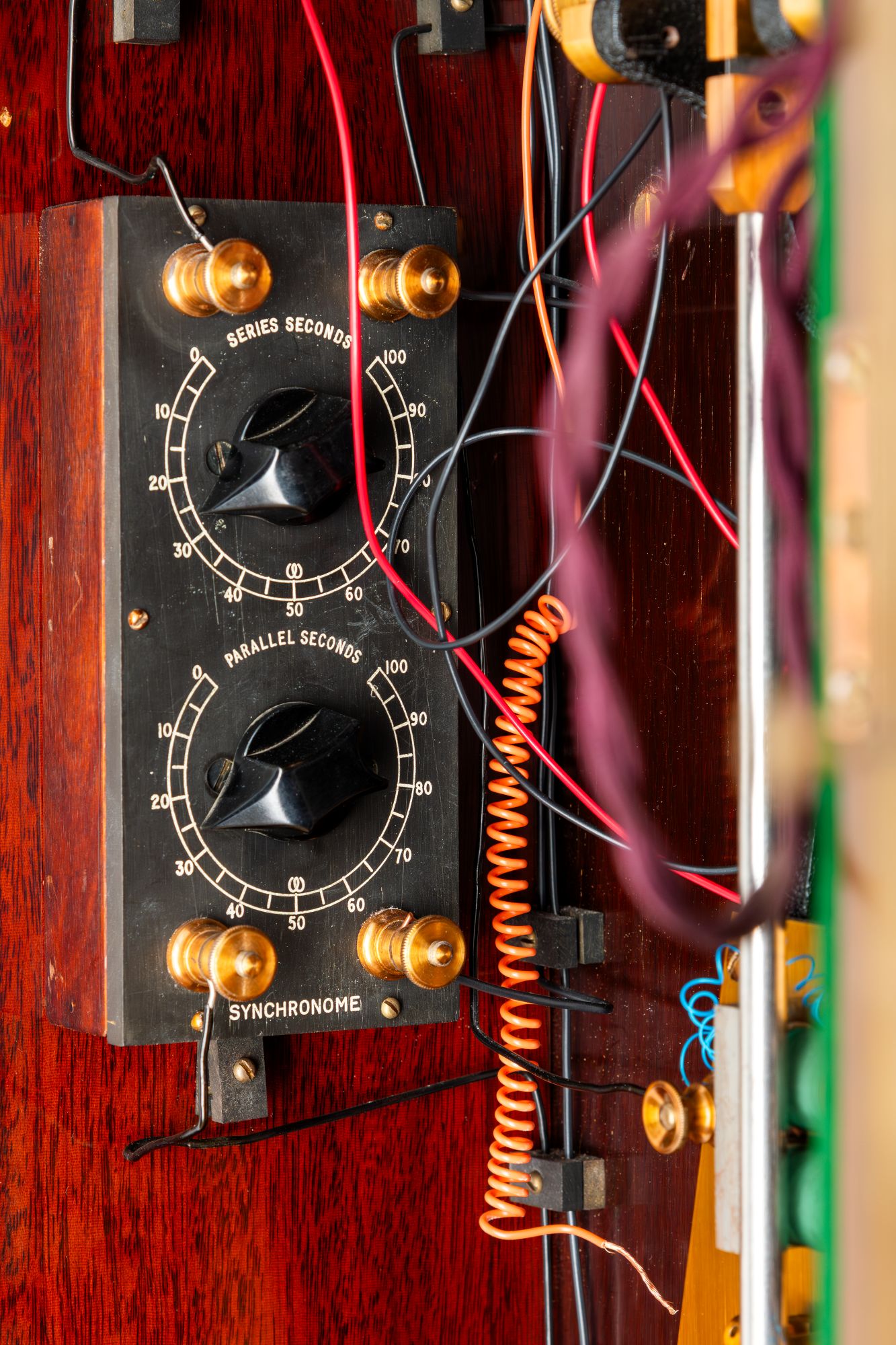
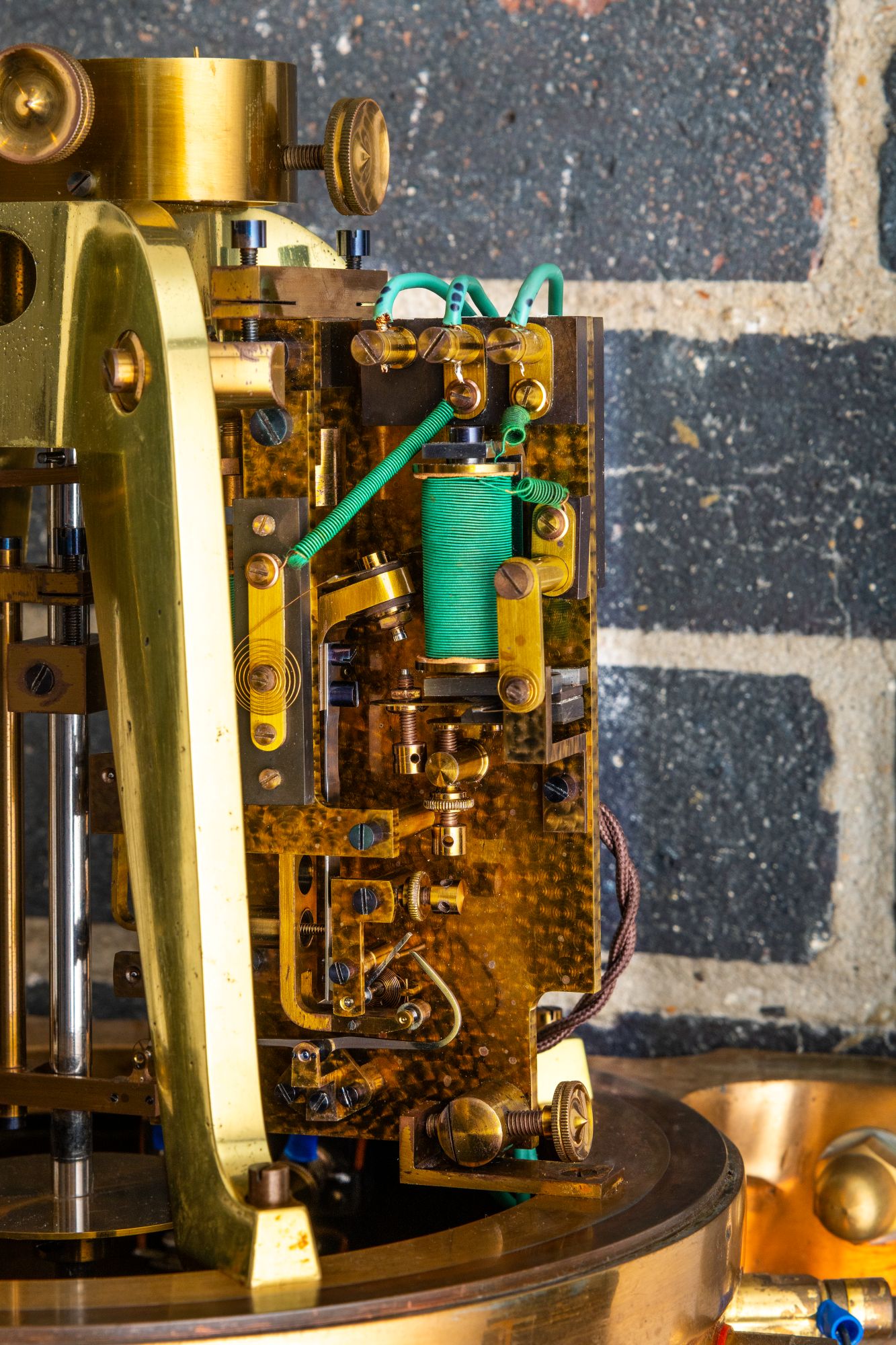
The two clocks are electrically linked; the free pendulum transmits a synchronising signal to the ‘slave’ every 30 seconds. The fall of the master gravity terminates with the closing of an electric circuit which includes the electromagnet in the ‘slave’ pendulum synchroniser – a long spring which will accelerate the 'slave' pendulum if it comes into contact with it. Since the ‘slave’ is specially rated to lose about six seconds a day (1/480th of a second per half-minute), the action will either accelerate or do nothing - hence the phrase ‘hit and miss synchroniser’.
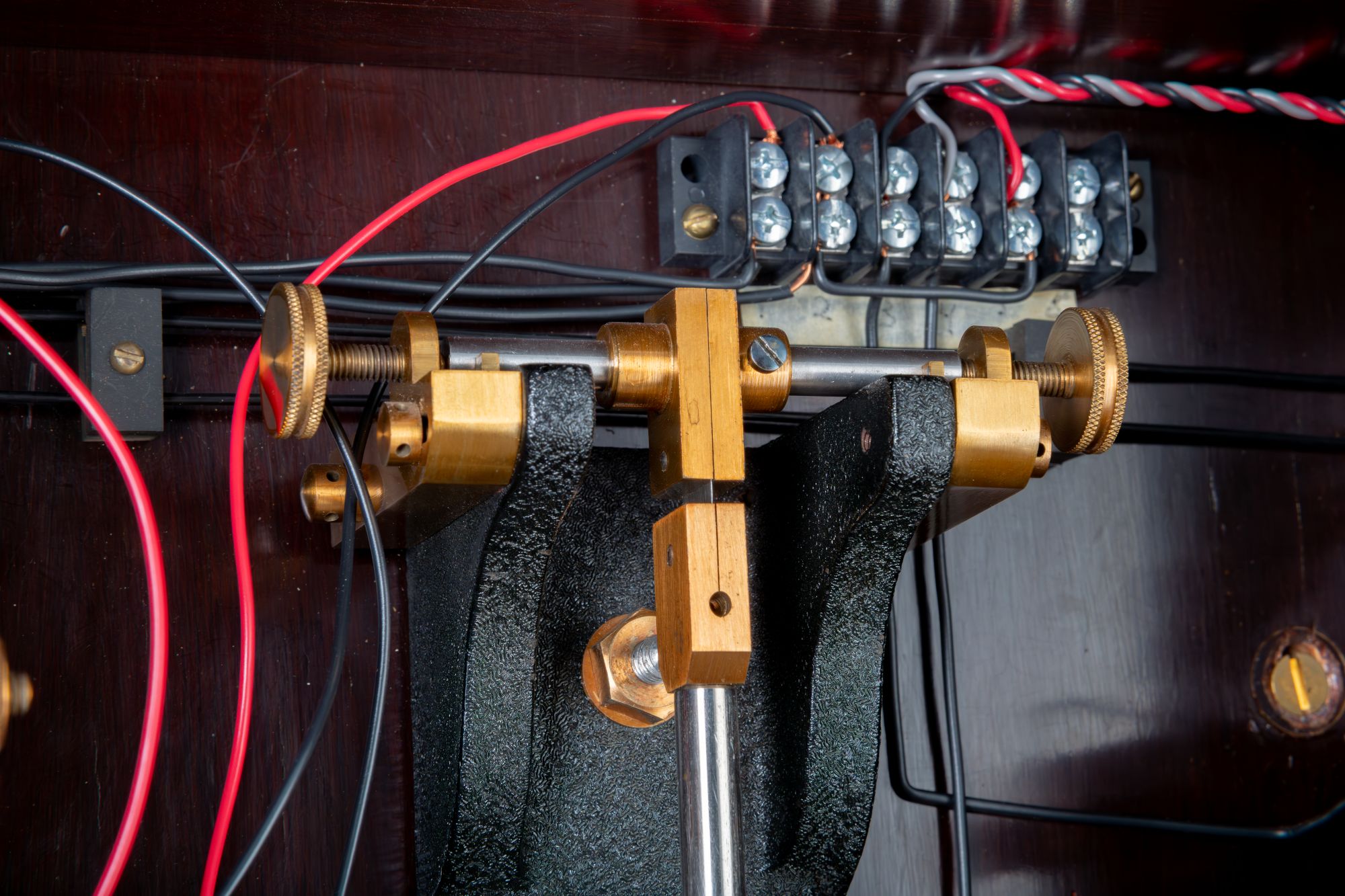
The regular impulses of the 'slave' clock, as it unlocks and resets its own gravity arm, are in the same circuit as the electromagnet in the master. This electromagnet releases the master clock gravity arm on the free pendulum at every fifteenth swing to the left, timed to fall when the free pendulum is at the midpoint of its swing. The master gravity arm carries a jewel that actually falls onto the top of a very small wheel mounted on the pendulum – a dead point – so the impulse is not given until the pendulum swings outwards again and the gravity arm can fall, the jewel travelling round the perimeter of the impulse wheel. As a result, the energy imparted by the gravity arm is constant.
The free pendulum is made of invar, with additional compensation: a piece of brass is inserted into the type-metal bob, using a modified gridiron principle. The length of each pendulum manufactured was calibrated for the gravity conditions of the observatory for which the clock was intended, though its rate could be altered by adjusting the pressure in the tank; in contrast, the rate of the ‘slave’ clock could be adjusted by adding or subtracting very fine weights to the weight tray on the pendulum rod.
Dimensions
subsidiary clock: 139 x 40.5 x 22.5 cm
Inventory number
TCW 1072
Date
1921
Bibliography
Frank Hope-Jones, Electrical Timekeeping (London: N.A.G. Press, 1940), pp.162-170
Robert H. A. Miles, Synchronome: Masters of Electrical Timekeeping (Ticehurst: The Antiquarian Horological Society, 2011), pp.168-194
Harold Spencer Jones, ‘The Determination of Precise Time’, lecture given at the Smithsonian Institution, 14 April 1949, https://www.royalobservatorygreenwich.org/articles.php?article=1088
The Synchronome Company Ltd., Astronomical Regulators and Observatory Time Installations, together with a brief essay on the free pendulum and the general principles of the Synchronome System on which it is based (London: Synchronome Company, n.d.)