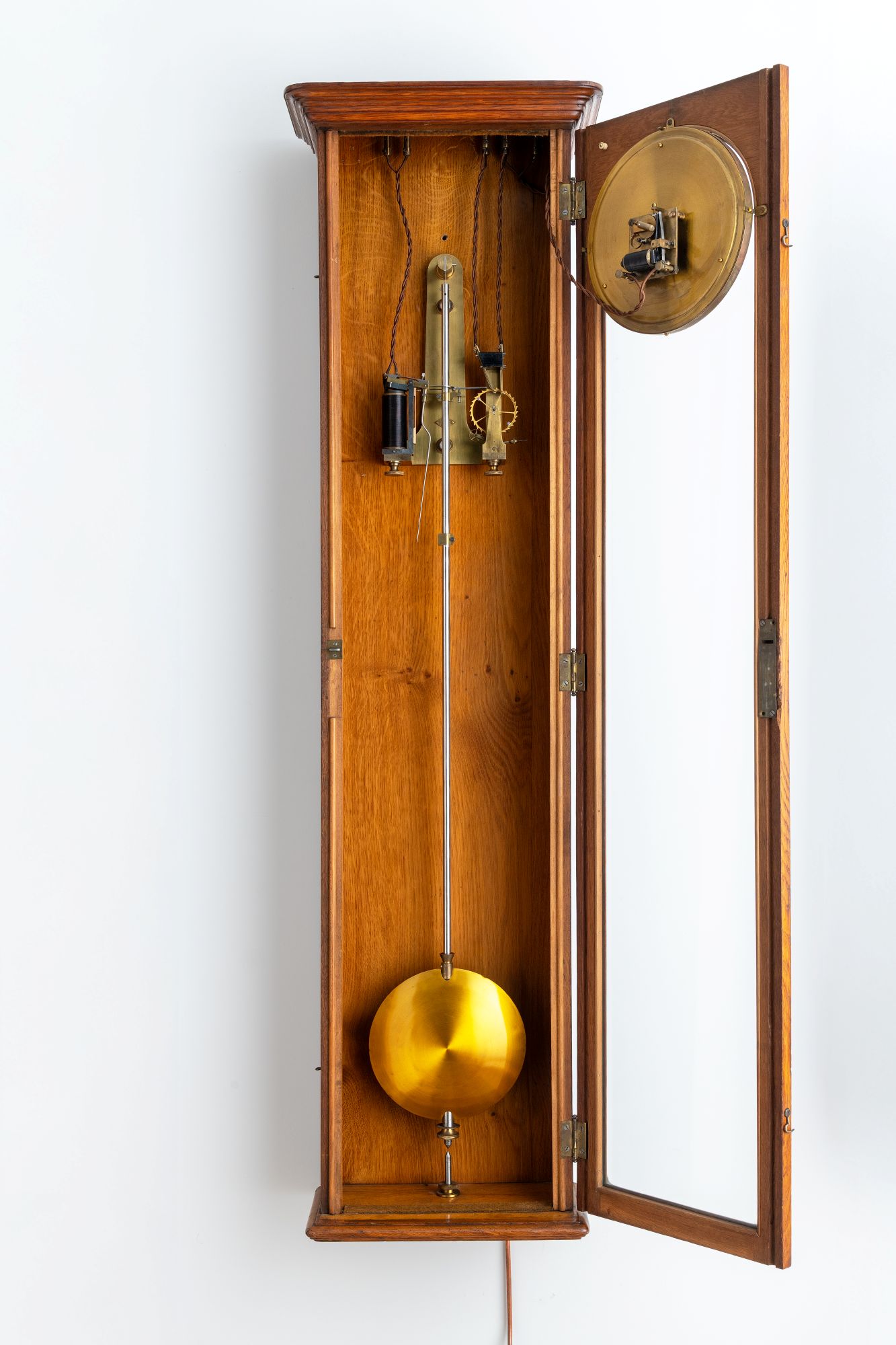
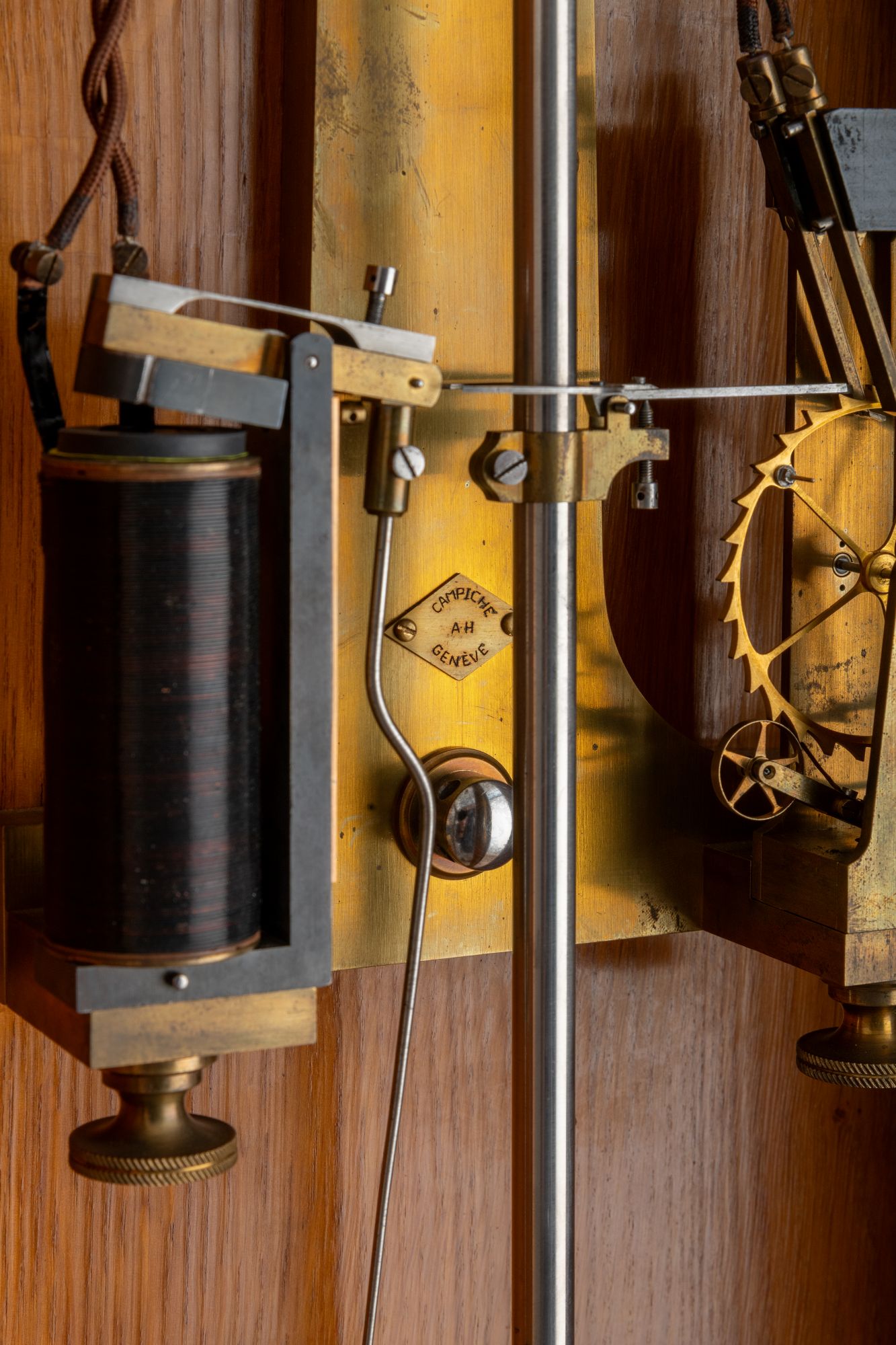
According to L’Électricien for 1912, Swiss engineer Henri Campiche came down one morning and noticed that a pendulum he had hung haphazardly the night before was still running. This prompted him to explore the idea of maintaining its oscillation with a very feeble electrical current. Working with his brother, M. A. Campiche, he patented the design for this clock between 1893-99.
In this model, the pendulum hangs free from an escapement, and instead pushes a count wheel. This wheel carries a pin that makes two electrical contacts each minute: the first activates the electromagnet that impulses the pendulum by means of a flat spring, and the second advances the hands on the dials connected to the clock in series. This is believed to be the first electric clock design to deploy a count wheel, later an essential component in many electrical clocks.
Dimensions
143 x 38 x 19 cm
Inventory number
TCW 1004
Date
c.1895
Bibliography
Charles K. Aked, (ed.) Electrifying Time (Wadhurst: The Antiquarian Horological Society, 1976), pp.89-90
Léopold Reverchon, ‘L’électrification de l’heure’, L’Électricien, no. 1105, 2 March 1912, pp.129-32