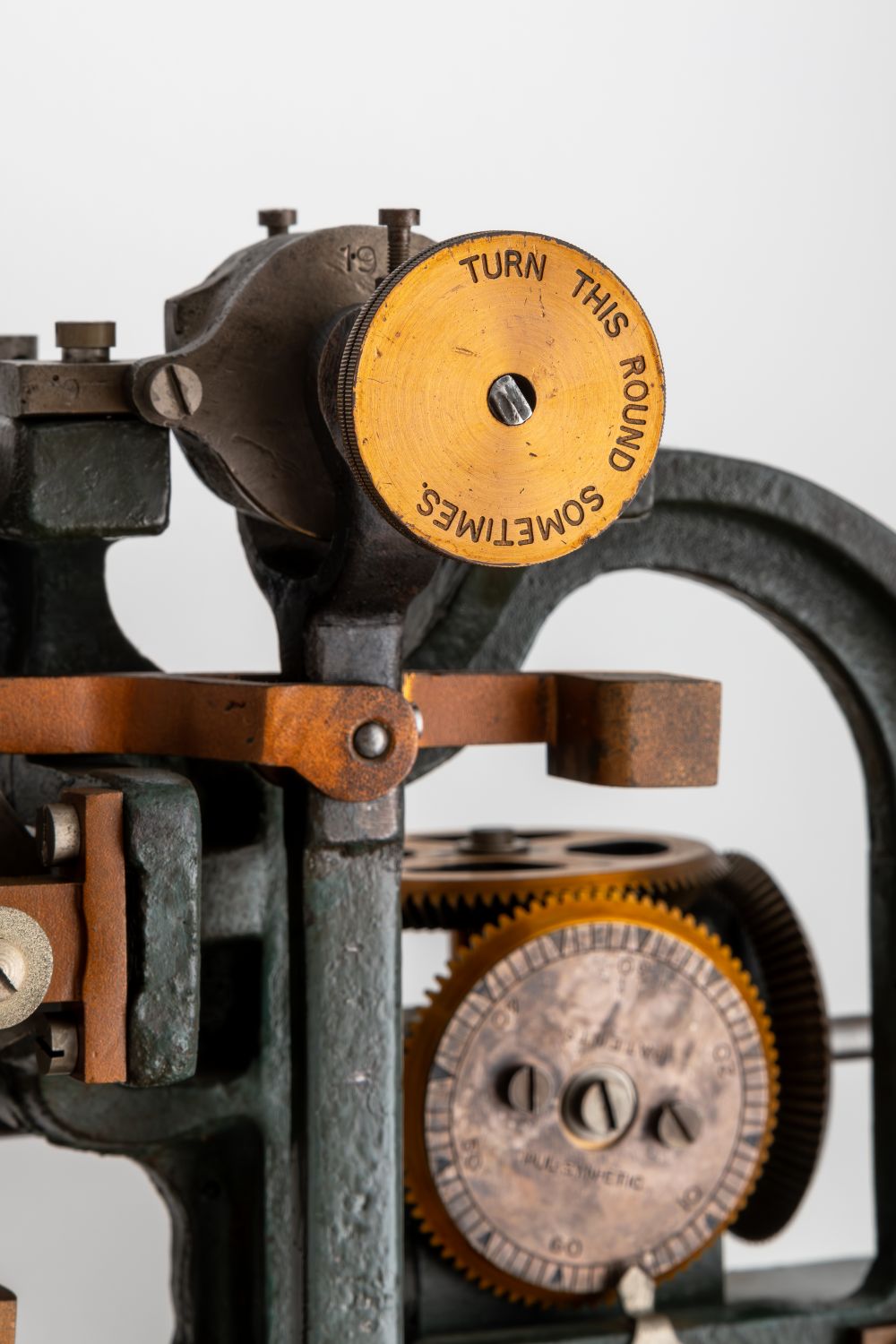
On knob at top: 'TURN THIS ROUND SOMETIMES'. On wheel: 'PUL-SYNETIC | PATENTS'
Provenance
Graham Newman
Overview
Gent installed several ‘mammoth clocks’ across the British Empire in the early twentieth century, in factories and railway stations from Clydebank to Sydney and Shanghai. This ‘Waiting Train’ movement allowed their dials to increase significantly in size while remaining electrically actuated. The pendulum sits between the controlling clock and the external dial, and acts as a maintaining and regulating force. Most famously, four were installed behind the dials of the clock in the Royal Liver Building in 1911.
In depth
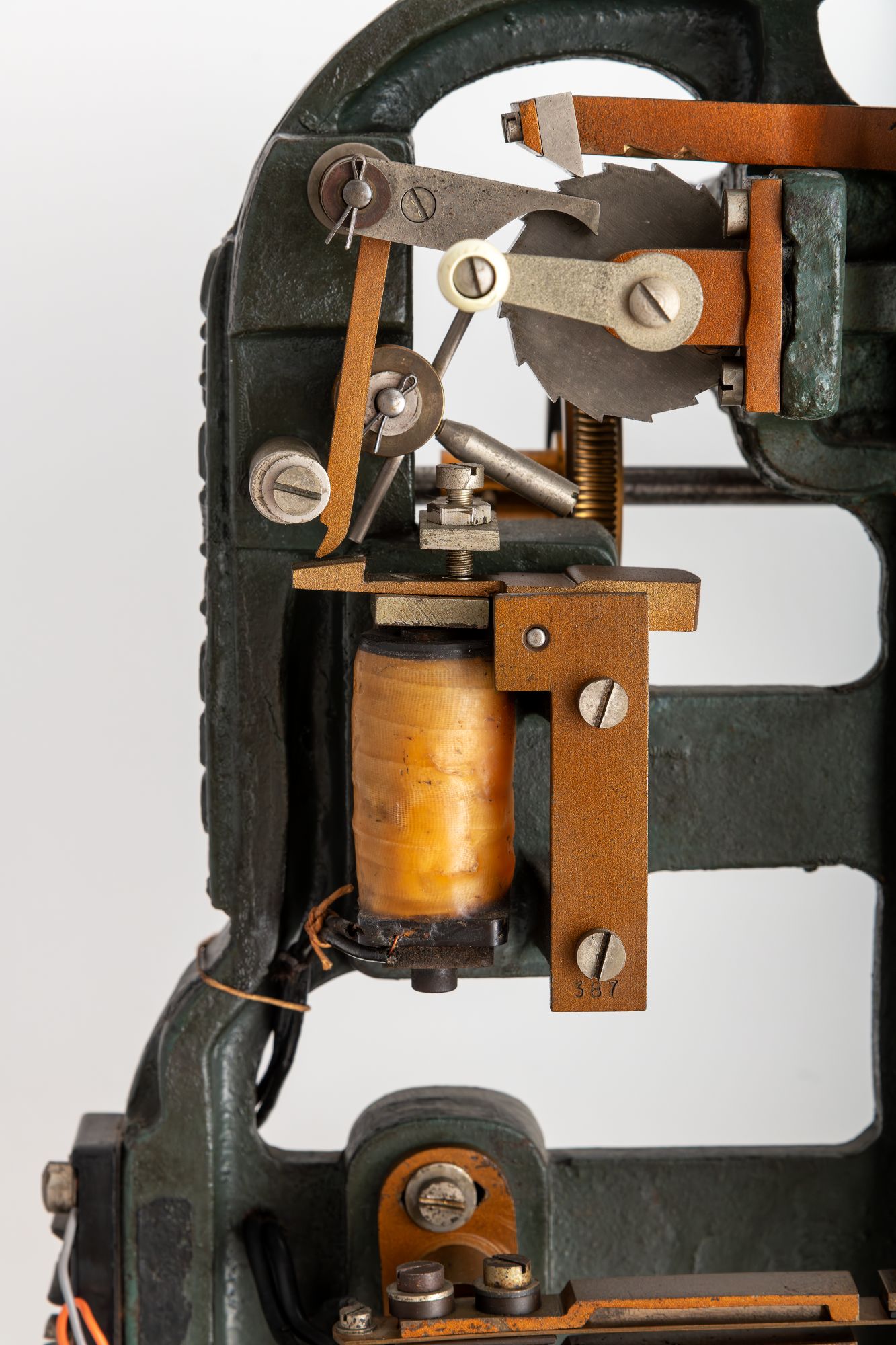
This is the C40A ‘Waiting Train’ movement produced by electric clock manufacturers Gent of Leicester from c.1908. During this period, Gent successfully made and installed what they termed ‘mammoth clocks of British Empire’: electrically controlled dials in factories, railway stations and post offices, including the Singer Factory, Clydebank, Terry’s Chocolate Works in York, and, most famously, behind the four dials of the clock in the Royal Liver Building, Liverpool, installed in 1911. The ‘Waiting Train’ allowed these dials to expand significantly in size while still remaining electrically actuated, thus obviating the need for large weights and weekly winding.
Also referred to as a pendulum motor, the movement sits at the interface between the external dial and a controlling clock transmitting the time. It incorporates a Hipp Toggle (named for its nineteenth-century inventor, Matthaus Hipp – see TCW 1035) to impulse the pendulum whenever its arc decays, and thus ensure the hands on the external dial receive as much power as is required. In inclement weather conditions, for example, this requirement will increase, and the pendulum will be impulsed more frequently, with the driving force transmitted to the dial via a worm and wheel arrangement at the back of the clock.
Meanwhile, the eponymous ‘waiting train’ sits at the top left of the movement: a pin on a countwheel will automatically put the clock into ‘waiting mode’ at the end of each minute, until it receives the time impulse from the controlling clock. Since the Waiting Train itself is set to run slightly fast, this ensures consistent timekeeping.
Video
Dimensions
42 x 66 x 18 cm
Inventory number
TCW 2001
Date
1936
Bibliography
Colin Reynolds, A Conspectus of Clocks and Time Related Products Produced by Gent & Co. of Leicester: 100 Years of Electrical Horology (Colin Reynolds, 2010), pp.156-60
Gent, ‘The “Pul-Syn-Etic” System of Electric Impulse Clocks and Time Discipline Apparatus for indicating Uniform and Accurate Time in “Office, Institute and Industry”’, Book 5, Section 1g, April 1932