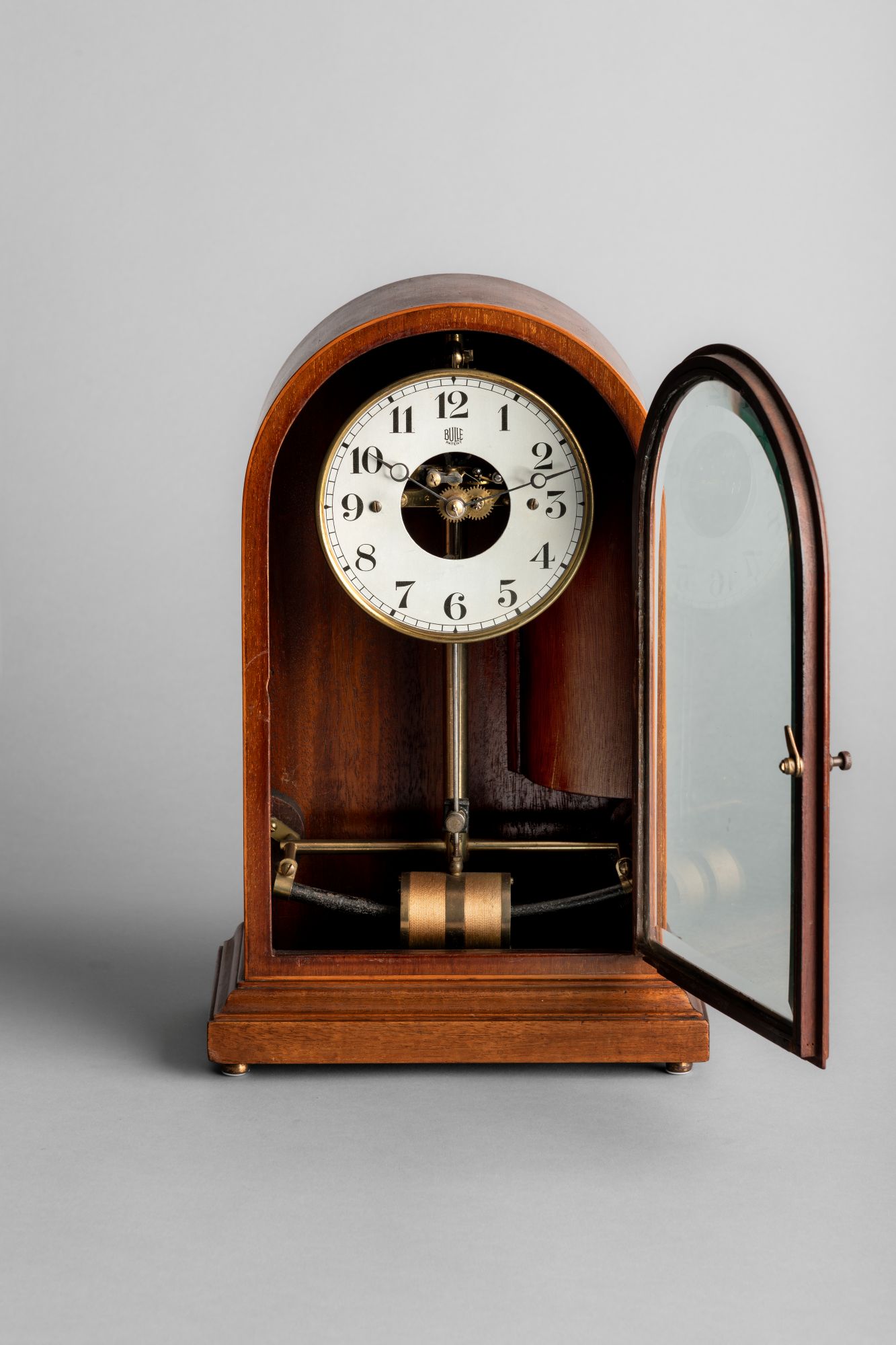
An electric mantel clock in an arched wooden case, made by Bulle, established in France in 1920 by Maurice Favre-Bulle. Along with their rivals, ATO, Bulle pioneered battery technology at a time when domestic mains power was still unreliable, producing covetable clocks for domestic markets in a range of designs. The principle is an electromagnetic solenoid used as a pendulum bob, which swings back and forth over a stationary, curved magnetic bar. Near the top of the pendulum is a silver pin, which makes contact alternately with the two sides of a pivoted fork as the pendulum swings back and forth. One arm of the fork is insulated while the other acts as a conductor, allowing the circuit to be made and current to flow to the drive coil of the bob. An isochronal spring is fitted to the pendulum rod to attempt to correct for circular error. A skeletonised dial makes it possible to see Bulle’s distinctive ‘walking pawl’ escapement in action, which is activated by the side-to-side motion of the fork. The movement is housed in a case with a glass door.
Dimensions
22.5 x 35 x 12.5 cm
Inventory number
TCW 3005
Date
c.1920s
Bibliography
Charles K. Aked, Electrifying Time (Ticehurst: The Antiquarian Horological Society, 1976), pp.76-77.
Henry L. Belmont, La Bulle-clock: horlogerie électrique (Besançon: Éditions Millot & Cie, 1975)
Mel Kaye, ‘The ATO Clock’, NAWCC Bulletin (June 2003), pp.333-47