Robert Knowles collection; purchased from Knowles’s heirs by Johnny Flower, from whom purchased for The Clockworks, 2020.
In depth
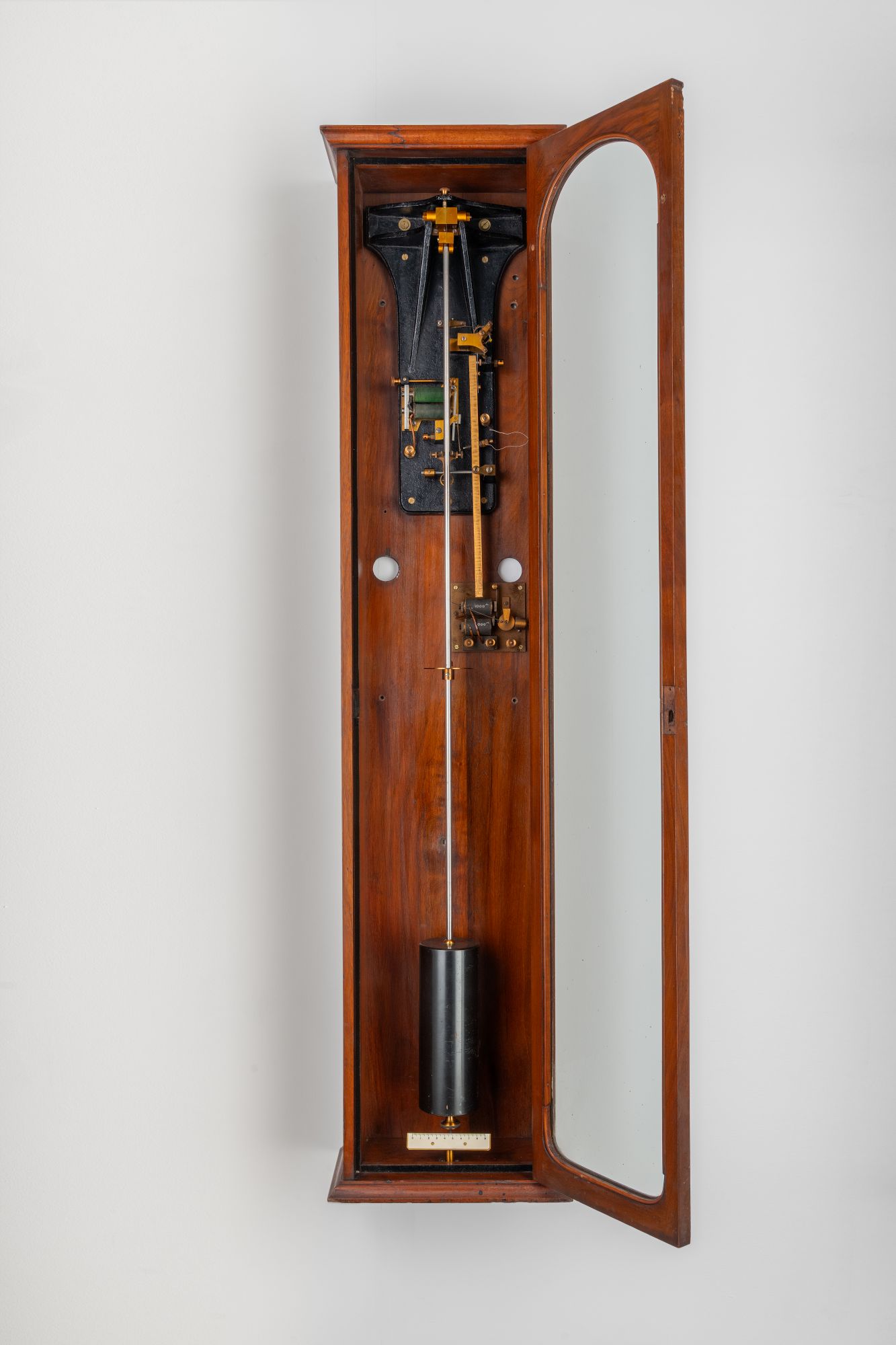
This is an example of the ‘inertia bar’ regulator made by the Synchronome Company during their period of collaboration with railway engineer William Hamilton Shortt, which began in 1910 and would culminate in the so-called ‘Free Pendulum’ of 1921 (see TCW 1073). According to Synchronome founder Frank Hope-Jones, only 12 inertia bar clocks were made; 6 are known today, and, though these appear to have been commercially produced, they differ slightly in design, suggesting a sequential process of design and development from one clock to the next. The three-quarter version of this clock was patented in 1911.
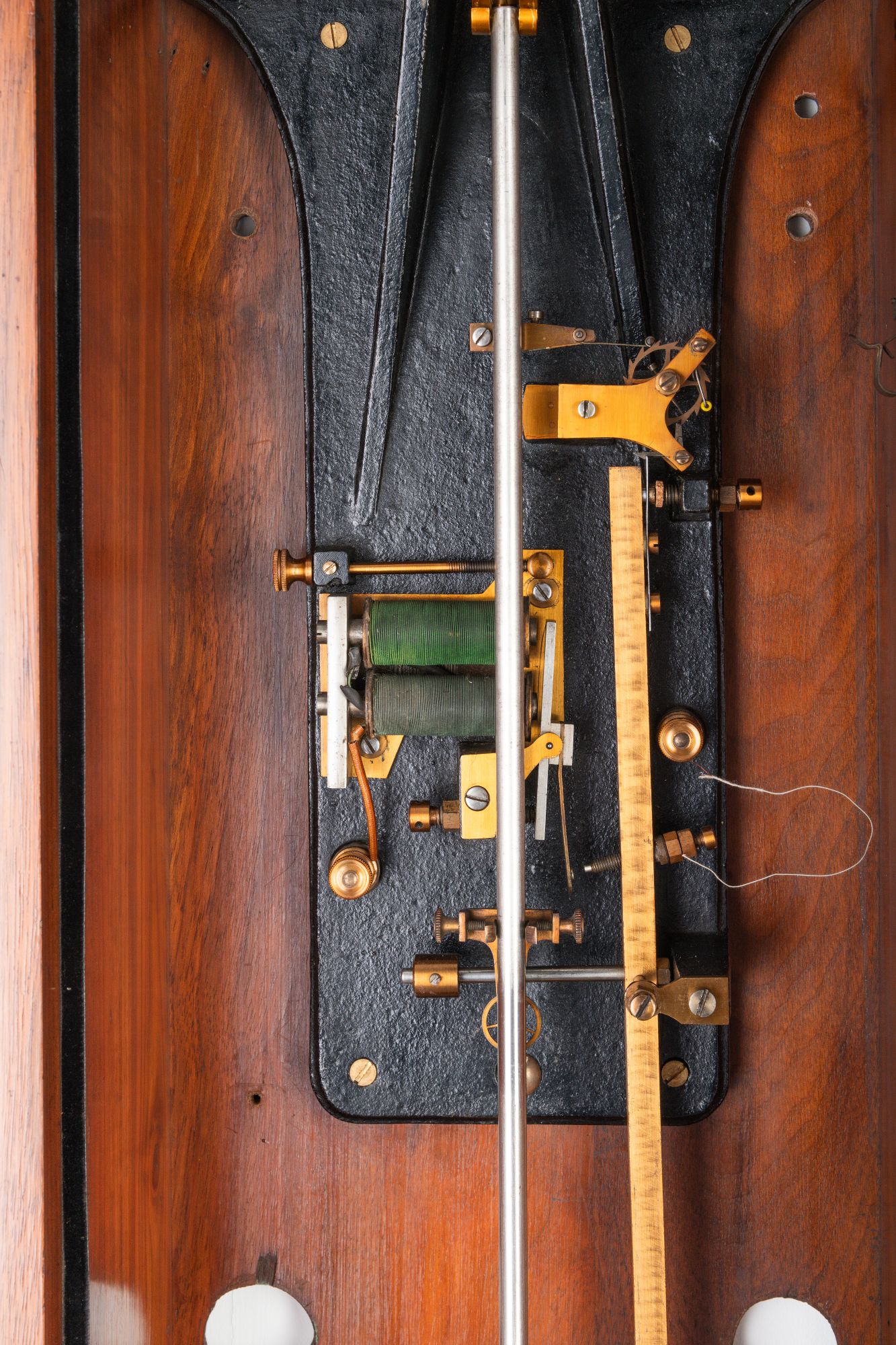
Shortt’s aim was to control the amplitude of the pendulum, and to compensate for variable loss in the arc by making the impulse dependent on the arc of the swing. It does this by using the comparatively slow movement of the bar, which will miss the impulse jewel if the pendulum is moving fast enough. Though Shortt seems to have moved on from the inertia bar escapement fairly quickly – he began working on the ‘triangle’ movement in 1915 – he would incorporate many of these principles into the successful free pendulum clock he produced almost a decade later.
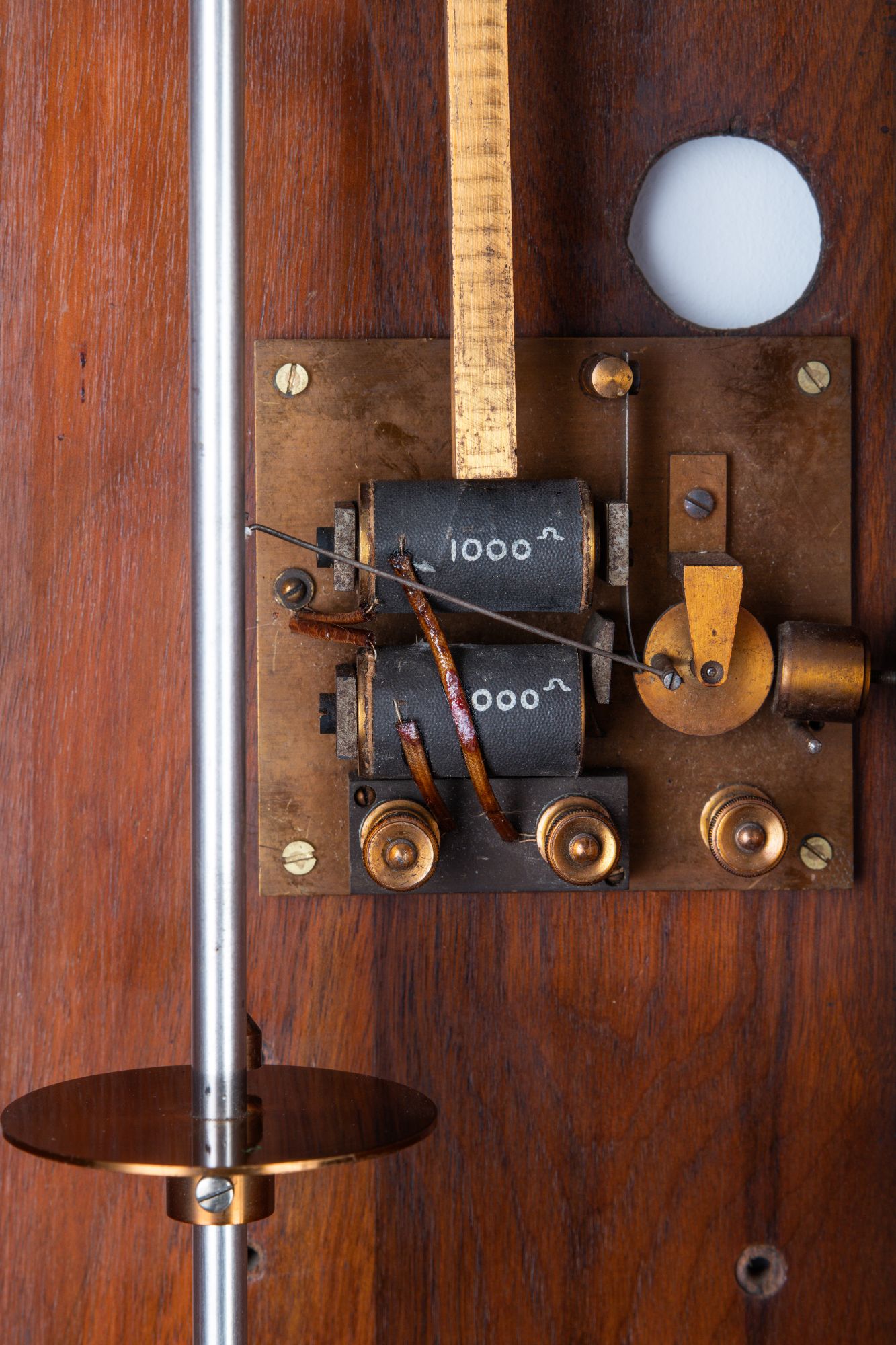
This clock has lost its original pilot dial and has three large holes in the back of the case, presumably from where it was attached directly to a wall. A see-saw synchroniser attachment is likely to have been added later. A similar clock is pictured in an early twentieth-century photograph of the National Physics Laboratory, but had disappeared from the building by the 1920s; whether or not that clock is identical with this one, the photograph suggests the kind of technical use-case to which Shortt was aspiring.
Dimensions
126 x 29 x 16 cm
Inventory number
TCW 1065
Date
c.1911-12
Bibliography
Robert Miles, Synchronome: Masters of Electrical Timekeeping (Ticehurst, 2011), pp.154-156
Edward Odell, lecture to the Electrical Horology Group of the Antiquarian Horological Society, 2026.