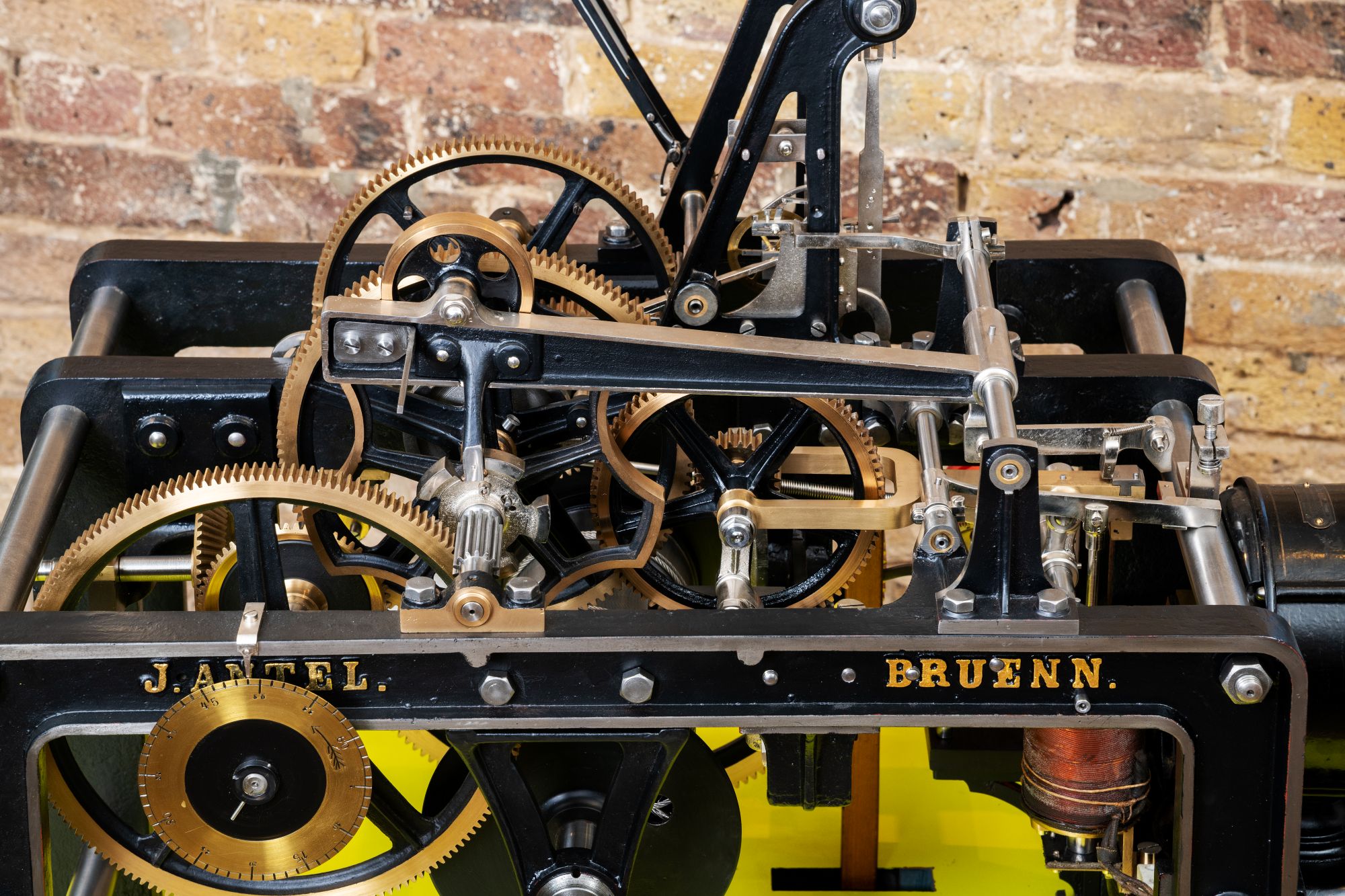
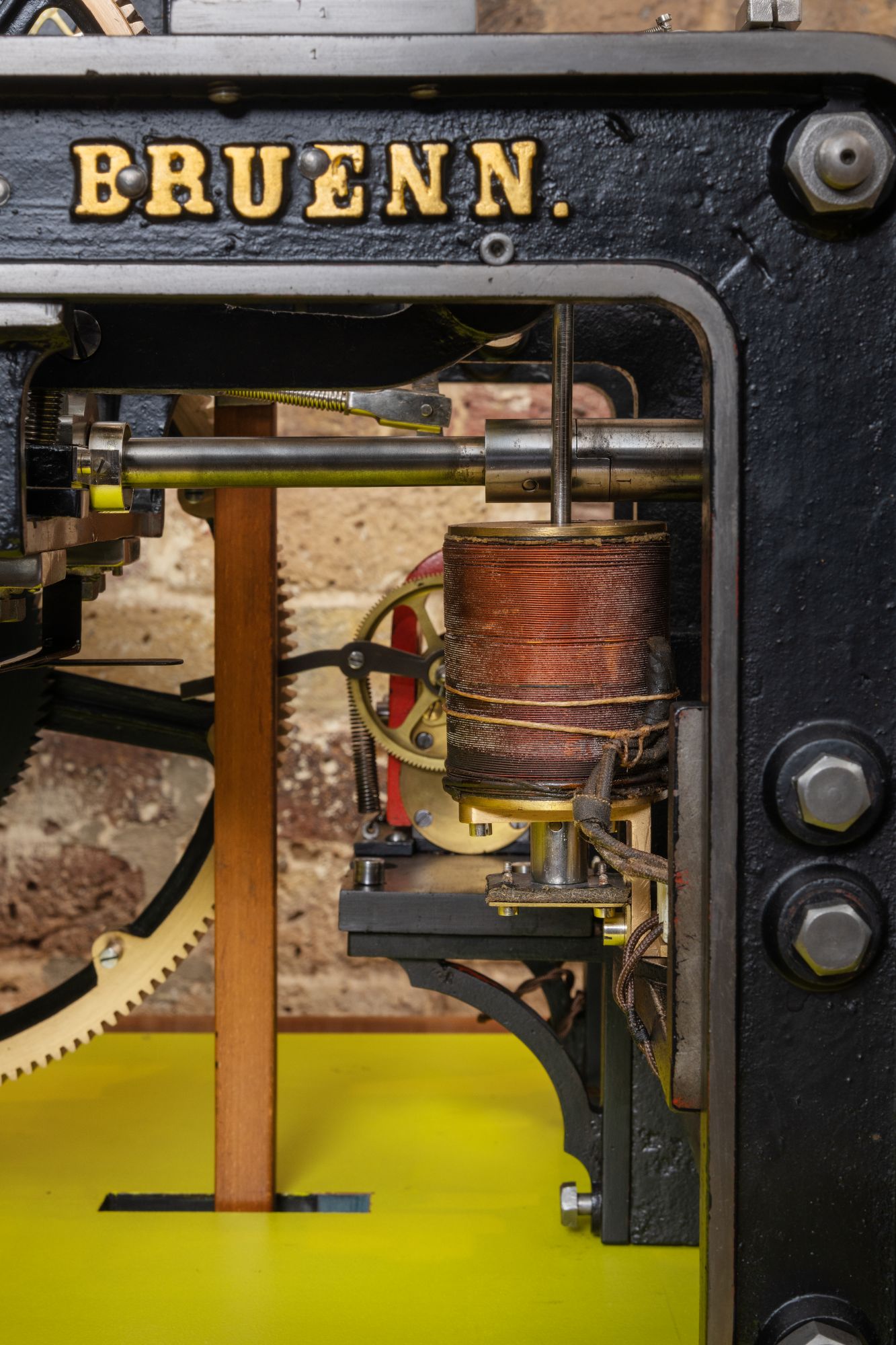
On each plate: J. ANTEL. | BRUENN. On each of the three plates. Plaque: 'TOWER SLAVE, C.1905 | JOHANN ANTEL (1866-1930) | MADE FOR THE WEST TOWER OF | BRNO'S MAIN RAILWAY STATION | RESTORED BY JAN WRIGHT 2000-2005
Provenance
Thomas Schraven collection
Overview
In 1900, Brno installed electric trams, lighting, and a network of public clocks. Designed by Johann Antel, this clock was installed in the railway station. It advances the hands each minute in response to an electric impulse from a controlling clock. However, since Antel (or his client) was nervous about the new system’s reliability, the movement includes a mechanical backup. If the power failed, this weight-driven timekeeper would keep the clock running and trip a magneto to alert staff.
In depth
In 1900, the city of Brno, in what is now Czechia, went electric, installing trams, street lighting and several top-of-the-range electric clocks – one in the town hall, one in the church of sv. Jakub, and one in each of the twin towers of the central railway station (each with three dials). These were commissioned from the local clockmaker Johann Antel, a farmer’s son, who had secured a patent for an electric turret clock design on 15 July 1903.
Antel’s innovation was to transform the tower clock from a timekeeper to an electrically-powered subsidiary dial. Rather than remaining subject to the vagaries of wind and weather, his turret clock receives time signals from a high-quality regulator kept in a central control room, out of the way of interference. This time signal would come through each minute, starting the motor, which ultimately advances the hands on the dial, using a train of wheels between the first and second plates. However, since Antel (or his client), was nervous about the reliability of the electricity supply, this movement also incorporates a mechanical, weight-driven backup.
This is the only movement to survive from Antel’s railway station installation, which dates from 1905, shortly after the building was remodelled in Italianate style by Josef Nebehosteny (1852–1921). It comes from the east tower; the west one having been destroyed in an Allied air raid during the Second World War. The city invested heavily in its new electric clock, which, despite its remote location, was extensively nickel-plated. This may partly have been for aesthetic reasons, and prestige, but the plating also camouflages Antel’s extensive use of recycled metal in the movement. Though it is unlikely that Antel’s ideas influenced makers in other countries, in the decades following his death they were adopted independently elsewhere with much success – notably in the UK by Gent.
Technical description
A large conventional barrel for a weight is supported between the first and third plates. The mechanical movement has a pendulum, impulsed by a gravity arm, with a roller that runs down an inclined plane on the pendulum. The release of the gravity arm is controlled by a count wheel which revolves once each minute, advanced by a pawl on the pendulum. While electricity is available, the gravity arm is reset by a sprung-loaded mechanism, re-cocked each minute by the operation of the electrically driven train, and the main weight, supported on a weight line wound around barrel, is not used.
However, if the three-phase power supply fails, the gravity arm is now reset each minute by the motion of the going barrel and the descent of the main weight. Control of the clock is thereby handed back entirely to the mechanical train, which continues to advance the hands in the normal way.
Meanwhile, pins on the great wheel, spaced at five-minute intervals, lift a spring-loaded rotor carrying the armature within a small ringing magneto. As each pin releases the lever, the magneto generates an electric pulse. In the clock’s earlier installation, this pulse would have rung an alarm in the control room, alerting staff to the failure of the electrical supply.
Video
Inventory number
TCW 2000
Date
c.1905
Bibliography
James Nye, 'Johann Antel (1866-1930): Pioneering Electric Horology in Early 20th-Century Brno'