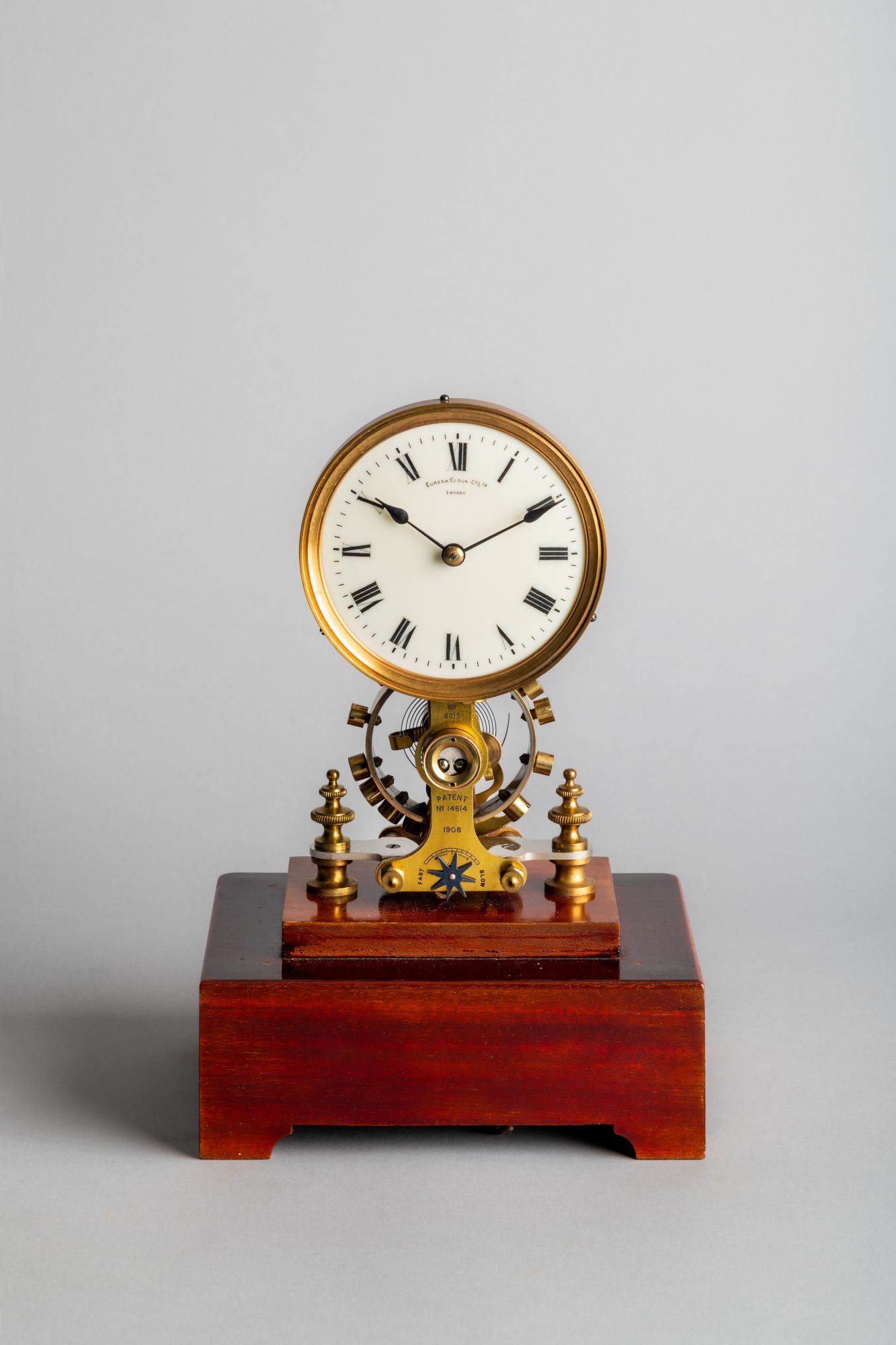
On dial: EUREKA CLOCK CO. LTD. | LONDON. On plate: No. 8213 | PATENT | No. 14614 | 1908.
Provenance
Dr J. N. B. Evans collection.
Overview
Marketed as ‘the wonderful 1,000 day clock’, in reference to the dry cell battery that powered it, the Eureka clock is characterised by a large, ‘lazy’, oscillating wheel. This is sustained in motion by the periodic attraction of a solenoid to an iron plate. Eureka clocks were luxury products – retailed by Harrod’s and Asprey – and may ultimately have proved too expensive to be viable. However, though the Eureka Clock Company folded after just five years, they helped spark a taste for electric clocks in the home.
In depth
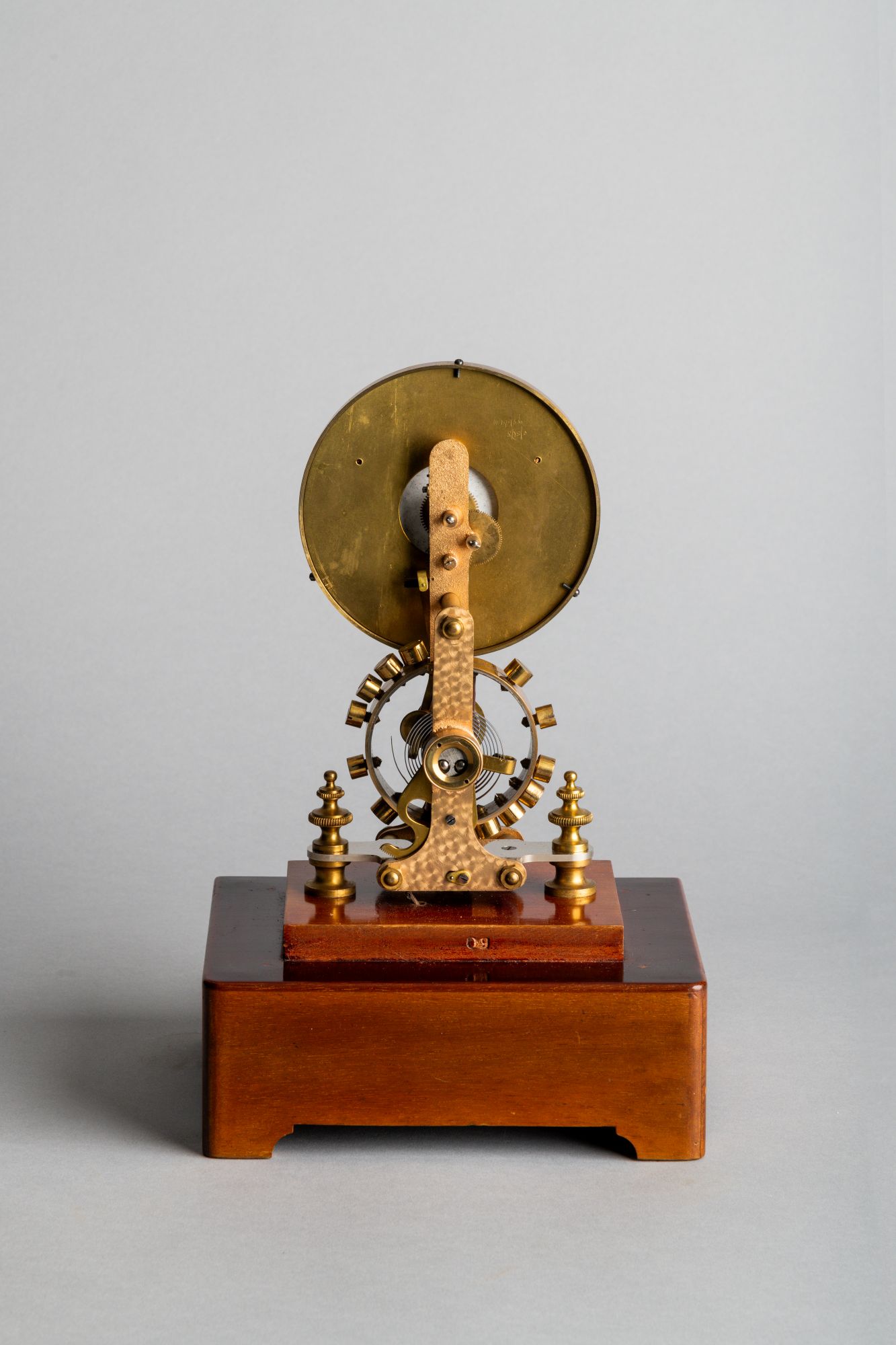
The Eureka clock was one of the first electrical timekeepers to enter the domestic market – marketed as the ‘wonderful 1,000 day clock’, in reference to the lifespan of the dry cell battery that powered it. Its distinctive feature is the ‘lazy’ motion of its large oscillating wheel, reminiscent of a watch balance (complete with hairspring), and movements were often sold in bell jars or four- or five-glass cases – like this one in mahogany wood with bevelled plate glass – to allow this to be seen. This is an example of the so-called ‘tall’ model, with the wheel set slightly below the dial (in ‘short’ models, the wheel is positioned behind).
The clock’s inventor was American electrical engineer Timothy Bernard Powers, who patented it with the support of the Kutnow Brothers in the UK, the USA and Europe in 1906. The Eureka Clock Company was established to bring the design to market in 1908, but wound down in 1914, on the advent of the First World War. Over a brief production period of about five years, some 10,000 numbered units are believed to have been made, most of them manufactured in Britain. Retailed by high-end outlets such as Harrod’s, Mappin & Webb and Asprey, Eureka clocks were known for their quality, but also for their price: advertised at between £5-10, they were more expensive than many high-quality striking mechanical clocks, and it may have been the company’s inability to reduce the price that ultimately brought them into terminal financial difficulties.
The motive power of a Eureka clock is its large oscillating balance wheel, which is kept sustained by a solenoid mounted on an iron bar passing across the centre. There is a contact pin on the cheek of the wheel composed half of conducting metal and half of insulating material. This makes periodic contact with a contact spring mounted to a stationary iron plate at the base of the movement. As the balance wheel oscillates, the first swing anticlockwise carries the contact pin past the spring with its insulated portion outwards; on the clockwise return, the pin again touches but this time on the metallic side, energising the electromagnet just as it approaches the iron plate. The electromagnet is immediately thereby attracted to the centre of the plate, but contact between the spring and pin has been broken by the time it reaches it. The balance wheel now continues to move under its own inertia until the circuit is completed again.
Video
Dimensions
34 cm (h) x 21 cm (w) x 17 cm (d) (cased)
Inventory number
TCW 3011
Date
c.1910
Bibliography
The Antiquarian Horological Society EHG ‘Eureka Clock Survey’
AHS EHG Technical Paper no. 73
F. G. Alan Shenton, The Eureka Clock (Rita Shenton Horological Bookseller, rev. edn., 1999)