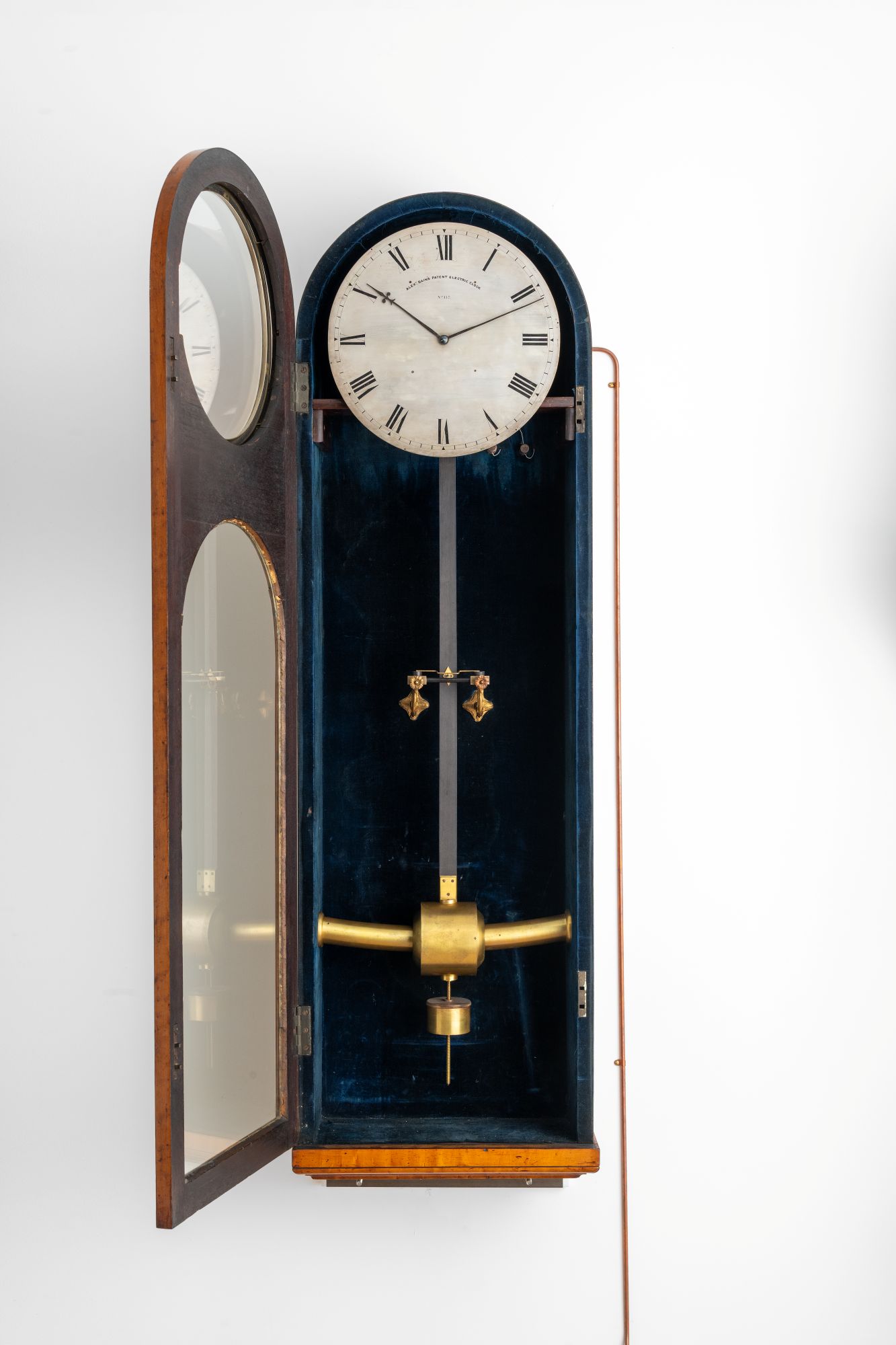
On dial: ALEX.R BAINS PATENT ELECTRIC CLOCK NO. 117
Provenance
Bonham’s, London, 28 June 2011, lot 139.
Overview
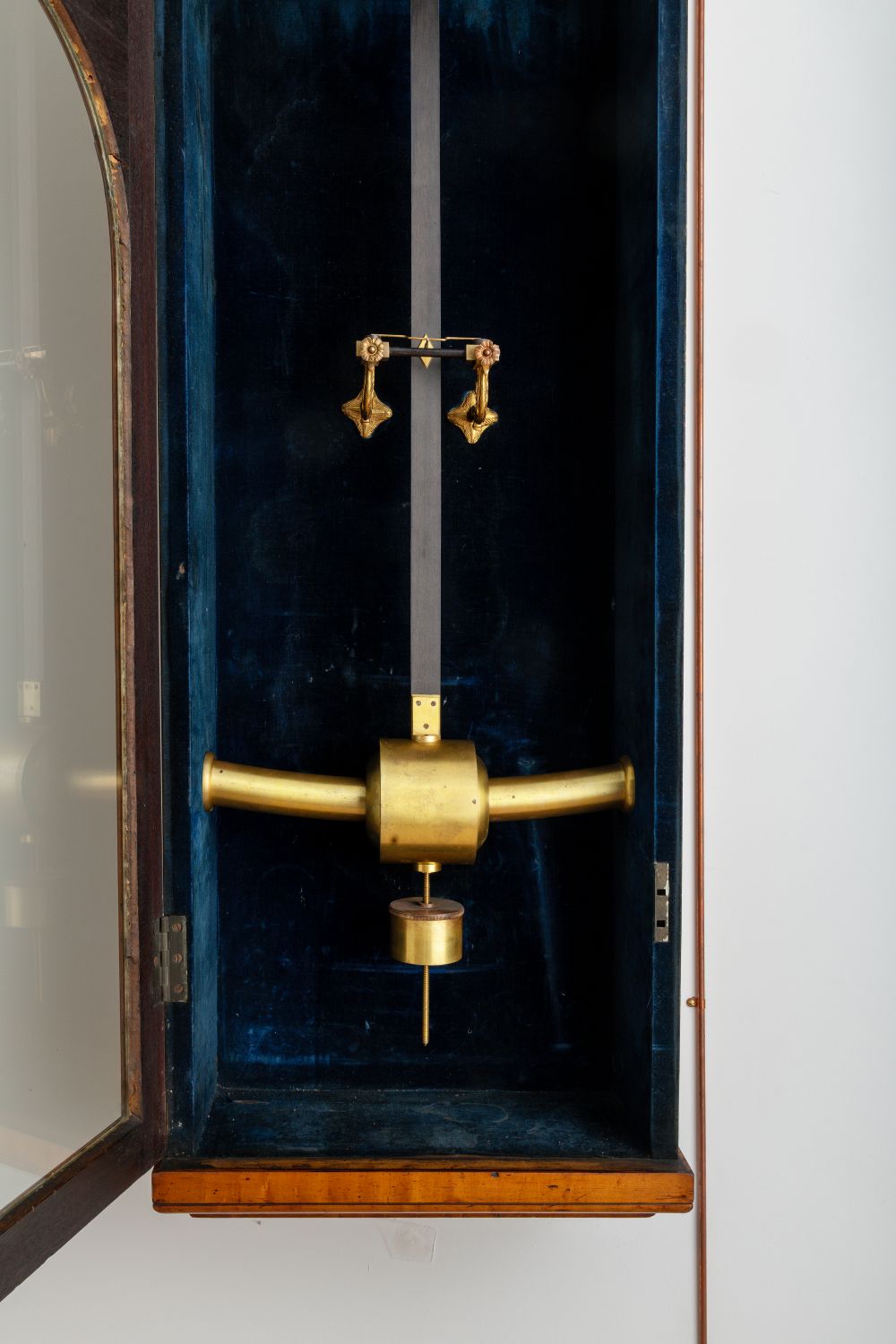
From humble beginnings in the Scottish highlands, Alexander Bain is now often dubbed the ‘father of electrical horology’. This clock was patented in 1845. It strips away the wheelwork of a conventional clock; the main pendulum bob houses an electromagnet, which passes over a curved brass tube containing permanent magnets. The interaction between the two maintains the pendulum’s oscillation. Bain’s clocks were powered by earth batteries, and he used his skills in telegraphy to send time signals down the new railway line from Edinburgh to Glasgow.
In depth
Often dubbed the ‘father of electrical horology’, Alexander Bain came from humble beginnings. Born in a small croft to a large family in the highlands of Scotland in 1810, he was initially apprenticed to a clockmaker, but became fascinated with electricity after attending a public lecture in nearby Thurso at the age of twenty. He patented his first electric clock in 1840, powering it through a combination of zinc and carbon electrodes buried in moist earth. During the same period, he also invented a ‘printing telegraph’ – a forerunner of the fax machine – and an electric telegraph. He would later use a telegraph line to send time signals from a controlling electric clock in Edinburgh down the railway line to a sympathetic pendulum in Glasgow, 46 miles away.
Bain’s wall clocks strip away the wheelwork associated with a conventional mechanical clock. Instead of a bob, the one-and-a-quarter-second pendulum finishes in an electromagnetic coil, wrapped around a curved brass tube fixed across the lower part of the case. Inside the tube are two permanent magnets. Midway along the pendulum, a pin operates a sliding contact bar that alternately opens and closes a switch in the circuit between the earth battery and the coil. On each closure, the energised coil is attracted or repelled by the fixed magnets at either side, which keeps the pendulum moving. At the suspension end, this oscillation is transmitted via a ratchet wheel and pawl to advance the hands.
Bain’s clocks proved the concept of applying electricity to horology, as well as the idea of distributing unified time electrically. They also established his vision for the ‘centralising agency’ of electricity. ‘All the towns in the kingdom’, he wrote in the 1850s, ‘could be so connected with the Royal Observatory, as to indicate true Greenwich time in each and all of the places so connected’ – an idea no less remarkable for its ambition than for its ultimate prescience.
The Clockworks clock is numbered ‘117’, and probably dates from c.1846–48, after Bain was awarded his third patent (September 1845) for the sliding switch. It marks the first appearance of the curved one-piece tube magnet holder, and is very close in design to another clock now in the collection of the National Maritime Museum, Greenwich.
Dimensions
132 x 42 x 18 cm
Inventory number
TCW 1000
Date
c.1846-48
Bibliography
Charles K. Aked, ‘Alexander Bain, the Father of Electrical Horology’, Antiquarian Horology, December 1974
Alexander Bain, A Short History of the Electric Clocks, with Explanations of their Principles and Mechanism and instructions for their management and regulation (London: Chapman and Hall, Piccadilly, 1852)