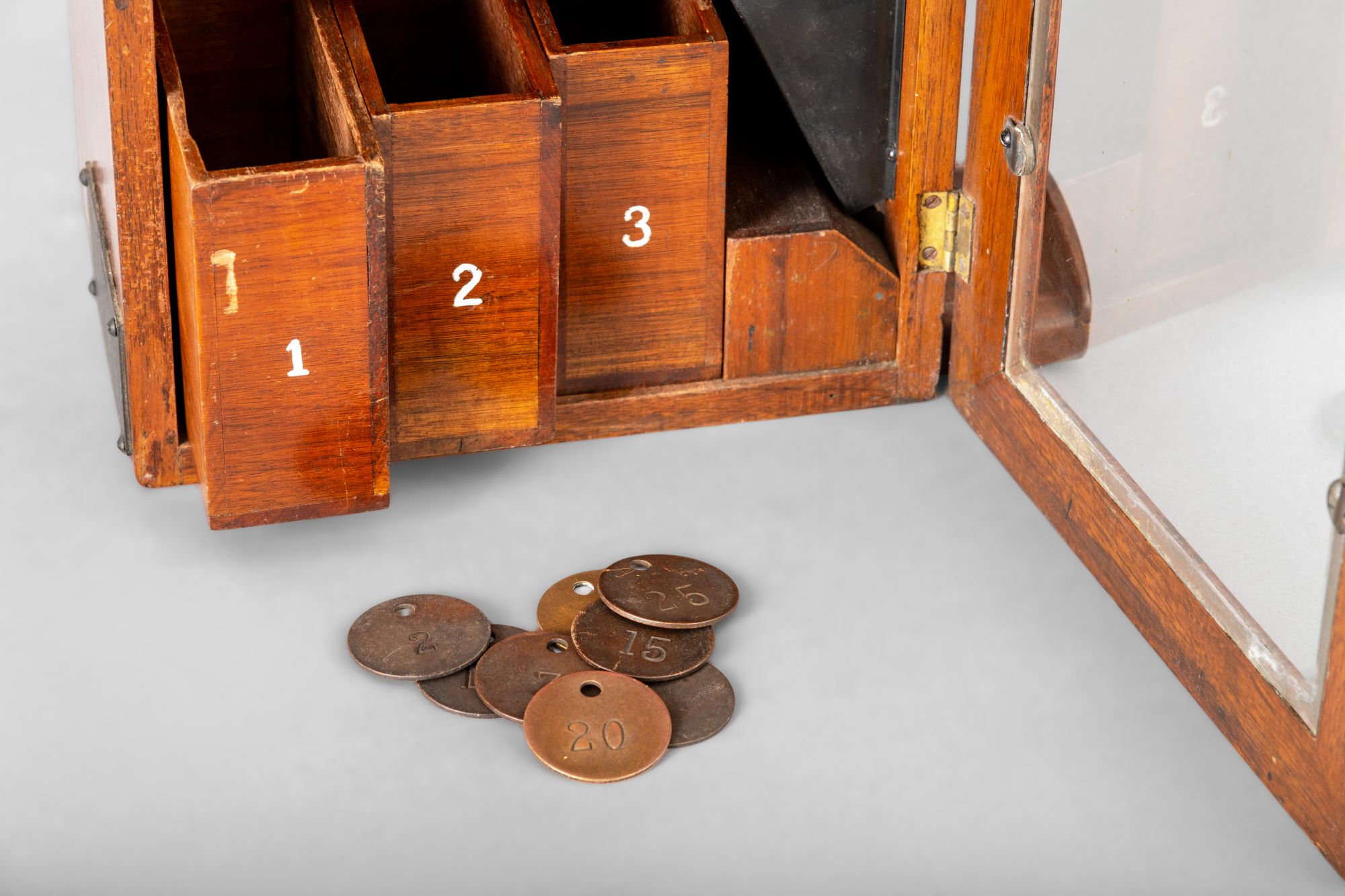
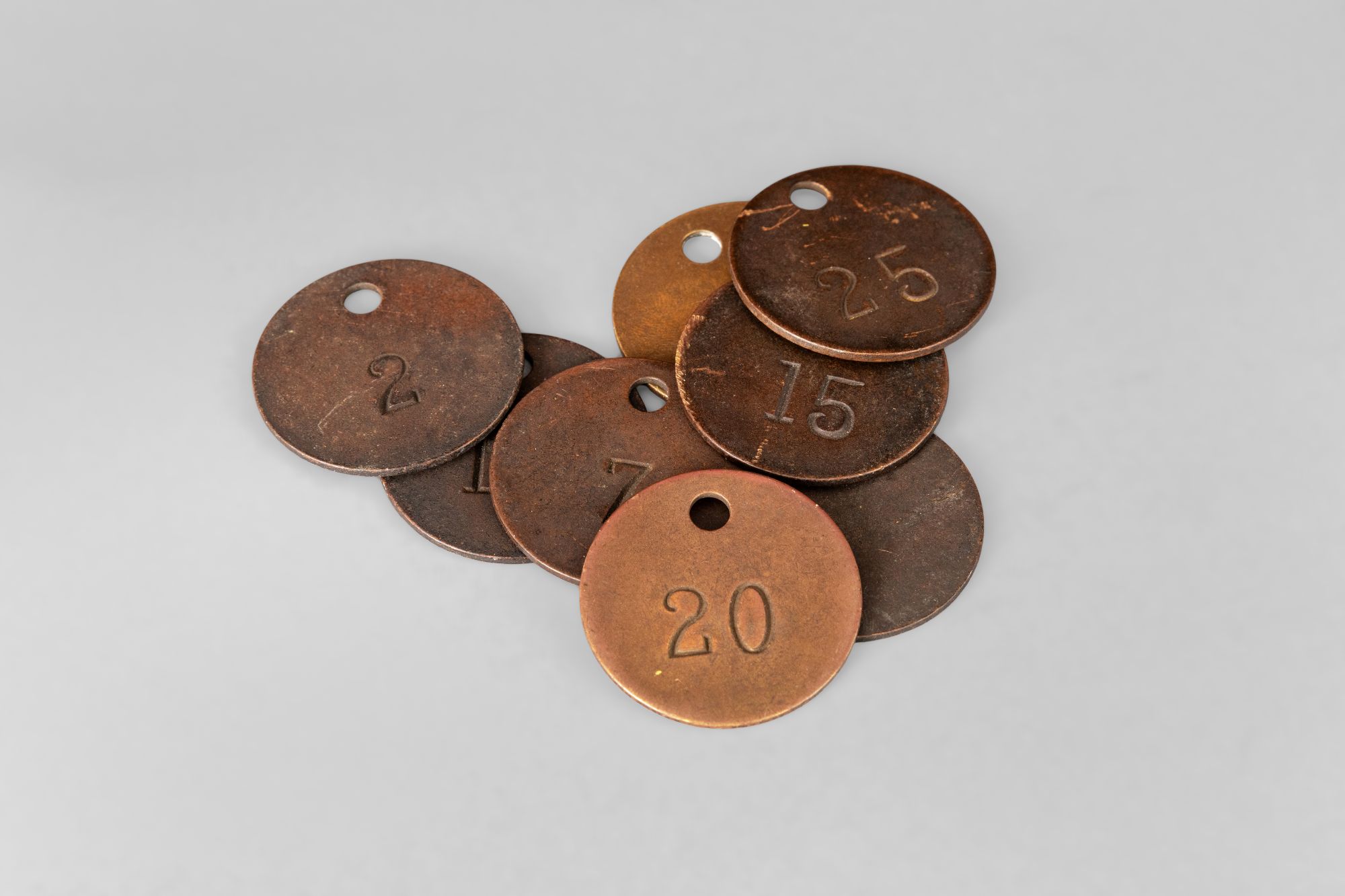
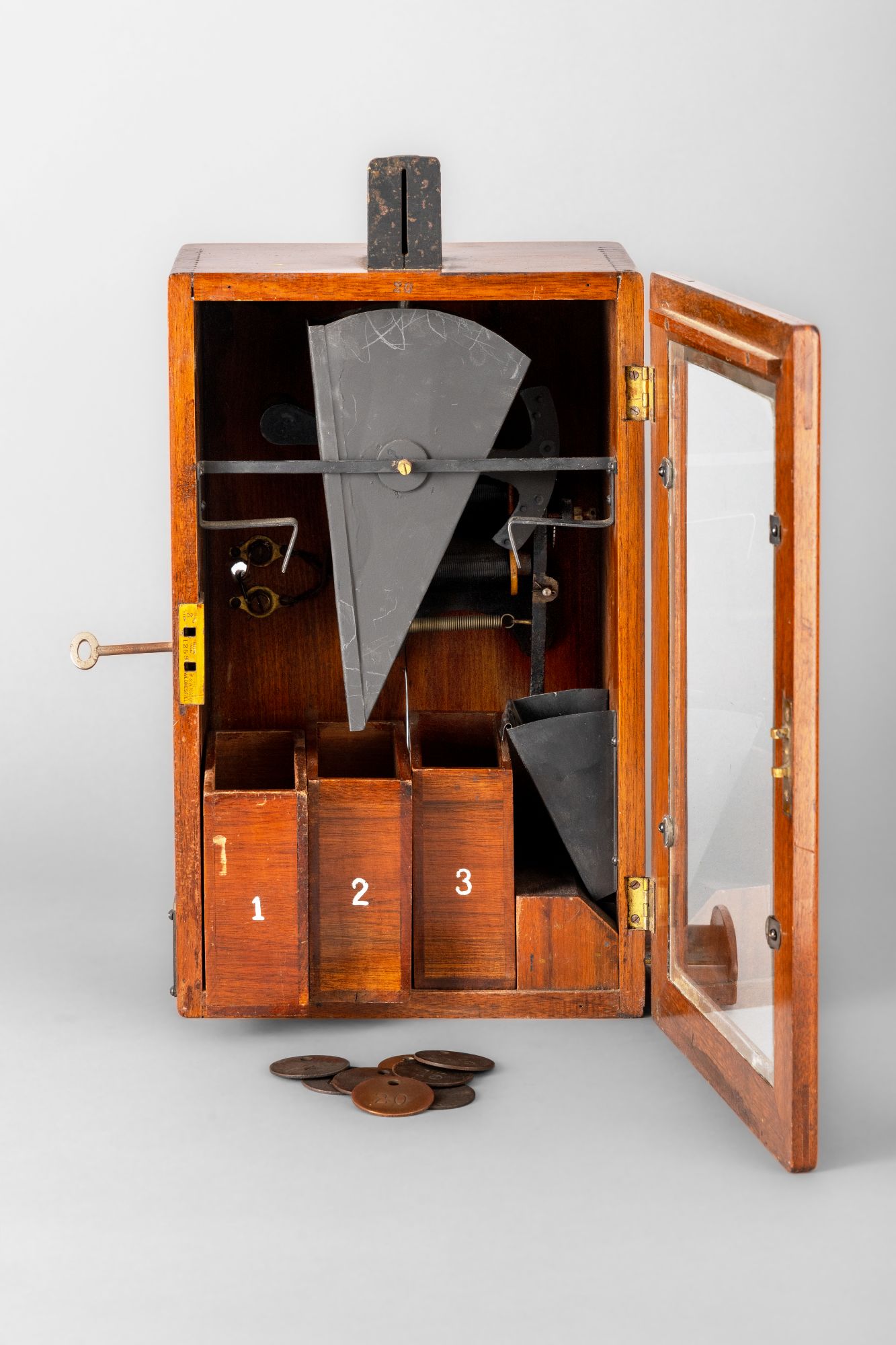
On plaque on case: 'GENT & Co. LTD | MAKERS | LEICESTER'. 1, 2, 3 in tipex or white paint on the boxes inside the case. Label on clock key: 'GENT CHECK / TIME UNIT'. On lock: 'SAFETY LOCK 1259 | F & A MASON | WEDNESFIEL. On top of inside case: '20'. Nine tokens inside, numbered 2, 7, 10, 11, 15, 20, 23, 24, 25
Provenance
Colin Reynolds; purchased 2025.
In depth
This is a ‘clocking in’ or ‘check time’ clock intended for use in factories or other workplaces with large numbers of employees. It was manufactured and sold by Gent, who apparently also used it themselves, since an early photograph from the Gent archive shows a group of women workers lining up beside one to ‘clock in’ at their factory c.1895. This unit retains nine of the original tokens, numbered 2, 7, 10, 11, 15, 20, 23, 24 and 25, each of which would have corresponded to a worker at the factory.
The ‘Check Time’ unit would have been connected to a controlling clock sending impulses every five minutes. Each impulse activated the solenoid at the back of the case, causing the centrally pivoted funnel to swing to the right and move along the three canisters in turn, thus ensuring that the worker’s numbered token fell into the canister that corresponded to the time they had arrived. The three increments suggest a period of 15 minutes, with canister 1 indicating early arrival, and canisters 2 and 3 within a ten-minute grace period. After the funnel has passed the third canister, indicating fifteen minutes past the contracted time of arrival, it advances to a chute that rejects the worker’s token altogether, thus either depriving them of a day’s pay, or possibly sending them to a separate entrance to explain their tardiness (presumably at the employer’s discretion). At this point the funnel also has to be manually reset.
This is one of a number of clocking in and time check devices devised from the later half of the nineteenth century, testifying to a broader shift in how time and work were understood. Before the industrial revolution, many workers were doing ‘piece work’ and receiving pay that corresponded to set outputs. Gradually, the paradigm shifted with the result that workers began receiving pay for time spent in a particular place – creating the need to measure that time remotely. This is a remarkably simple solution to the problem, but Gent would go on to develop much more complicated clocking in and ‘tell-tale’ devices as the century wore on.
Dimensions
7.5 x 28 x 42.5 cm
Inventory number
TCW 1081
Date
1895-1900
Bibliography
Colin Reynolds, A Conspectus of Clocks and Time Related Products Produced by Gent & Co. of Leicester: 100 Years of Electrical Horology (Colin Reynolds, 2010), pp.16-17.