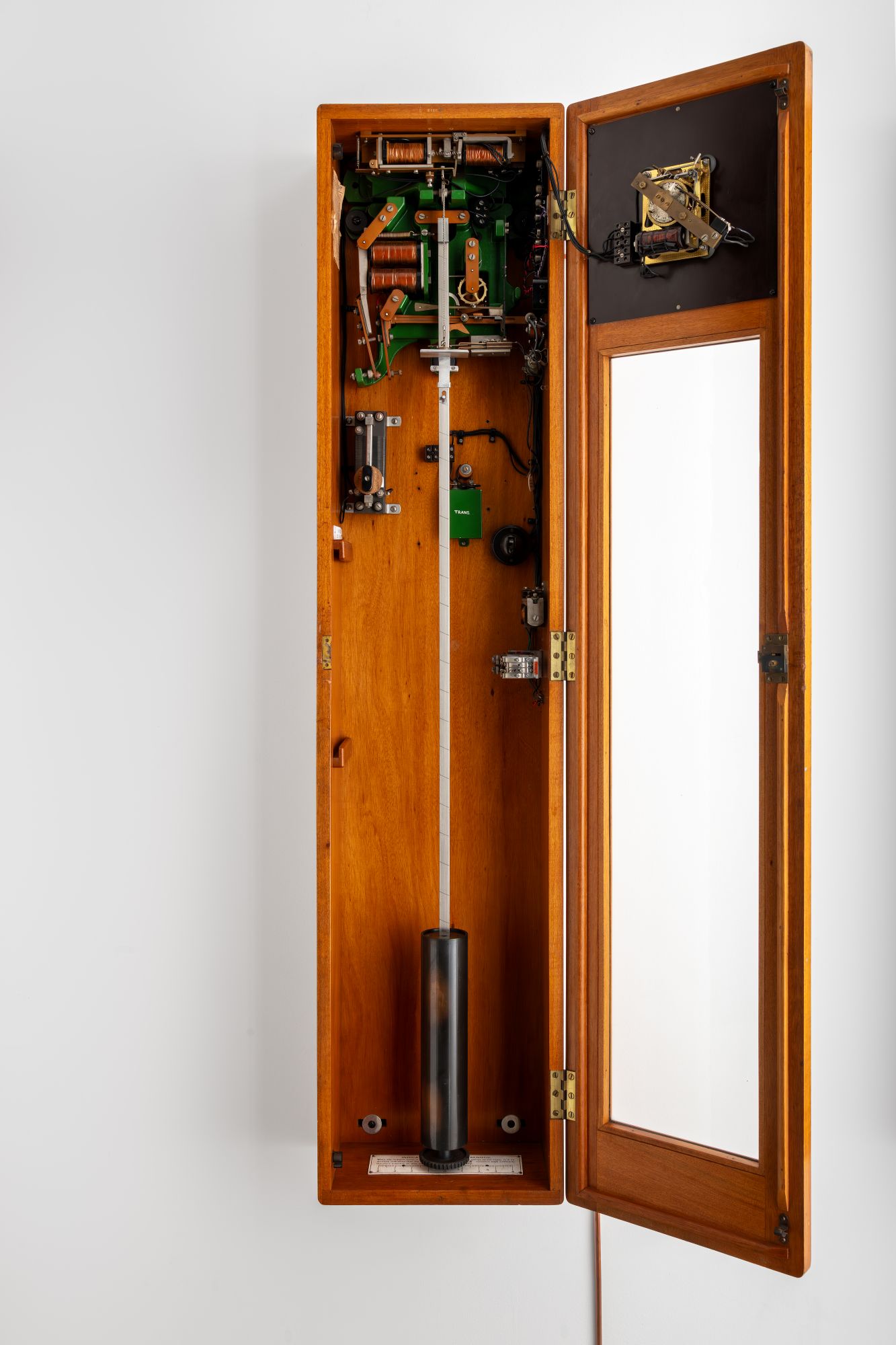
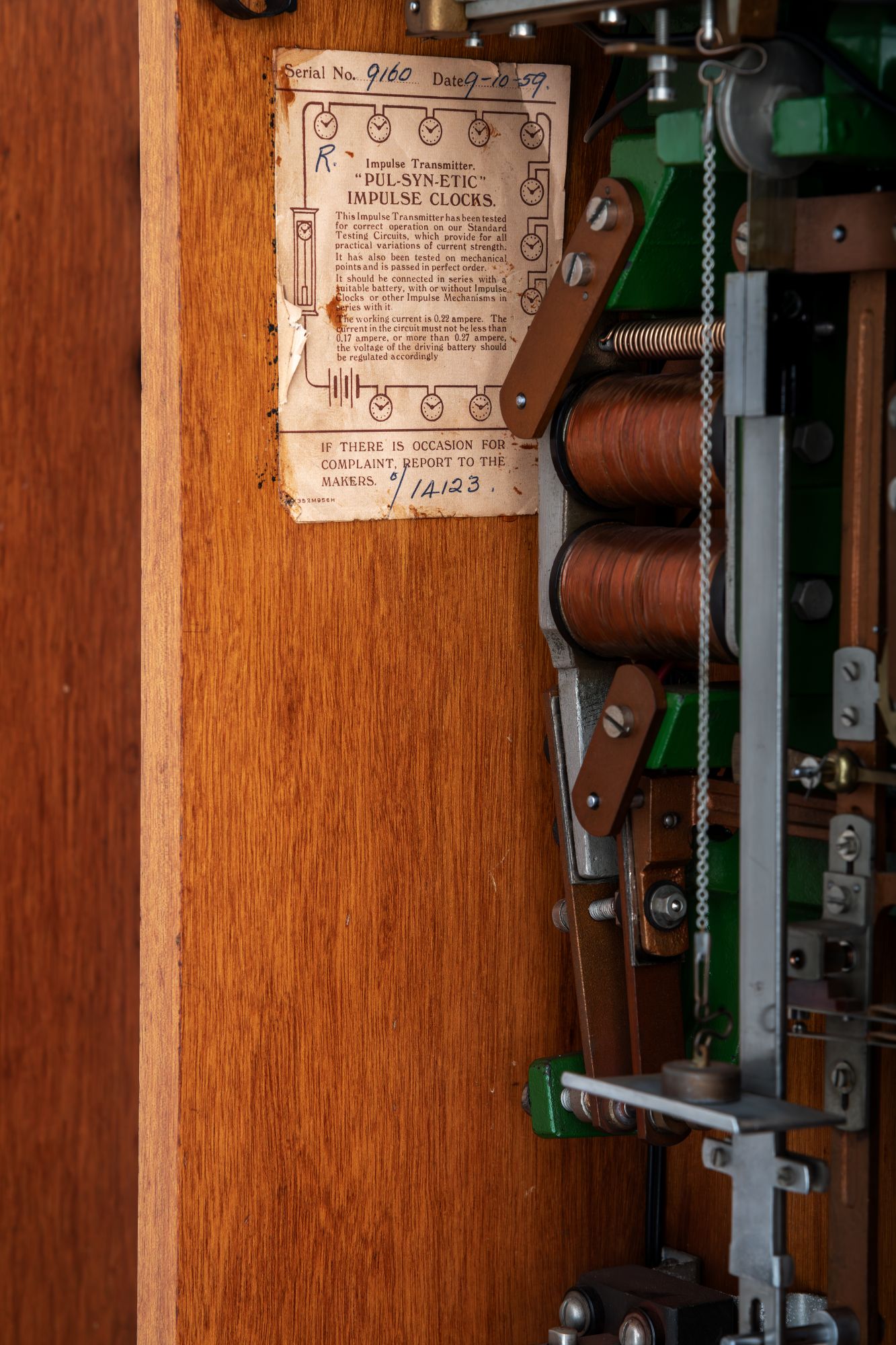
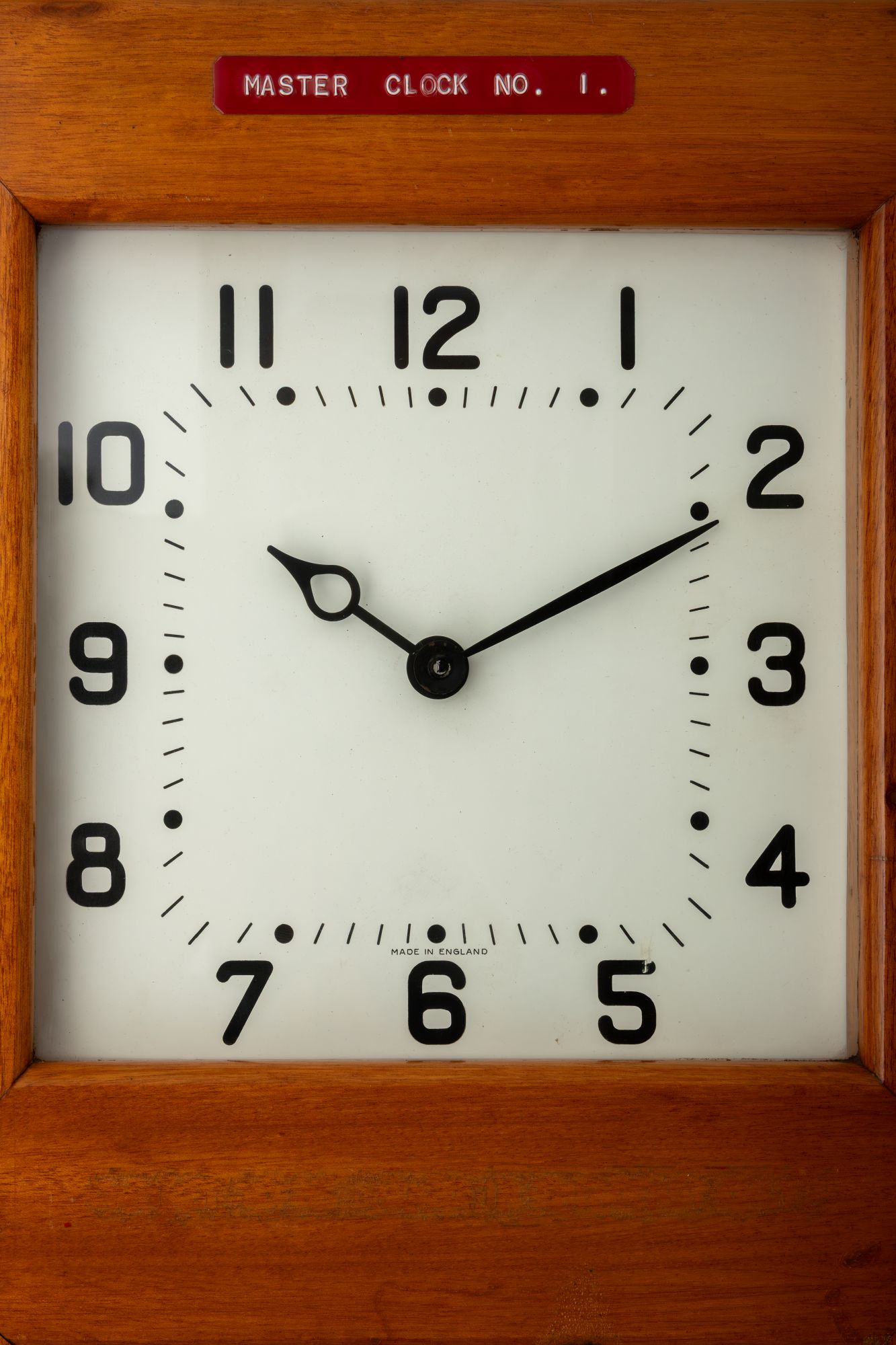
On case, above dial: 'MASTER CLOCK NO. 1.' (on Dymo tape). Around keyhole: 'GENTS & CO LTD. | LEICESTER | PULSYNETIC | TIME | TRANSMITTER'. Label inside 'INSTRUCTIONS TO BE KEPT HERE'. On dial: MADE IN ENGLAND
Provenance
Purchased new by the BBC television centre; retired from use in the 1990s; Geoffrey Goodship collection, from whom purchased 2000-2001.
Overview
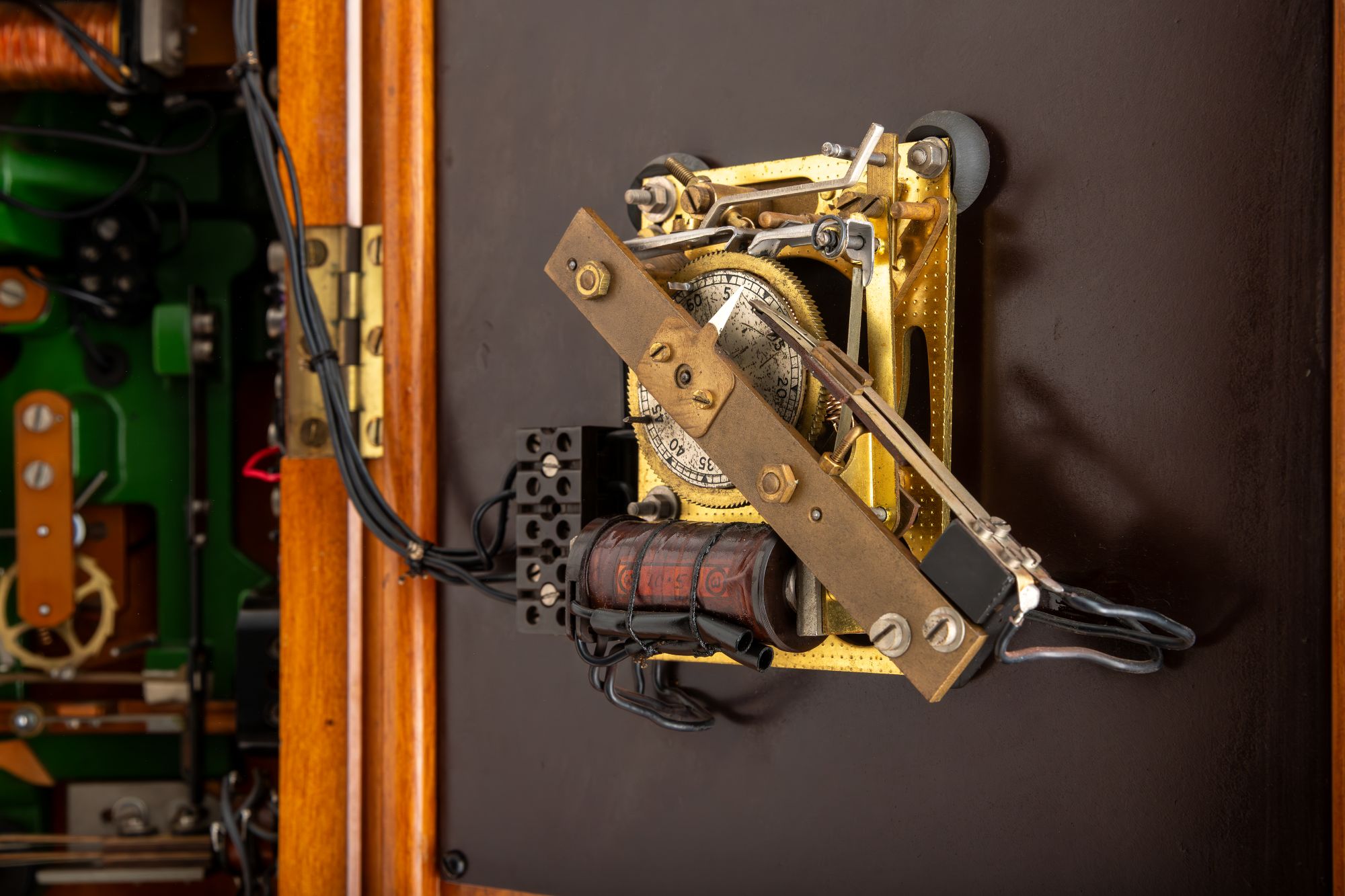
For much of the twentieth century, the Gent ‘C7’ was a fixture in British institutional buildings, thanks to its reliable electrically reset gravity escapement. This example was installed in the new BBC television centre in 1959. Like its fellows, it could control dozens of the corporation’s subsidiary dials. More unusually, it has been fitted with a ‘See-Saw’ synchroniser, which regulates the pendulum according to an internal BBC time signal – six identical tones broadcast internally every 15 minutes (like the hourly ‘Six Pips’, but without the lengthened last pip).
In depth
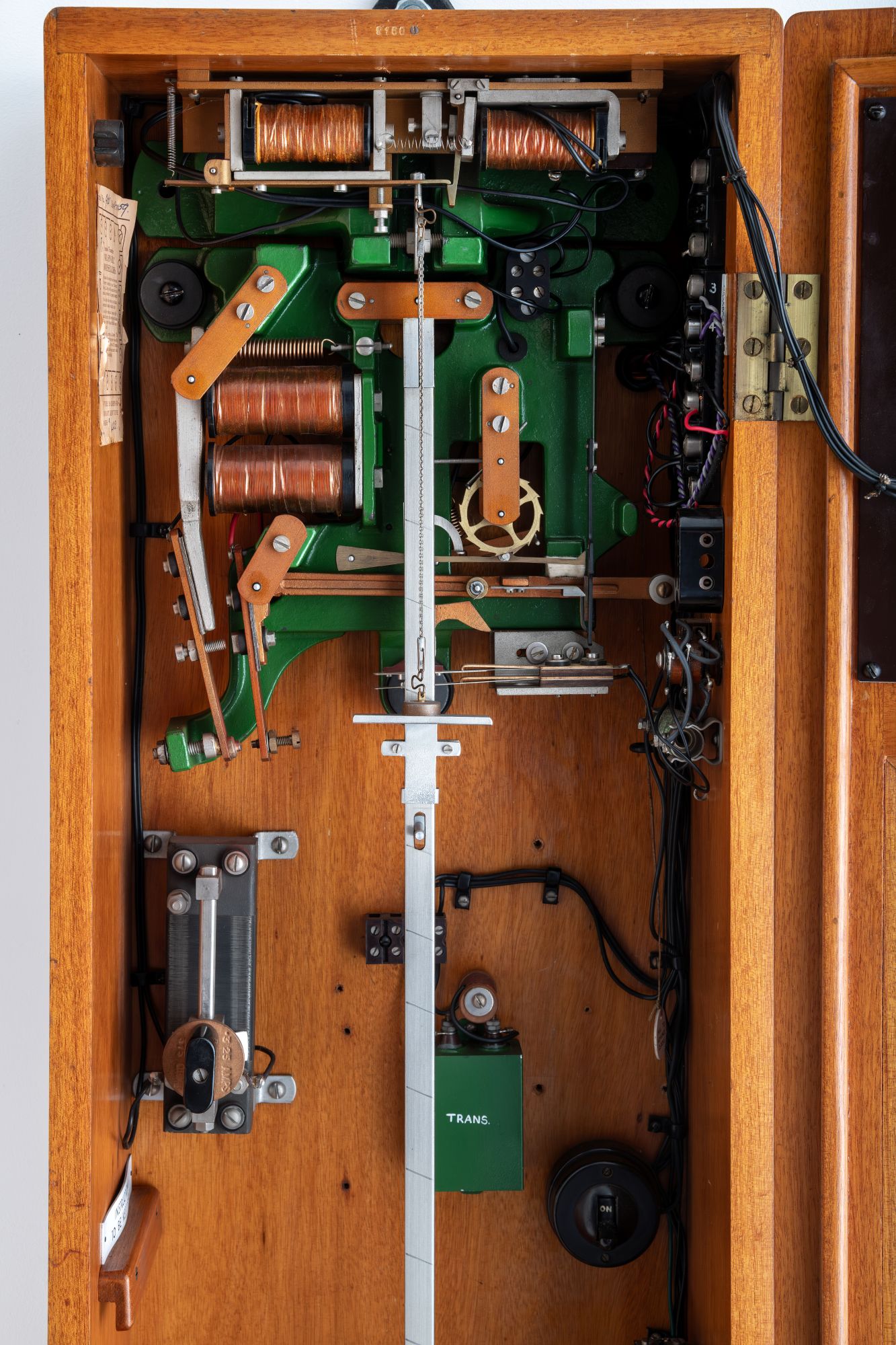
This is a model ‘C7’ controlling clock manufactured by Gent. First produced c.1908, the ‘C7’ became one of the Leicester-based company’s most enduring products. Its success resulted from the innovation of the electrically reset gravity escapement, originally patented in 1904 by Gent’s director Isaac Hardy Parsons (an electrical engineer) in partnership with clockmaker Alfred Ball. The pendulum is impulsed every thirty seconds by a gravity arm, carrying a roller that runs down an inclined plane on the pendulum. The gravity arm is released by the action of a count wheel, advanced by a pawl on the pendulum. At the end of its travel, the gravity arm closes electrical contacts which allow power to flow through the electromagnets which in turn reset the gravity arm in a latched position, ready for the next half-minute cycle. Marketed as ‘Gent’s Pulsynetic [sometimes ‘Pul-Syn-Etic’] System’, and along with the clocks produced by Gent's great rival, Synchronome, this was the first electrical gravity escapement to gain significant commercial traction, being both reliable and economical with current consumption. It was widely used until the 1960s in industrial and commercial settings, transmitting the time around a network of subsidiary dials, from boardrooms and offices to factory floors.
Though the ‘C7’ is already a reliable timekeeper, the accuracy of this clock has been enhanced through the addition of Gent’s so-called ‘See-Saw’ synchroniser, which uses rudimentary gate logic to raise or lower a weight on the pendulum to adjust its speed, in response to a time signal from an external source. This clock was originally installed in the new BBC Television Centre in Shepherd’s Bush in 1959; it was therefore synchronised to a BBC time signal consisting of six identical tones, transmitted each 15 minutes around studios and other key locations in the Corporation (very similar to the famous hourly ‘Six Pips’, but without the lengthened final 'pip'). It was presumably a member of BBC staff who stuck the Dymo tape label on this clock identifying it as ‘Master Clock No. 1’. The label implies the existence of at least one further controlling clock in the BBC offices (presumably immediately adjacent), and indeed, the Corporation’s clock network was extensive, synchronised accurate time being essential to successful scheduling.
Though the clock reflects the latest in mid-century electrical horology, its commercial use is clear from its agba case, which is typical of the type produced by Gent from the 1930s onwards – designed to be at once robust and self-effacing. Many Gent cases were designed by Hardy Parsons himself, who (in 1905) expressed exasperation at the public enthusiasm for ornate clocks: ‘[O]ne does not,’ he complained, ‘put a gas or electric meter in an elaborate case and give it a prominent position, therefore, my contention is, why should we the “Time Meter”[?]’. Though Gent did, in fact, often make concessions to popular design preferences – including in this case, whose square dial, rounded corners and warm varnish reflect contemporary tastes in furniture – Hardy Parsons’s attitude reflected a new consensus about the use and function of electrical clocks throughout the early twentieth century: these were above all precision instruments for commercial and industrial use, intended to do a particular job, and do it well. However, with the subsequent advance of other forms of timekeeping, notably cheap battery-operated wall clocks, this clock was apparently considered to have outlived its usefulness by the 1990s, at which point it was retired by the BBC and shortly afterwards purchased for The Clockworks.
Video
Inventory number
TCW 1020
Date
1959
Bibliography
Derek Bird, ‘The “Pulsynetic” System and its Place in the History of Electric Clocks: An Introductory Study’ (Wadhurst: The Antiquarian Horological Society, 1987)