
-
 Leroy Regulator, TCW 1026. Image available for non-commercial use via Creative Commons under a CC BY-NC 4.0 license. TCW_1026_01Download
 -
 Leroy Regulator, TCW 1026. Image available for non-commercial use via Creative Commons under a CC BY-NC 4.0 license. TCW_1026_07Download
 -
 Leroy Regulator, TCW 1026. Image available for non-commercial use via Creative Commons under a CC BY-NC 4.0 license. TCW_1026_08Download
 -
 Leroy Regulator, TCW 1026. Image available for non-commercial use via Creative Commons under a CC BY-NC 4.0 license. TCW_1026_12Download
 -
 Leroy Regulator, TCW 1026. Image available for non-commercial use via Creative Commons under a CC BY-NC 4.0 license. TCW_1026_14Download


-
 Leroy Regulator, TCW 1026. Image available for non-commercial use via Creative Commons under a CC BY-NC 4.0 license. TCW_1026_01
 -
 Leroy Regulator, TCW 1026. Image available for non-commercial use via Creative Commons under a CC BY-NC 4.0 license. TCW_1026_07
 -
 Leroy Regulator, TCW 1026. Image available for non-commercial use via Creative Commons under a CC BY-NC 4.0 license. TCW_1026_08
 -
 Leroy Regulator, TCW 1026. Image available for non-commercial use via Creative Commons under a CC BY-NC 4.0 license. TCW_1026_12
 -
 Leroy Regulator, TCW 1026. Image available for non-commercial use via Creative Commons under a CC BY-NC 4.0 license. TCW_1026_14
Creator
LeRoy & Cie.
Title
Astronomical Regulator no. 1403
Category
Inscriptions and markings
No. 1403 | L. Leroy & Cie. | 7. Bd. de la Madeleine | Paris. Separate unit: 'Chauvin & Arnoux | Paris | Breveté S.G.D.G.' and thermometer: 'THERMOMÈTRE AVERTISSEUR | BREVETÉ S.G.D.G. | RF'
Provenance
Commissioned by Lieb Harrison Dulles, 27 January 1930; by descent; with the Dulles collection of watches and clocks at Antiquorum, 23 October 1999 (lot 64), where purchased by William Scolnik, from whom purchased 2011.
Overview
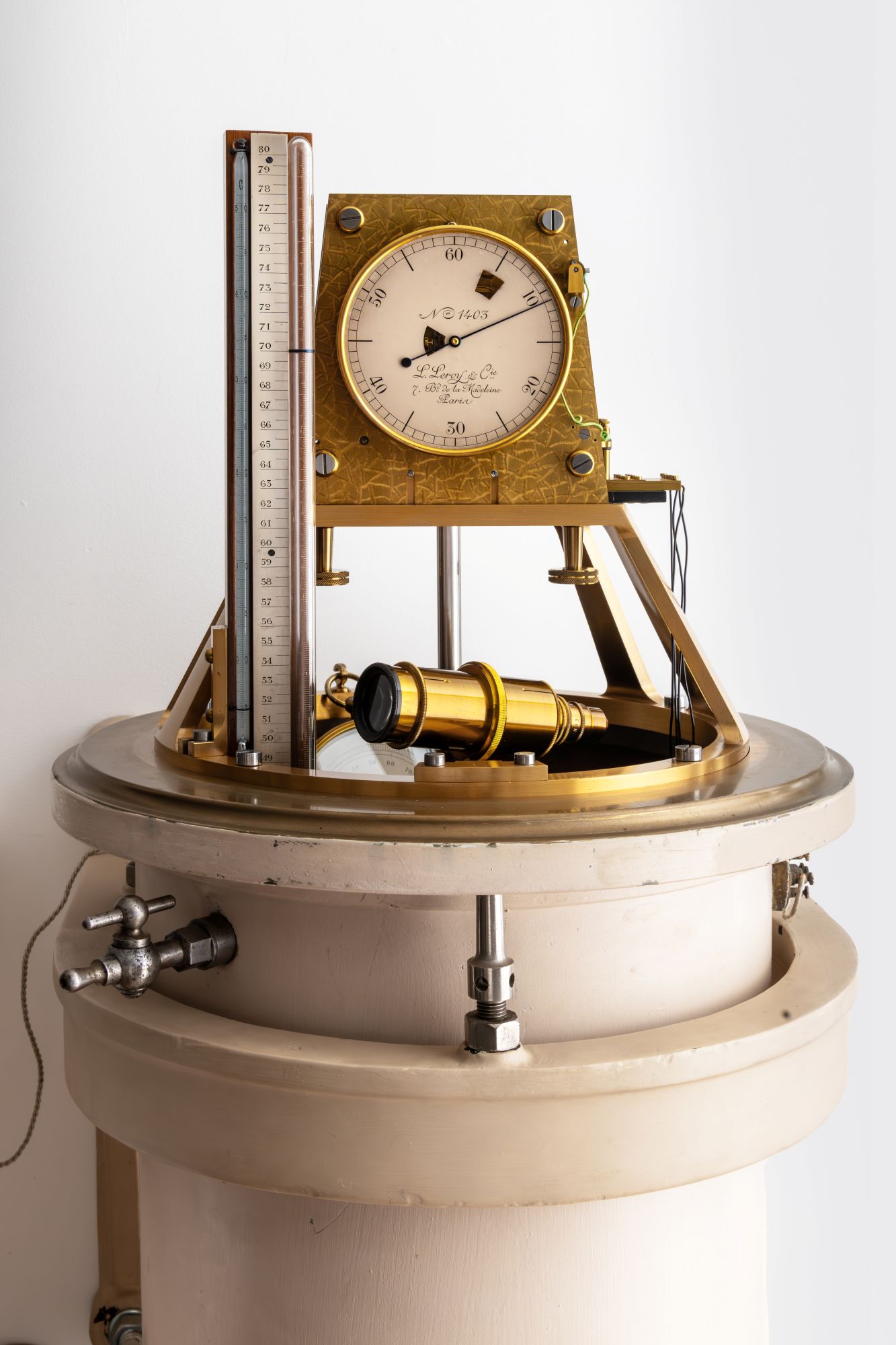
Leroy’s constant pressure regulator was described by its maker as a ‘paragon of precision’. The sophistication of the movement – its modified Reid-type escapement, Invar pendulum and electric remontoire isolated in a vacuum tank and bell jar – made this the French timekeeping standard. Though intended for observatories, this model was purchased in Paris by the American collector Leib Harrison Dulles, a millionaire with a personal passion for timekeepers. He paid 25,000 francs for it in 1930.
In depth
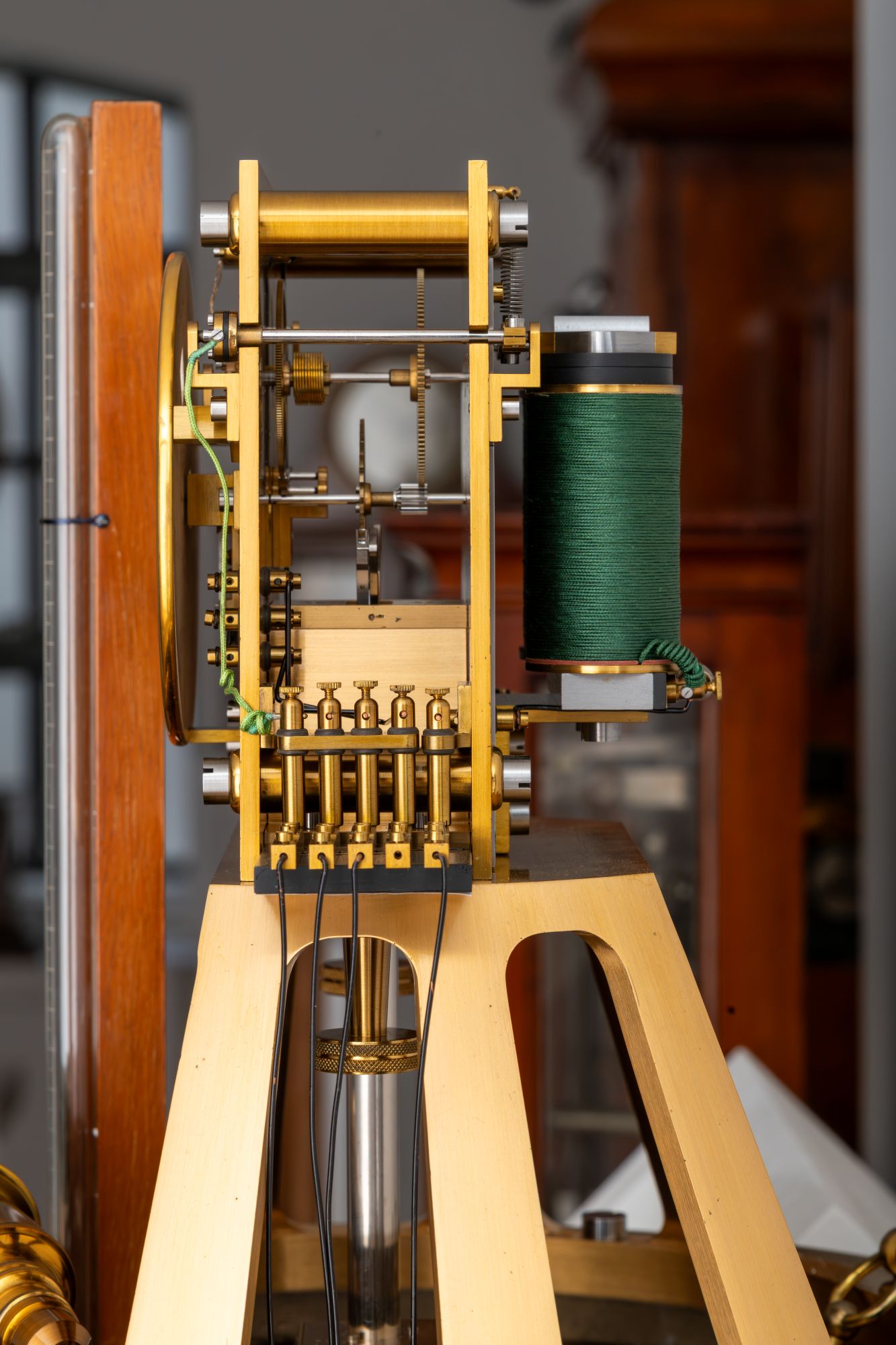
Based on the fashionable ‘grand boulevard’ de la Madeleine, the Paris firm of Leroy (founded in 1785) specialised in this model of constant pressure regulator, which its maker, P. Rudolf, proudly described as ‘a paragon of precision; the jewel of the workshop’. Enclosed in a bell jar and vacuum tank, these clocks were always intended for astronomical use, their precision partly the result of the modified Reid-type escapement, which acts on the pendulum directly, and partly the remontoire action, which activates a double electric contact, so that both circuits are closed momentarily with each oscillation of the Invar pendulum – except on the 61st swing, which marks the minute.
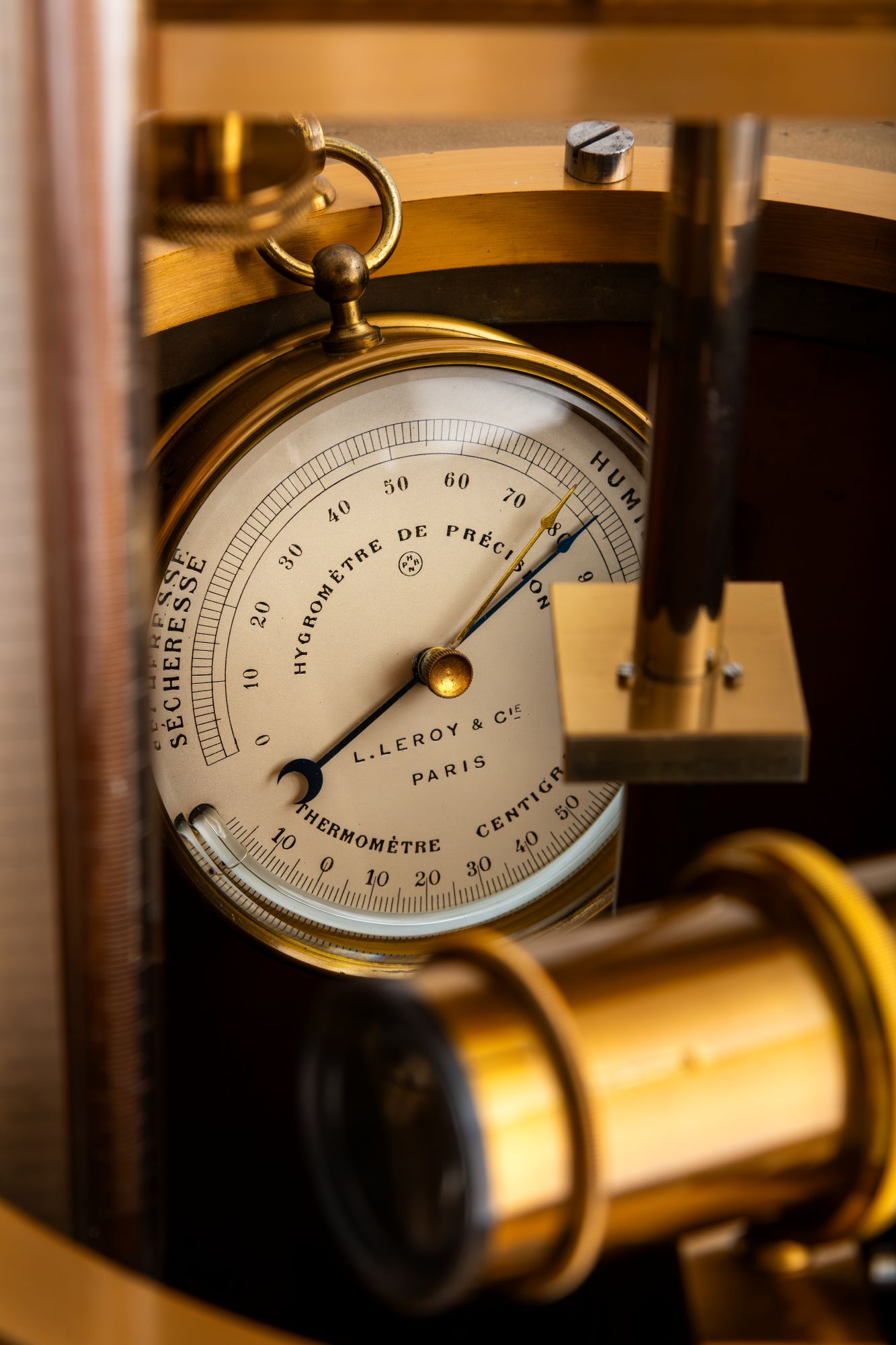
Despite the beauty of their workmanship, including elaborately damascened plates and typically thin French wheels, these clocks were designed to be sequestered deep underground, isolated from human interference as well as fluctuations in temperature and barometric pressure. Surviving records from Nice Observatory describe their two Leroy regulators sitting in cemented chambers, behind a chain of three insulated doors, more than 10 metres underground. From here, the clocks’ ‘thermometres-avertisseurs’ (‘warning thermometers’) would alert staff remotely to any significant ambient alteration.
The efficiency of the Leroy regulator quickly made it the French standard. From the cellars beneath the Paris Observatory (this time at a depth of 26 metres) three of these clocks serviced the radio time signals distributed from 1910, twice daily, from the Eiffel Tower by the Service de l’Heure – part of France’s (unsuccessful) attempt to wrest control of the international time standard from Greenwich. However, this particular clock – Leroy no. 1403 – was ultimately destined not for scientific use, but for the private apartment of Lieb Harrison Dulles (1899–1971) a wealthy American in Paris. Born in Philadelphia, Dulles had an established taste for precision timepieces; he was a regular customer at the prestigious firm of Breguet, a stone’s throw from Leroy & Cie on the Quai de l’horologe. Dulles paid a deposit of 10,000 francs for this clock on 27 January 1930, settling the balance of 15,000 francs on 8 August. It was delivered on 2 December (in line with Leroy’s standard manufacturing timescale – one year from order to completion).
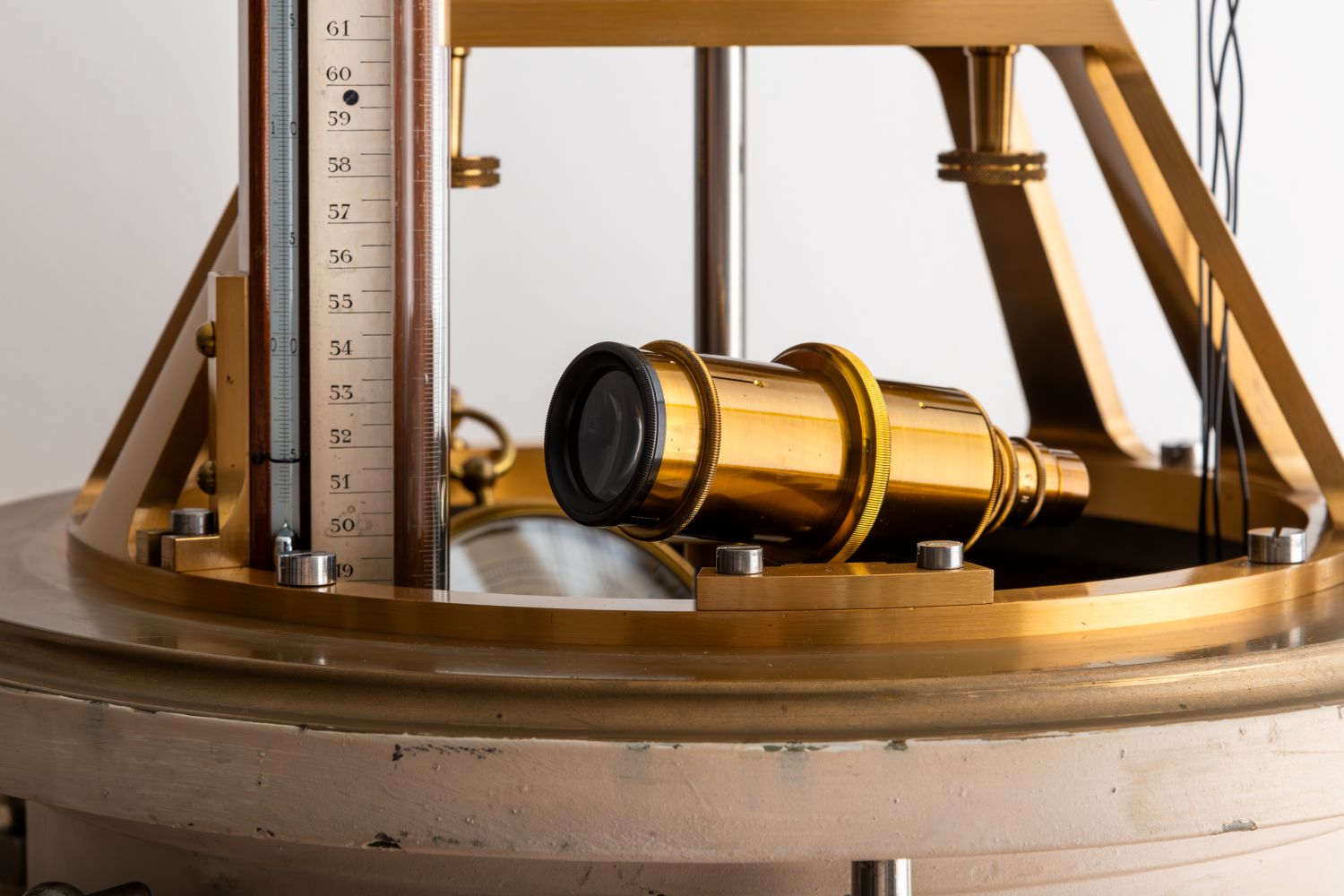
Number 1403 remained with the Dulles family until the 1990s, when it was sold to William Scolnik, a prominent collector of precision timepieces. It retains its original amplitude microscope, voltage control panel, temperature controlling thermometer, and thermometer signal, and is one of a group of clocks – primarily astronomical-grade regulators – to have entered The Clockworks from the Scolnik collection in 2011.
Dimensions
150 x 39 x 44 cm
Inventory number
TCW1026
Date
1930
Bibliography
Françoise Collanges, ‘Condition Report: Leroy constant pressure observatory precision regulator n.1403’, unpublished (copy at The Clockworks)
Françoise Le Guet Tully and Anthony Turner, ‘A Regulator for Nice Observatory in 1930’, Antiquarian Horology, 3:25 (March 2000), pp.297-302
L. Leroy, L’heure (Paris; Besançon: L. Leoy & Cie, s.d.)