
-
 ACHf3 Regulator, TCW 1011. Image available for non-commercial use via Creative Commons under a CC BY-NC 4.0 license. SC3_6811Download
 -
 ACHf3 Regulator, TCW 1011. Image available for non-commercial use via Creative Commons under a CC BY-NC 4.0 license. LP1_2955(1)Download
 -
 ACHf3 Regulator, TCW 1011. Image available for non-commercial use via Creative Commons under a CC BY-NC 4.0 license. LP1_3017Download
 -
 ACHf3 Regulator, TCW 1011. Image available for non-commercial use via Creative Commons under a CC BY-NC 4.0 license. LP1_3132_cropDownload
 -
 ACHf3 Regulator, TCW 1011. Image available for non-commercial use via Creative Commons under a CC BY-NC 4.0 license. SC3_6774Download


-
 ACHf3 Regulator, TCW 1011. Image available for non-commercial use via Creative Commons under a CC BY-NC 4.0 license. SC3_6811
 -
 ACHf3 Regulator, TCW 1011. Image available for non-commercial use via Creative Commons under a CC BY-NC 4.0 license. LP1_2955(1)
 -
 ACHf3 Regulator, TCW 1011. Image available for non-commercial use via Creative Commons under a CC BY-NC 4.0 license. LP1_3017
 -
 ACHf3 Regulator, TCW 1011. Image available for non-commercial use via Creative Commons under a CC BY-NC 4.0 license. LP1_3132_crop
 -
 ACHf3 Regulator, TCW 1011. Image available for non-commercial use via Creative Commons under a CC BY-NC 4.0 license. SC3_6774
Creator
Feodosii Fedchenko
Title
Astronomical Regulator Model AChF-3, No. 26, with subsidiary dial
Category
Inscriptions and markings
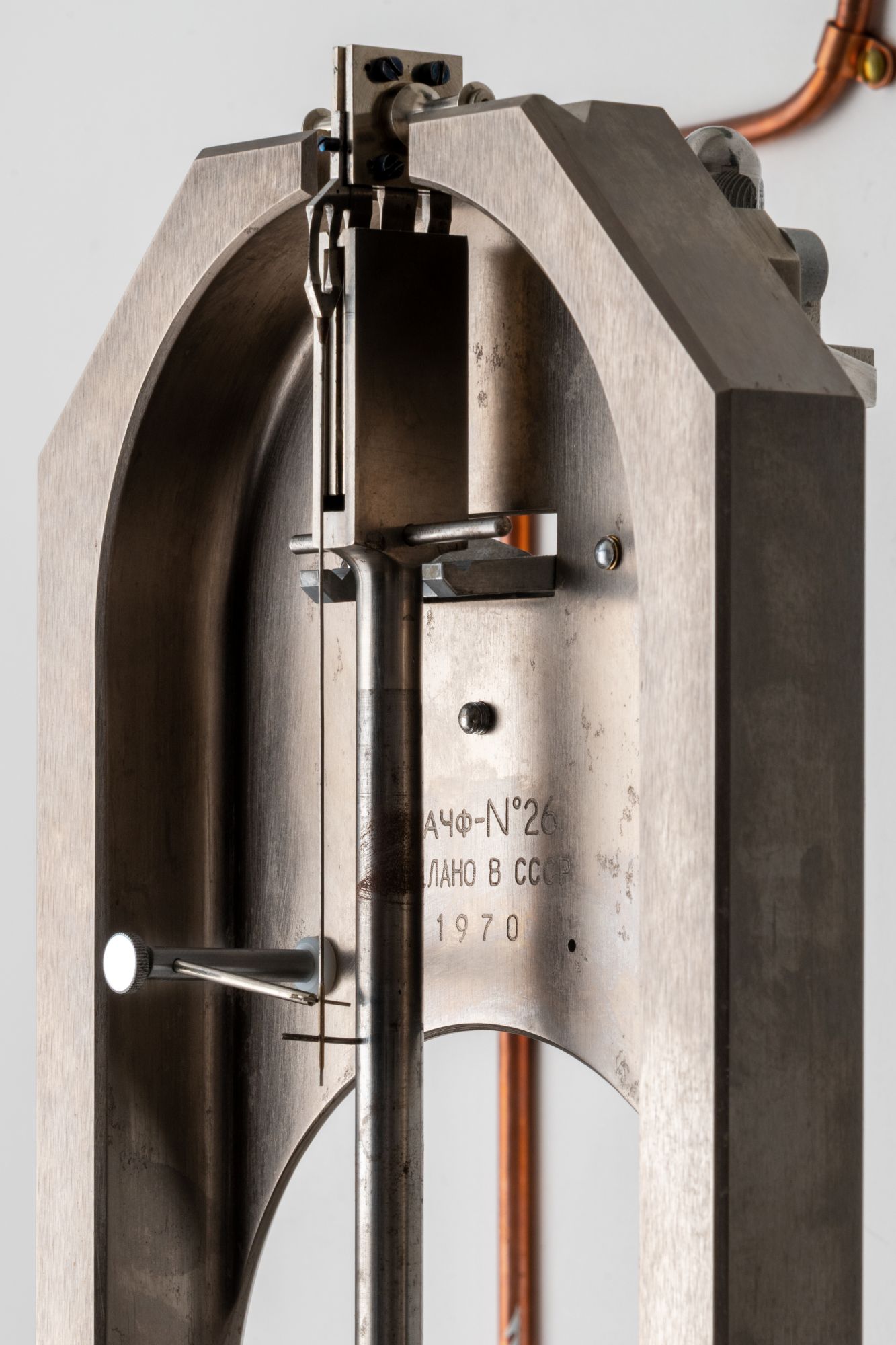
on plate: А4Ѳ-СДЕЛАНО ВСССР | 1970 On subsidiary dial: ЗНИИѲТИ
Provenance
With the Obninsk Institute for Nuclear Power Engineering; decommissioned 1997, and acquired by Kirill Romanov; purchased from Romanov in 2001.
Overview
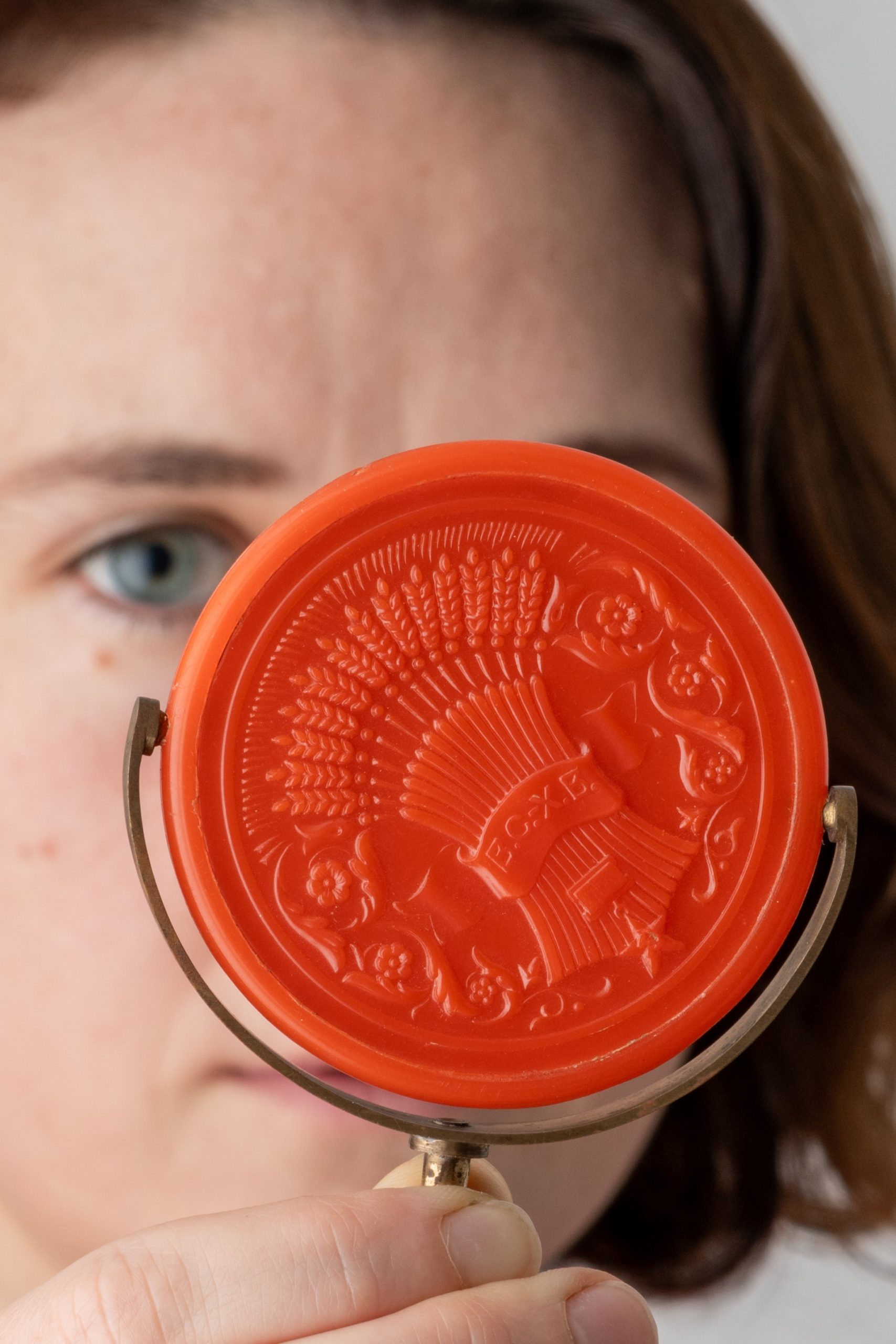
In 1955, behind the Iron Curtain, Feodosii Fedchenko created the world’s most accurate pendulum clock, the ‘AChF-3’. This example was bought by the Obninsk Institute for Nuclear Power Engineering, where, at some point, the small mirror (used for illuminating the pendulum beat-scale) was broken. The clock retains the makeshift replacement: a powder compact badged by the Exhibition of Achievements of the National Economy (VDNKh). This national trade fair was a grand celebration of the Soviet passion for technological innovation – much like the AChF-3 itself.
In depth
This is one of two precision tank clocks in the collection at The Clockworks made to a 1958 design by Feodosii Fedchenko, then working in the Time Laboratory of the Kharkov State Institute of Measures and Measuring Instruments. A model ‘AChF3’, it boasts precision in the range of quartz clocks – an extraordinary achievement for a pendulum clock – but was largely unknown in the world beyond the Soviet Union until the 1990s.
Soviet scientists had been following international developments in pendulum technology since the beginning of the twentieth century, recognising the need for a robust and reliable timekeeper that would function in the country’s most inhospitable regions. Experimentation on home soil stepped up after communication between the Soviet Union and the West was effectively severed in 1939 – incidentally also blocking Soviet access to information about developing quartz and atomic technology, both of which had superseded pendulum clocks by midcentury.
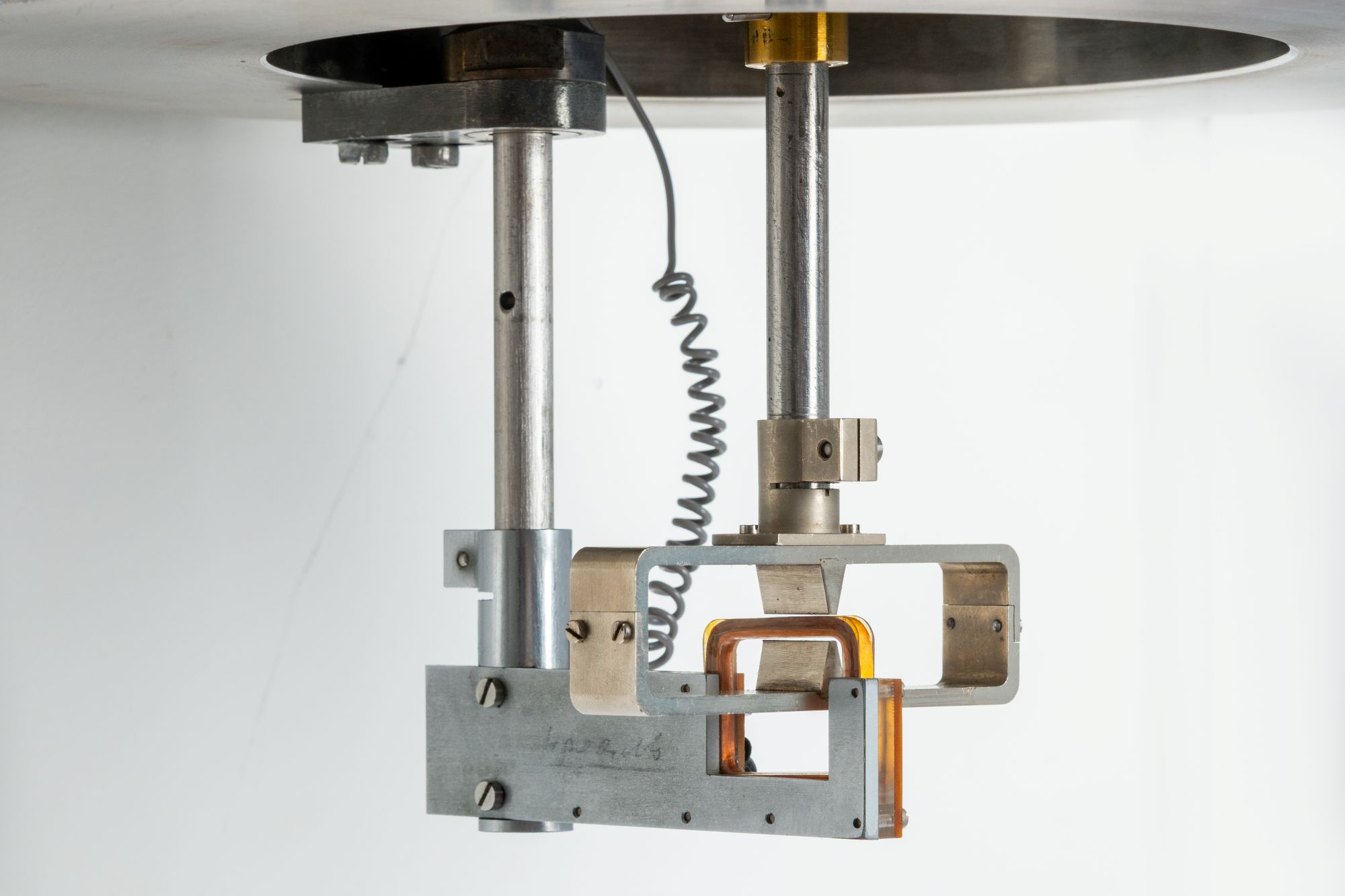
Fedchenko’s movement acts electromagnetically on the pendulum, delivering a precisely timed impulse at the midpoint of its arc to maintain amplitude with minimal disturbance, and correct for circular error. This is effected through a permanent magnet fixed at the base of the Invar pendulum, which passes through two coils on the same former – one is a sense coil; the other a drive coil. As the pendulum swings through the midpoint, the magnet induces a small voltage in the sense coil; this pulse is fed into the drive coil, creating a magnetic field which interacts with the pendulum’s magnet. It is an effective innovation, but Fedchenko’s early experiments on these principles were disappointing until he accidentally left the centre spring of the pendulum’s suspension under slight tension. In so doing, he discovered he had made the suspension tuneable and isochronous, meaning the period of the pendulum remained constant even if the arc of the swing changed. The clock he designed to these specifications runs on a small battery, keeps time to within a few thousandth of a second per day, and was widely used in Soviet observatories, broadcasting centres and transport networks from the 1950s.
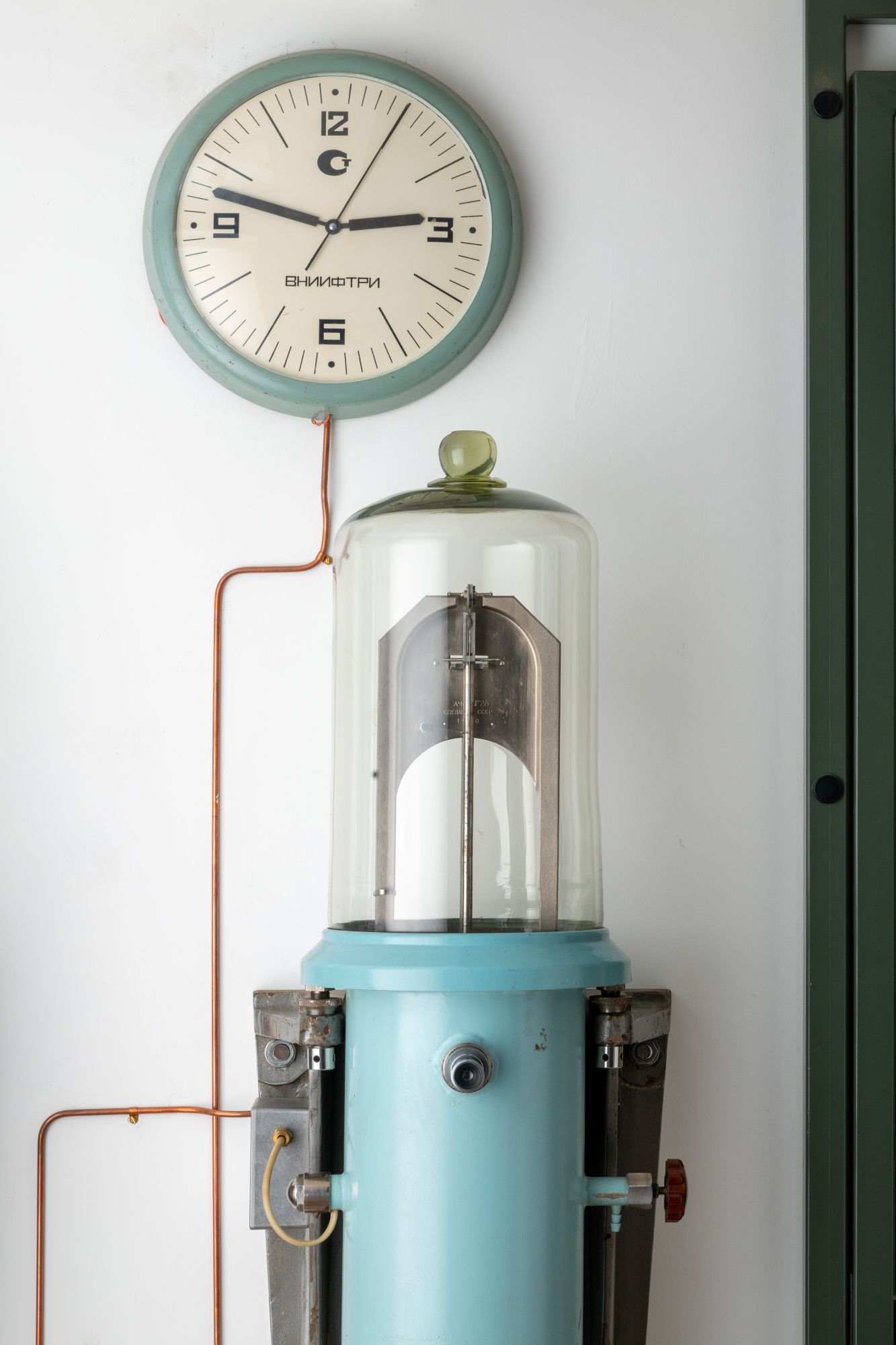
This clock is numbered and dated on the plate – number 26, made in 1970. This identifies it as one of the later models of AChF-3, likely to have been made in production line conditions (as opposed to The Clockworks’s other AChF-3, number 10, which was probably produced under Fedchenko’s personal supervision). It is in a light blue tank, with blown glass bell jar to the top and sealed glass dome to the bottom. Number 27 was supplied to the Obninsk Institute for Nuclear Power Engineering (later the Institute of Physics and Power Engineering), which had begun as a branch of the Moscow Engineering and Physics Institute to provide specialists for the USSR’s growing nuclear industry. Obninsk ultimately led the development of the world’s first nuclear power plant for large-scale production of electricity (1954), and doubled as a training base for the crew of the K3 Leninsky Komsoml, the Soviet Union’s first nuclear submarine. The Institute’s AChF3 would have provided a stable timebase for experimentation at a time when (in the words of Paul Josephson) ‘high hopes existed for the power of the atom’: the Soviet Union’s most powerful clock, and its most prestigious industry working in tandem.
This clock was retired from use in 1997 and purchased from Kirill Romanov in 2002. Its subsidiary dial has standard, rather than regulator presentation, and may not be original to the clock. Another later addition is the small adjustable mirror, intended to help illuminate the pendulum scale; this is not the original scientific instrument, but an orange plastic-backed compact mirror decorated on the reverse with a moulded wheatsheaf emblem and the motto ‘VDNH’ (ВДНХ). This was the acronym used by the Exhibition of Achievements of National Economy, a trade show and amusement park that opened in Moscow in 1939, and exemplified the Soviet passion for technology, much like the ACHF3 itself.
Born to a peasant family in Kiev, Feodosii Fedchenko originally taught school Physics and Maths, before going to work at the Institute of Measurements and Measurement in 1946. He began experiments with the concept of the free pendulum in 1949, and received a certificate of recognition for the isochronous pendulum on 18 March 1955. He died in Mandeleev in 1989.
Video
Dimensions
Subsidiary dial: 36 circumference x 6cm
Inventory number
TCW 1011
Date
1970
Bibliography
George Feinstein, F. M. Fedchenko and his Pendulum Astronomical Clocks, NAWCC Bulletin, April 1995
Kenneth James, ‘Precision Pendulum Clocks – Circular Error and the Suspension Spring’, Antiquarian Horology (September 1974), pp.868-883
Paul R. Josephson, ‘“Projects of the Century” in Soviet History: Large-scale technologies from Lenin to Gorbachev’, Technology and Culture (July 1995), 35:3 (July 1995), 519-559
Leslie Paton, ‘The Fedchenko Isochronous Pendulum Suspension’, The Antiquarian Horological Society, EHG Paper No. 55
Myron Pleasure, ‘The Fedchenko Clock’, Horological Journal, September 1973, pp.3-5
Eglé Rindzevičiūté, ‘Nuclear Power as cultural heritage in Russia’, Slavic Review, Winter 2021, 80:4, pp.839-862
Sonja D. Schmid, ‘Celebrating Tomorrow Today: The Peaceful Atom on Display in the Soviet Union’, Social Studies of Science, 363 (June 2006), 331-365