


Creator
Jefferson Electric Company
Title
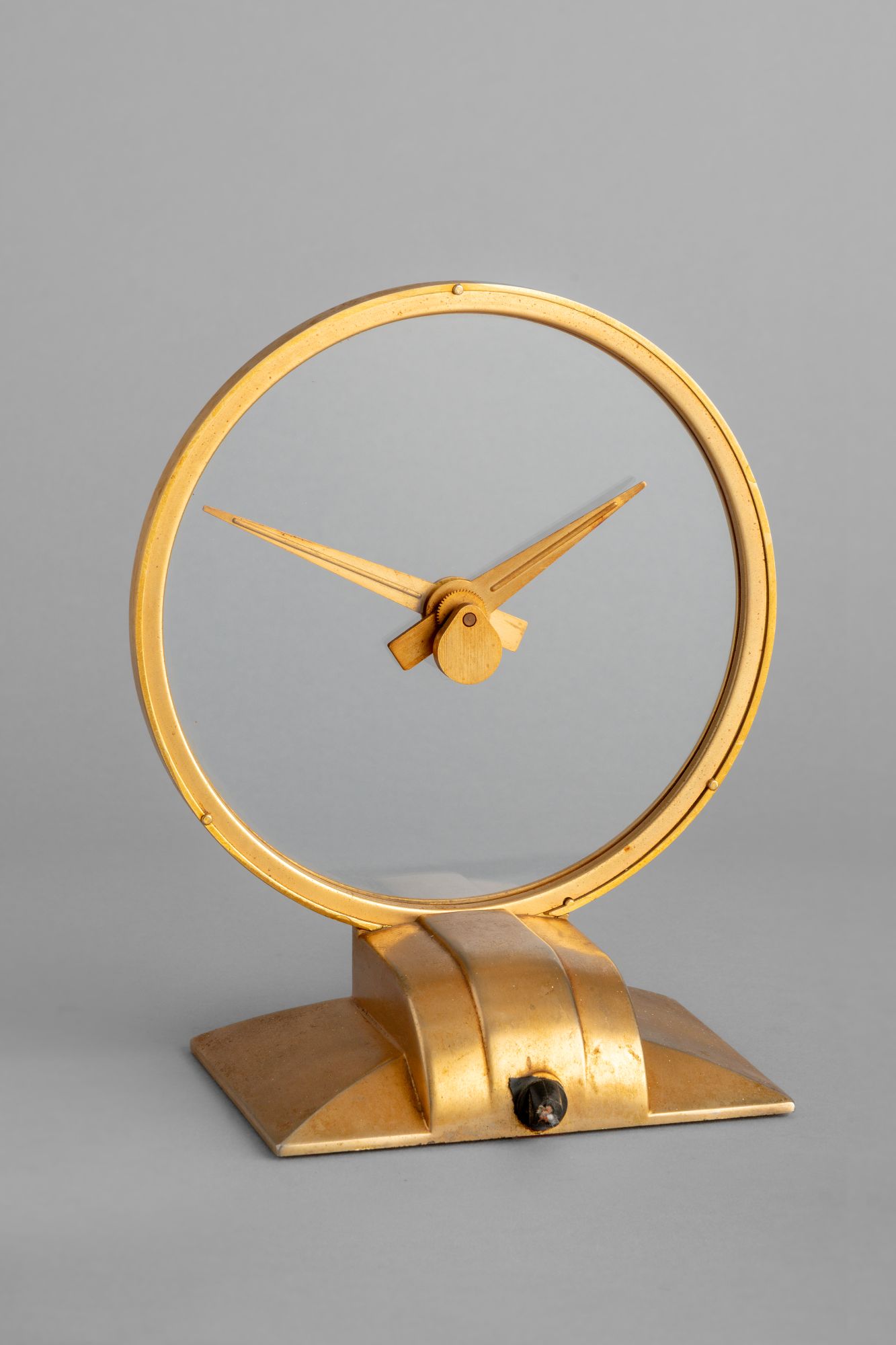
'Golden Hour' mystery clock
Category
Inscriptions and markings
On base: 'Jefferson | Golden Hour | electric clock | JEFFERSON ELECTRIC COMPANY BELLWOOD, ILLINOU | 115 V.A.C. 60 CY ONLY 2.5 WATTS | AT. NO. 580-101 | PATENT PENDING. Date on inside - 10.11.51
Overview
Manufactured by the Jefferson Electrical Company between 1949 and 1991, the ‘Golden Hour’ was one of the USA’s most popular midmarket clocks. It exploited the increasing availability of domestic mains power: a synchronous motor in the base translated the regular cycle of mains frequency to the equally regular movement of the hands. Synchronous clocks were very easy to run and maintain, but the true appeal of this one lay in the mystery of the hands. They seem to float free of any gearing. What makes them turn?*
*The glass dial is both the problem, and the solution; it rotates completely (but barely perceptibly) over the course of each hour, taking the hands with it.
In depth
Manufactured by the Jefferson Electrical Company of Bellwood, Illinois, the ‘Golden Hour’ was one of the most successful ‘mystery clock’ designs of the early twentieth century. Around 2 million were sold between 1949 and 1991, over which period the design remained virtually unchanged.
The clock was explicitly pitched (according to an advert in Time Magazine) at ‘upper-bracket families […] thinking about new and distinctive gifts for Mother’s Day and this year’s June brides’, but Jefferson Golden Hours soon became ubiquitous: during the 1950s, they were offered as giveaways to farmers and gas station owners by the Pfister Feed Company and the Plastone Company of Chicago, respectively.
The Clockworks clock is dated in the base to 10 November 1951, and in common with all earlier models has ‘Patent Pending’ stamped on the maroon base plate. The patent in question was not Jefferson’s own; it was purchased from the Etalage Reclame Corporation of New York (2,248,195), who had possibly themselves adapted the ‘Dutch Secret’ clock made by the Nederandsche Uuwerkfabrieken (NUFA).
The principle is extremely simple, and yet effective: the minute hand is moved by the regular, but invisible, rotation of the glass, while the hour hand is driven by a weighted mechanism behind it. The clock runs on a synchronous motor in the base, geared down to 1/6 rpm with a cut brass gear on the output shaft. The dial is circular glass cemented into a large peripheral sheet-metal ring with gear teeth that mesh into the motor drive gear, turning the dial at one revolution per hour. Both the ring and base are made of a zinc alloy, plated with 24k gold. In common with most Golden Hour clocks produced before the mid-1960s, this clock has radium paint on the numerals and markers of the ring and lines on the hands.
Jefferson Electric was founded in 1915, with John A. Benan as President. The company made a wide range of electrical products; the ‘Golden Hour’ was their first clock, and entered production in December 1949. The clock division closed in 1991.
Dimensions
22.5 x 19 x 12 cm
Inventory number
TCW 3022
Date
1951
Bibliography
Roger Russell, Jefferson Electric Clocks http://www.roger-russell.com/jeffers/jeffers.htm [accessed 2.12.25]
Roger Russell, ‘Etalage and Rex Cole: Mystery Clocks’, NAWCC Bulletin, 340 (October 2002), pp.571-76
Roger Russell, ‘The “Dutch Secret” and Jefferson Electric Clock History’, NAWCC Bulletin, 352 (October 2004), pp.600
Mel Kaye, ‘The Haddon “Sun Dial” Mystery Clock’, NAWCC Bulletin, 369 (August 2007), p.441
Mel Kaye, ‘A “Mystery Clock” for the Space Age’, NAWCC Bulletin, 292 (October 1994), pp.627-8