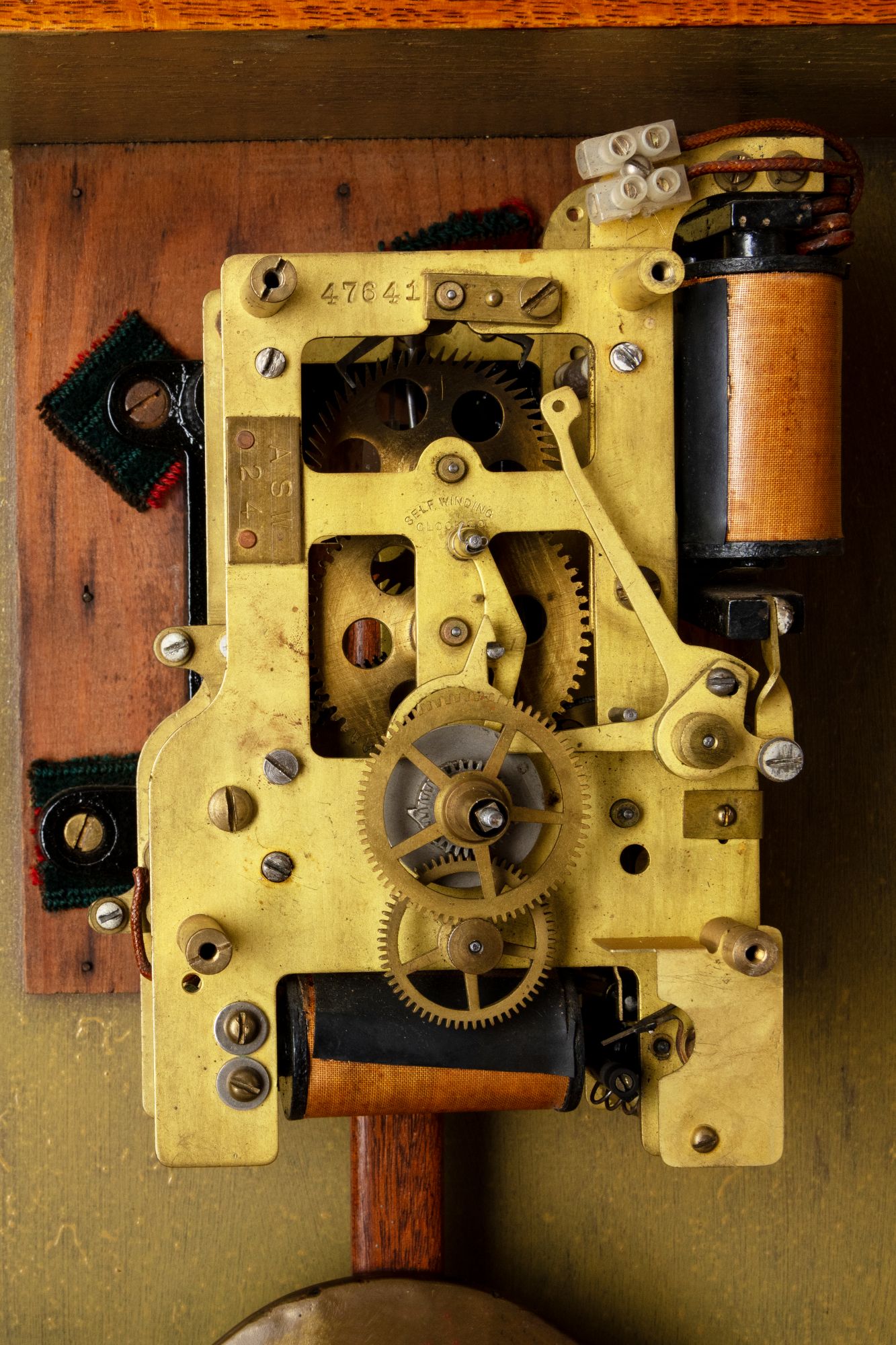
On plate: serial number 47641; ‘SELF WINDING CLOCK COMPANY’; ‘ASW 24’. On base of case: 10 (left) 12 OHM F ½ (right)
Provenance
Installed in the traction substation at Mill Hill Park (now Acton Town), when it was built in 1904; withdrawn in 1982, and acquired by David Burton, from whom purchased in 2020.
Overview
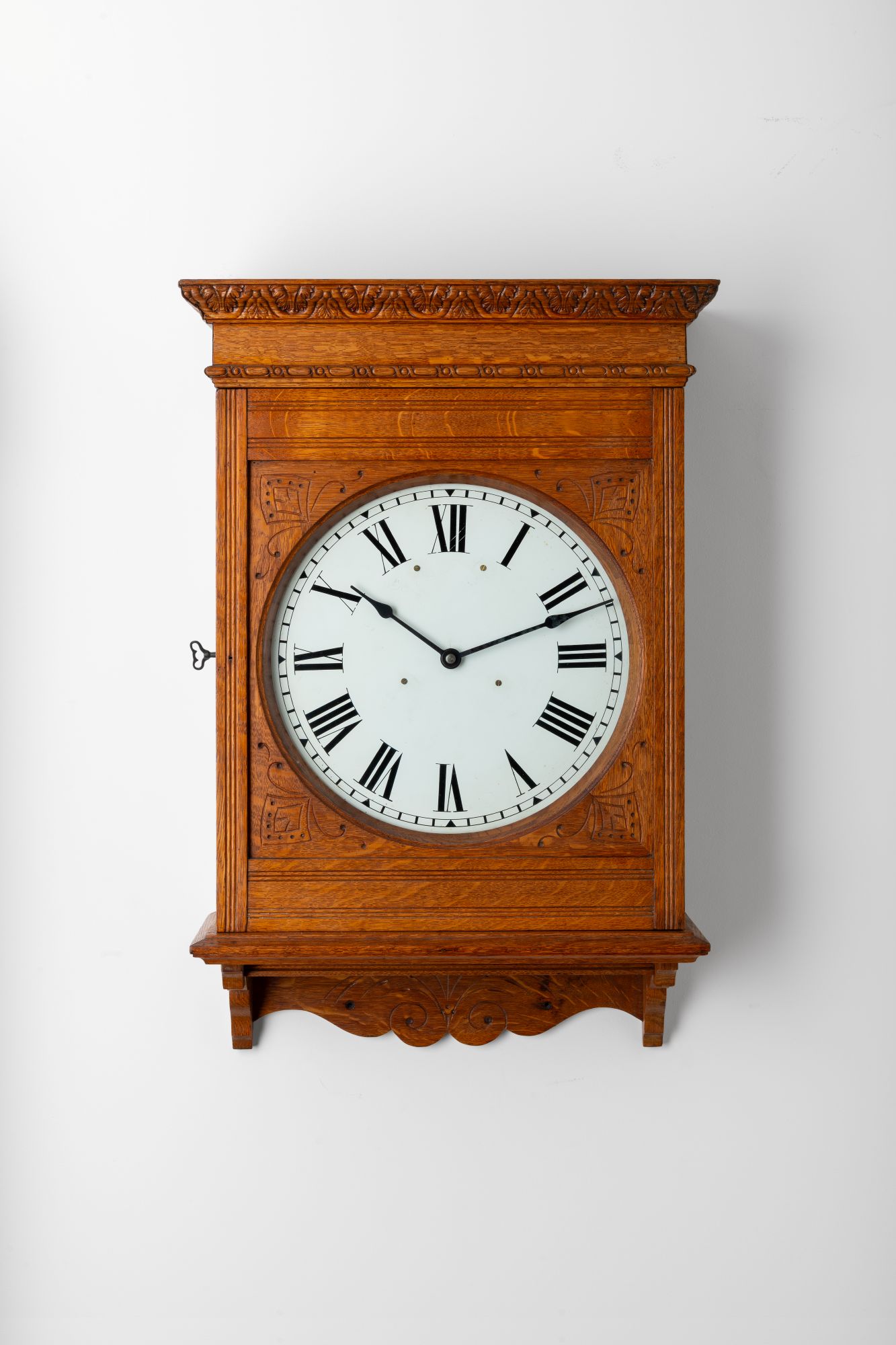
This clock was made in New York and installed on the London Underground by American tycoon Charles Tyson Yerkes, who bought the early District, Bakerloo, Piccadilly and Northern Lines and had them electrified. The clock rewinds itself once an hour and can also be synchronised, reducing the need for staff maintenance. Around 600 of these clocks were installed on the Underground; some remain in service today. This one spent most of its life at Acton Town, on the District and Piccadilly Lines.
In depth
This clock spent much of its life at Acton Town, on the London Underground’s District and Piccadilly Lines. It was made by the Self Winding Clock Company, and is in their standard ‘model 10’ wooden case, with a pedimented top and engraved dial surround.
For the first 70 years of its operation, the London Underground was operated by a hodgepodge of private companies, and its early clock systems were similarly varied in origin. The Self Winding Clock Company was based in New York, and their clocks were installed on the Underground on the initiative of the American tycoon Charles Tyson Yerkes, who had worked on railway electrification in Chicago and bought London’s District Line in 1901. After founding the ‘Underground Electric Railways Company of London’, Yerkes went on to purchase what would become the Bakerloo, Piccadilly and Northern Lines. He installed American engineers and American clocks on the London system: the ‘self-winding’ mechanism had been patented in 1884 by another American, Henry Pond, and was common in US railway and tram systems. Ultimately, around 600 of these timekeepers were used across the London Underground network. Some are still in service.
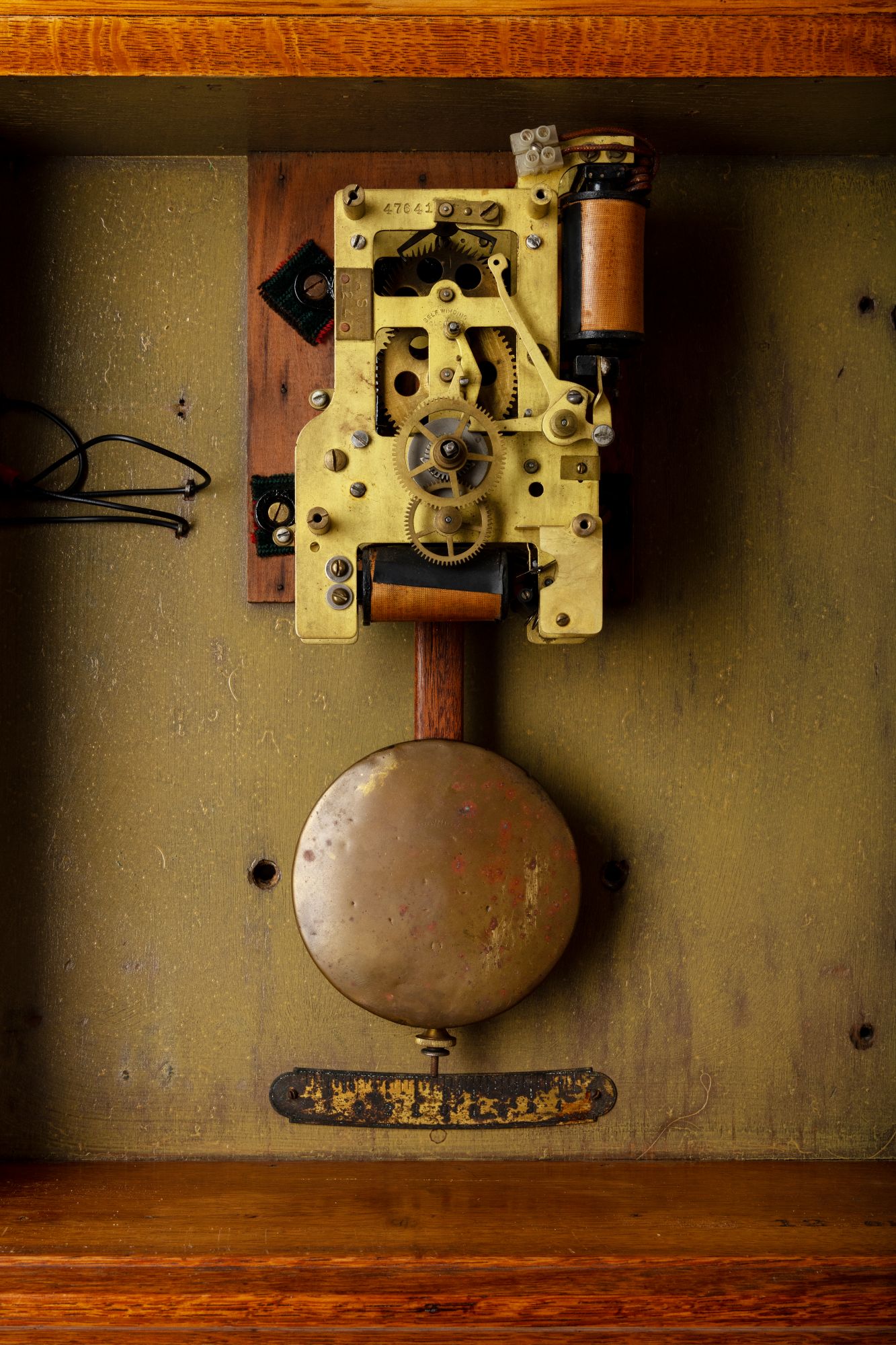
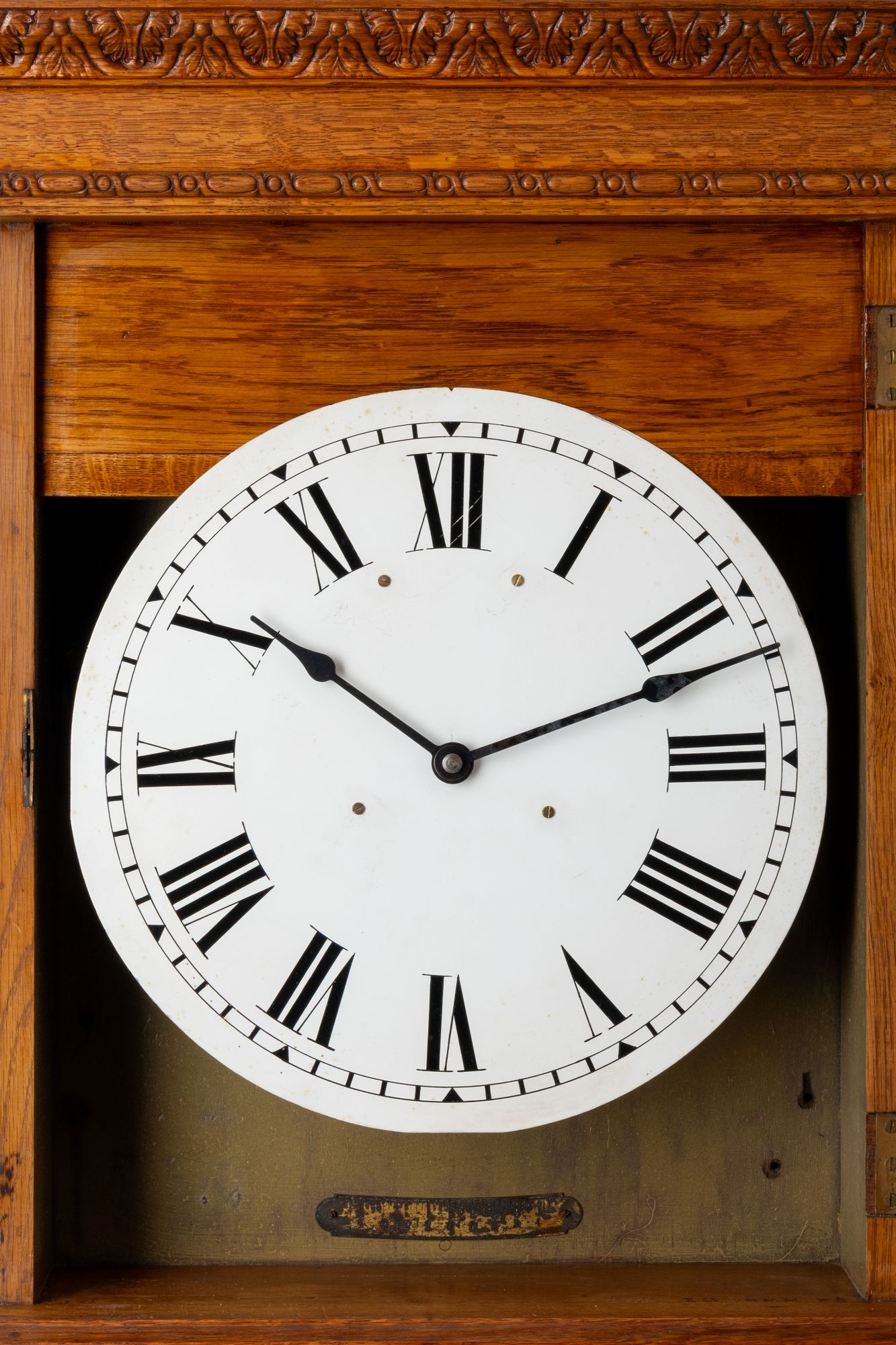
The serial number on this plate identifies it as the clock installed in the traction substation of Mill Hill Park (now Acton Town) when it opened in 1904, in preparation for District Line electrification (completed 1 July 1905). The 14-inch white painted dial conceals a half-seconds pendulum with a wooden rod and lenticular bob, and a deadbeat escapement; a brass beat scale is mounted onto the back of the case. The movement is the Self Winding Clock Company’s ‘Type F’; a conventional time train with a battery-powered winding mechanism at the bottom and a coil mounted at the right. This coil allowed the clock to be remotely synchronised by a controlling clock each hour, if required. In either case, the self-winding mechanism is activated once an hour by a gathering pin on the main wheel arbor, which collects a cam, making an electrical contact with the winding solenoid. This rewinds the mainspring by a small amount via a ratchet wheel, and in turn de-energises the solenoid and remakes the first contact, fully winding the mainspring. The cam’s rotation continues with the train’s unwinding, closing the main contact again after an hour.
Though the movement and case are consistent, the clock itself is likely to be a marriage; London Underground clocks were frequently separated from their cases during regular servicing (latterly centralised), and this movement has been mounted on an additional piece of wood to create better ‘depthing’ with the case it is in. In between the mount and the plate, four spacers have been inserted – either to help with fitting, or perhaps to dampen the sound of the rewind movement – which appear to be made of London Underground ‘moquette’ fabric in green and red stripes, apparently identical to the fabric used to refurbish the 1938 tube stock in 1977 (see London Transport Museum 2004/9841). The dial pan has also been replaced: as supplied, it would have been zinc, with lead-based paint, which did not prove particularly durable.
Dimensions
80 x 52 x 19 cm
Inventory number
TCW 1042
Date
c.1905
Bibliography
J. Alan Bloore, ‘The Self Winding Clock Company and the Ubiquitous Style “F” Vibrator Movement: Tracing its Development from the Rotary Movement’, NAWCC Watch & Clock Bulletin, 397 (May-June 2012), pp.250-62
J. Alan Bloore, ‘The ABCs of the Self Winding Clock Company’s Rotary Movement’, NAWCC Watch & Clock Bulletin, 400 (November – December 2012), pp.597-608
David J. Boullin, ‘The Clocks of the London Underground – Part I’, NAWCC Watch & Clock Bulletin, 56:4, 410 (July- August 2014), pp.348-364
David J. Bouillon, ‘The Clocks of the London Underground – Part II’, NAWCC Watch & Clock Bulletin, 56:5, 411 (September – October 2014), pp.462-488
David Burton, ‘Timekeeping on the London Underground’, NAWCC Watch & Clock Bulletin, 41:4, 321 (August 1999), pp.455-468
David Burton, ‘The Electric Clock Systems of London Underground’, EHG lecture, Antiquarian Horological Society, Science Museum Library, South Kensington, 14 November 1992.