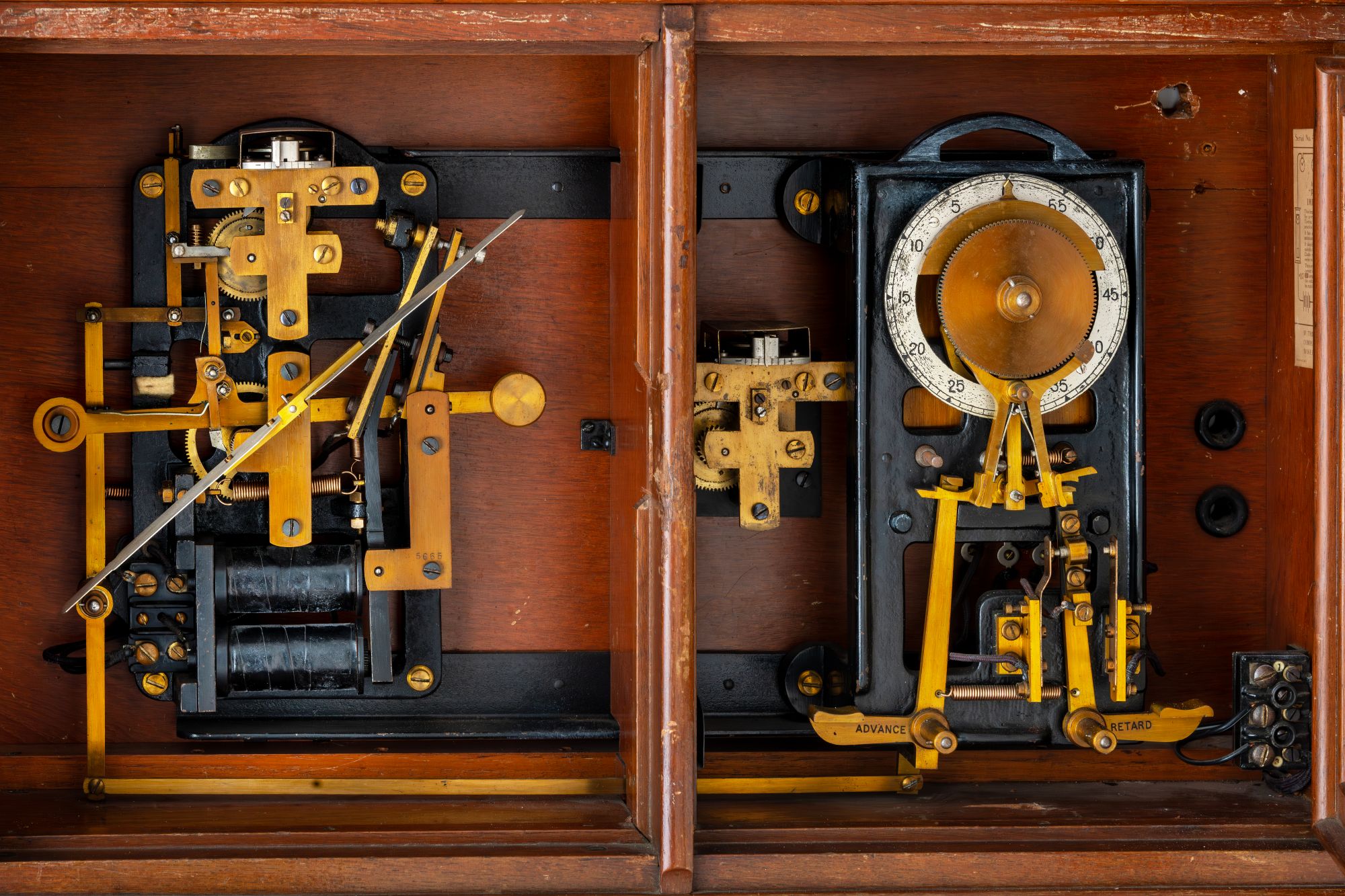
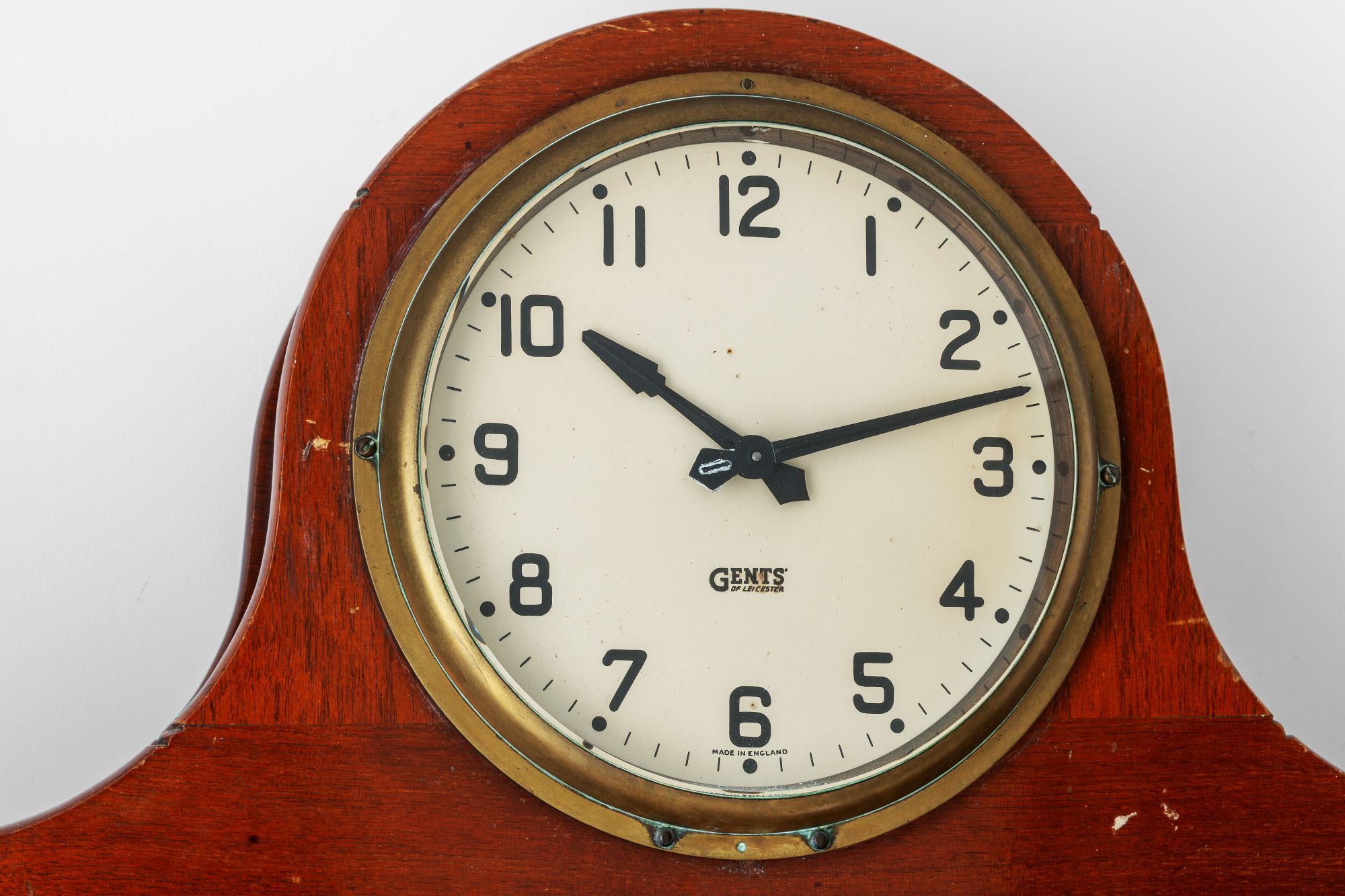
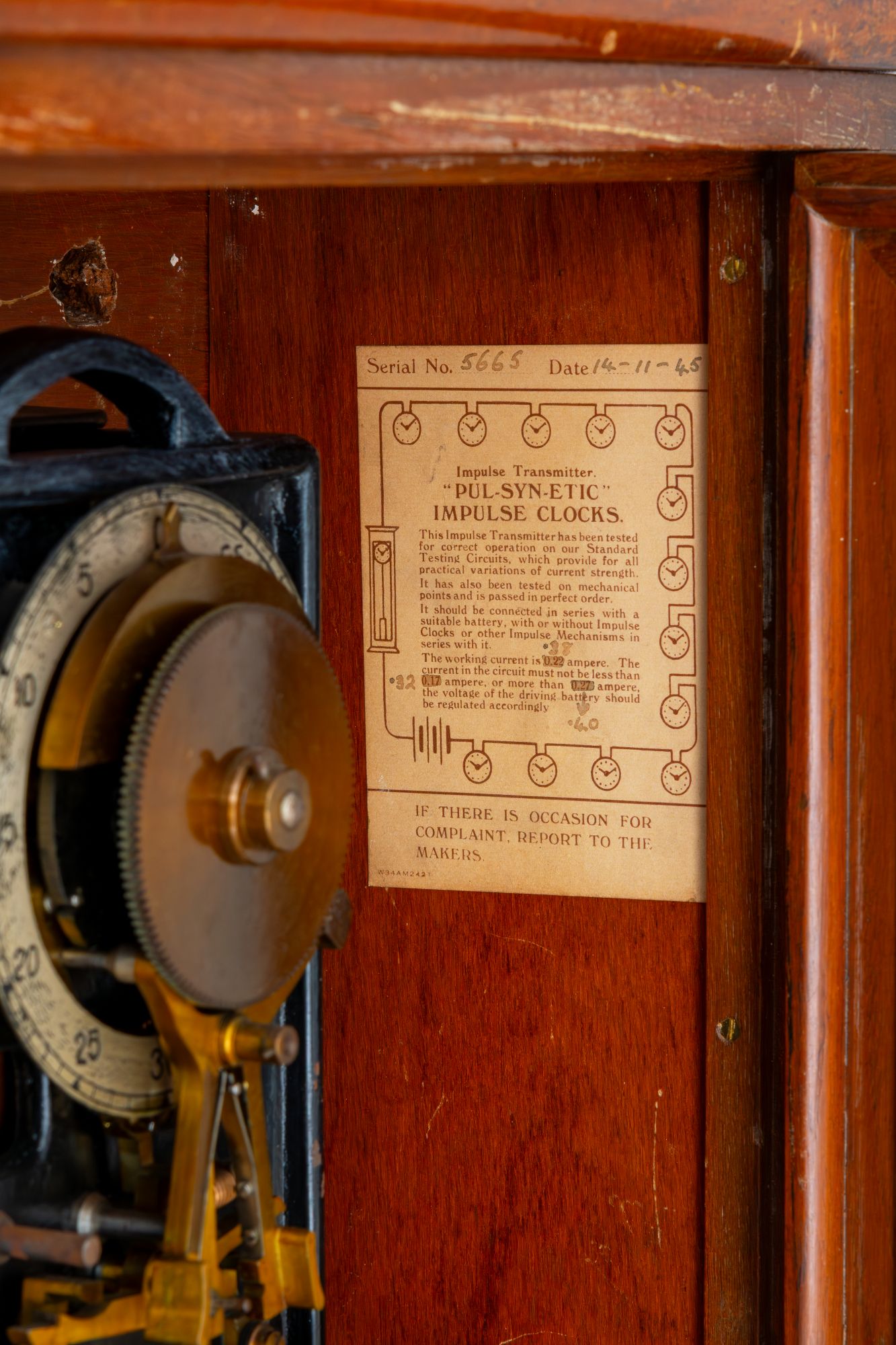
On dial: GENTS | OF LEICESTER. Plaque in case: 'TO ADVANCE OR RETARD THE CLOCKS | SET THE INDICATOR TO THE NUMBER OF MINUTES REQUIRED AND PRESS DOWN THE APPROPRIATE LEVER. | THE PUL-SYN-ETIC PATENT MARINE TIME TRANSMITTER. Printed note pasted inside case, with serial number 5665 and date 14.11.45.
Provenance
Purchased on eBay, April 2004.
Overview
This marine impulse transmitter can synchronise large numbers of ship’s clocks, at a time when transatlantic ocean liners were competing to offer passengers every modern comfort. The movement (on the left) uses a balance, rather than a pendulum, but incorporates much the same electrically reset gravity escapement found in landlocked Gent clocks. On the right, an advance / retard mechanism allowed the operator to move the clocks forward or back as the ship travelled through time zones.
In depth
This clock was designed for the radio room of an ocean-going ship, to advance the hands on a network of subsidiary clocks. It comprises a marine transmitter with half-minute impulse mechanism and jewelled lever escapement. The design is similar to the ‘Pulsynetic’ system Gent pioneered on land, but is governed by a platform escapement with balance (on the left). An ‘advance’ and ‘retard’ mechanism (on the right) allowed the operator to change all the clocks as the ship travelled east to west, or west to east, through time zones. A spare platform escapement is screwed to the back of the case for ease of maintenance at sea. The glazed two-door hardwood case is secured by lock and key, and surmounted with a 9-inch silvered pilot dial with gun metal surround.
By the end of the nineteenth century, developments in steamship technology had reduced the average speed of transatlantic crossing from 18 days to 5. A new era of ocean liners dawned, and with it a new market for reliable marine clock systems. Gent were among the most successful (along with Mercer, Magneta and Synchronome) and boasted that they had supplied clock systems to Cunard, the White Star Line and Royal Mail ships.
Though reliable, this system was never designed for precision timekeeping – that was the job of the navigational chronometer – but rather to keep the ship’s community of travellers synchronised over the course of their voyage. This example is dated in the case to 14 November 1945, which places it around the midpoint of Gent’s marine clock production, which ran from the 1920s until the 1970s.
Technical description
The transmitter advances all the clocks in its network by a half minute at a time, running on 0.38 amp current in simple series. If the ship’s clocks are to be advanced, the time is dialled up on the advance mechanism. When the ‘advance’ key is depressed, a balance brake is applied to the platform balance, and simultaneously a series of impulses are sent. The advance mechanism ticks down by a half minute for each impulse, and when they have all been sent, the balance brake is removed and the platform escapement is restarted.
A similar procedure is adopted for retarding the clocks, although the balance brake is not applied: instead, all the clocks are taken out of the circuit. The master mechanism continues as normal, and the advance/retard mechanism once again ticks down the amount of time dialled up. At the end of the desired period, the ship is put back into circuit and the clocks begin advancing as normal.
Video
Dimensions
63 x 69 x 20 cm
Inventory number
TCW 1017
Date
1945
Bibliography
Danile Finamore and Ghislaine Wood, Ocean Liners: Glamour, Speed and Style (London: V&A Publishing 2017)
Gent, ‘Pulsynetic impulse Clocks, Marine type: Hints for Users’ (Leicester: Gent & Co. Ltd., 1929)
Gent, ‘“Pul-syn-etic” System of Electric Impulse Clocks – Marine Type for Ships’, Book 5, Section 3 (September 1930)
Stuart F. Philpott, Modern Electric Clocks: Principles, Construction, Installation, and Maintenance (London: Sir Isaac Pitman & Sons, 1949)
Robert A. Simon, ‘The Marine Master Clock’, NAWCC Bulletin, no. 373 (April 2008)