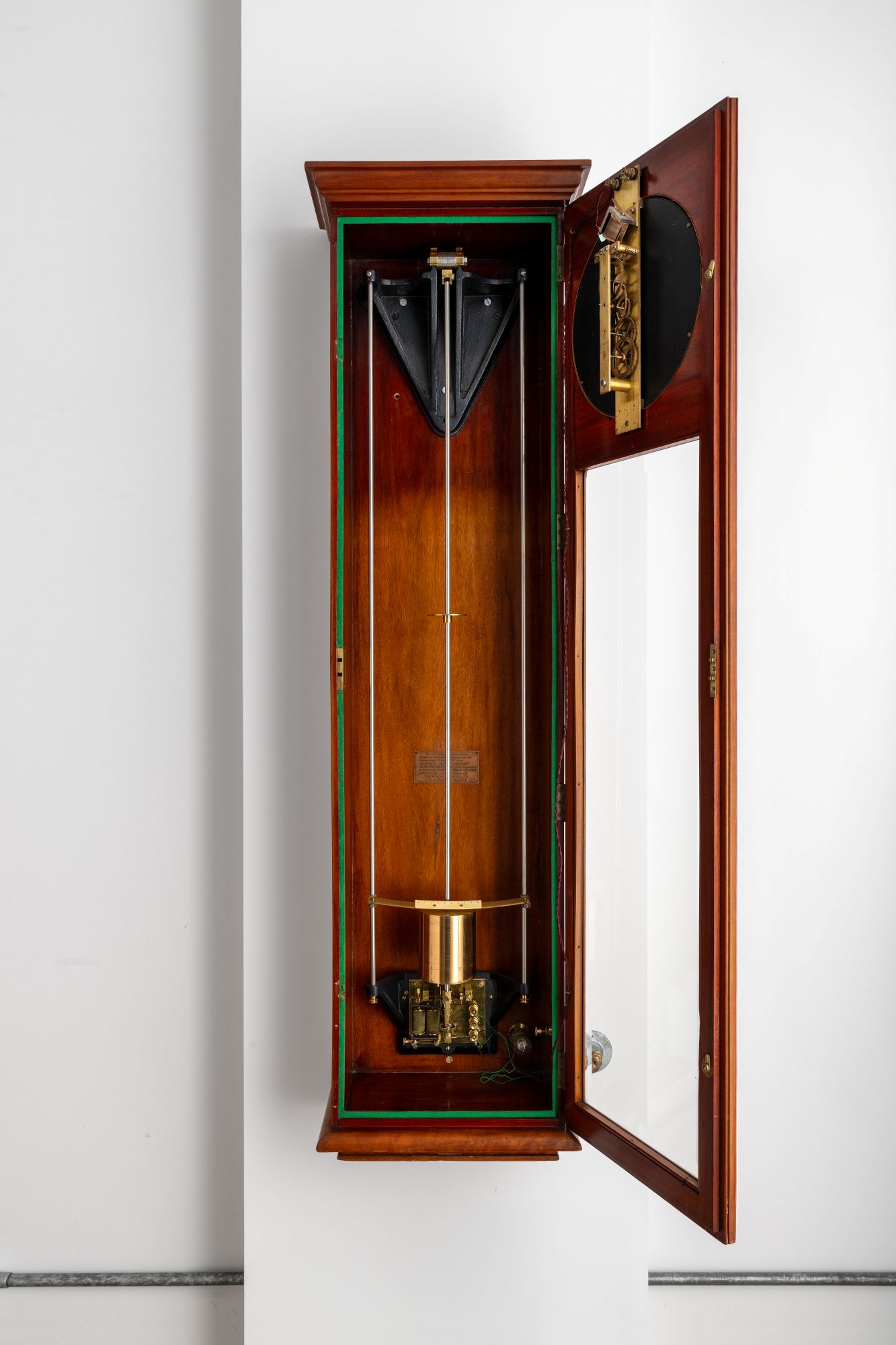
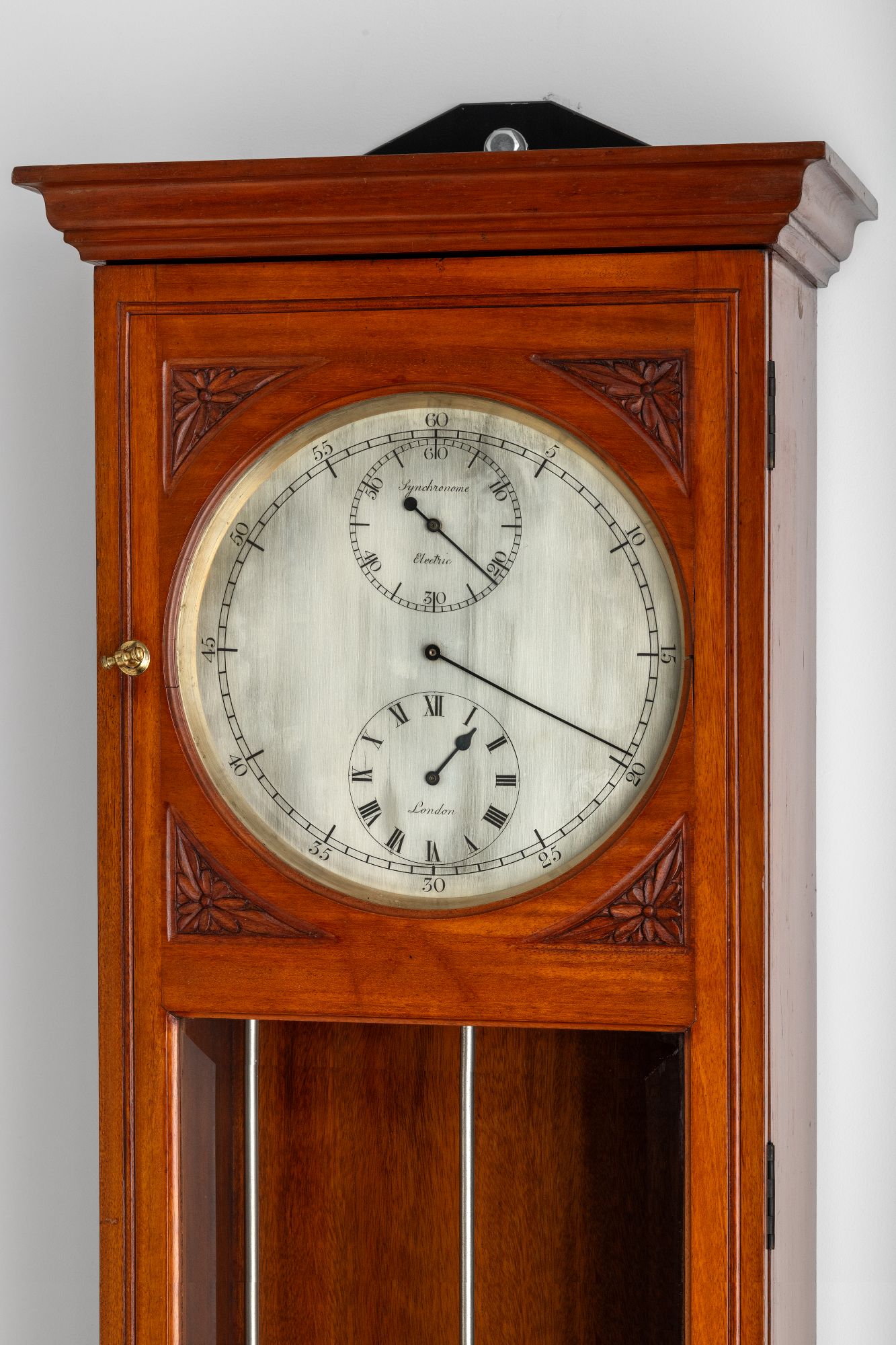
Synchronome | Electric | London. Plaque in back of case reads: 'The current rate in this circuit should be maintained between the following limits, .04 amp. & .043 amp. observed by means of a milliameter. NO ADJUSTMENTS (apart from Regulation of the Pendulum) SHOULD BE ATTEMPTED without direct correspondence with THE SYNCHRONOME CO. LTS. 32 & 34 Clerkenwell Road E. C.'
Provenance
William Scolnik collection
Overview
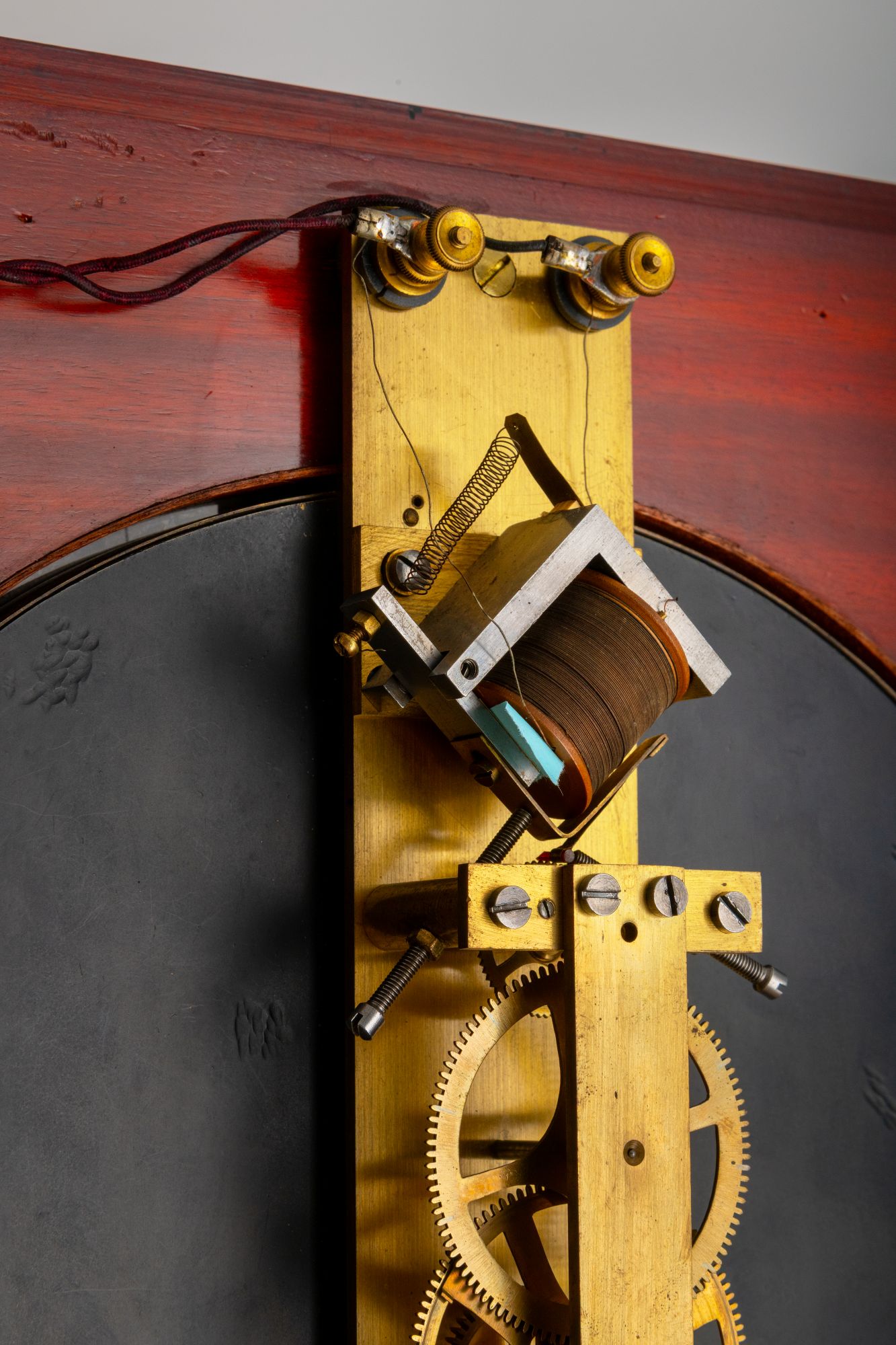
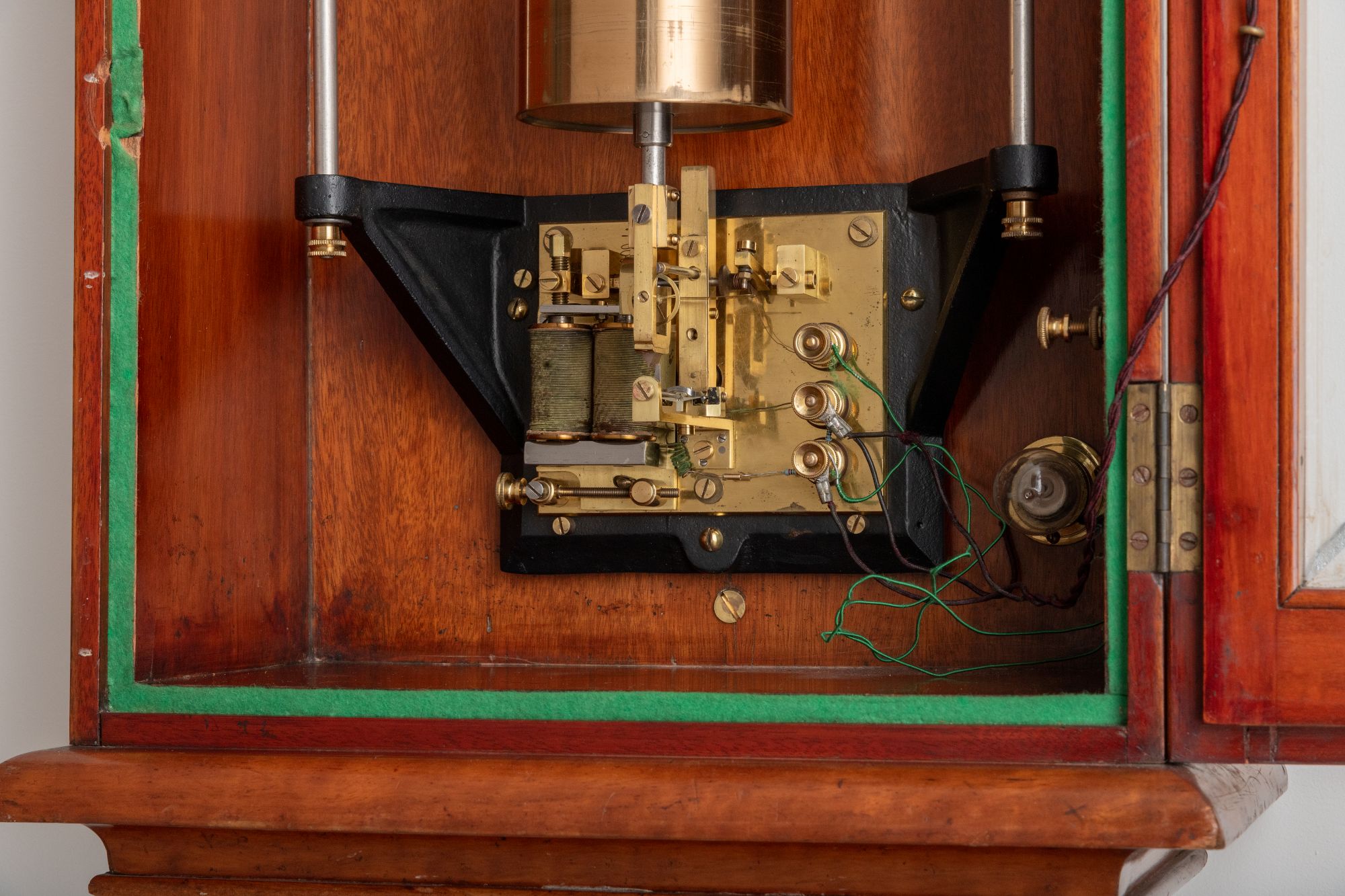
This experimental observatory regulator was made by William Hamilton Shortt and the Synchronome Company c.1913, and is one of a series of experimental clocks produced during the research process that would ultimately result in the ‘Free Pendulum’ of 1921 (see TCW 1073). It is described in the second part of a patent from 22 May 1911 (the first covering the ‘Inertia Bar’ escapement, TCW 1065). The movement is mounted on two Invar rods, so that temperature changes do not cause it to move relative to the bottom end of the pendulum, and the maintaining impulse on the pendulum is delivered from below, with the impulse delivered through a small wheel mounted onto the pendulum itself.
Though Shortt would go onto apply several of the principles used here – notably the wheel on the pendulum – in his successful ‘Free Pendulum’, the timekeeping results from this clock were disappointing compared with the standard Synchronome design, and it was ultimately abandoned. Only four examples are known to have survived.
Dimensions
145 x 21 x 40 cm
Inventory number
TCW 1072
Date
1913
Bibliography
Robert Miles, Synchronome: Masters of Electrical Timekeeping (Ticehurst: Antiquarian Horological Society), pp.155-7
Tabea Rude, ‘The inertia escapement – William Hamilton Shortt’s first step towards the free pendulum’, Antiquarian Horology, 38:1 (March 2007), pp.61-73