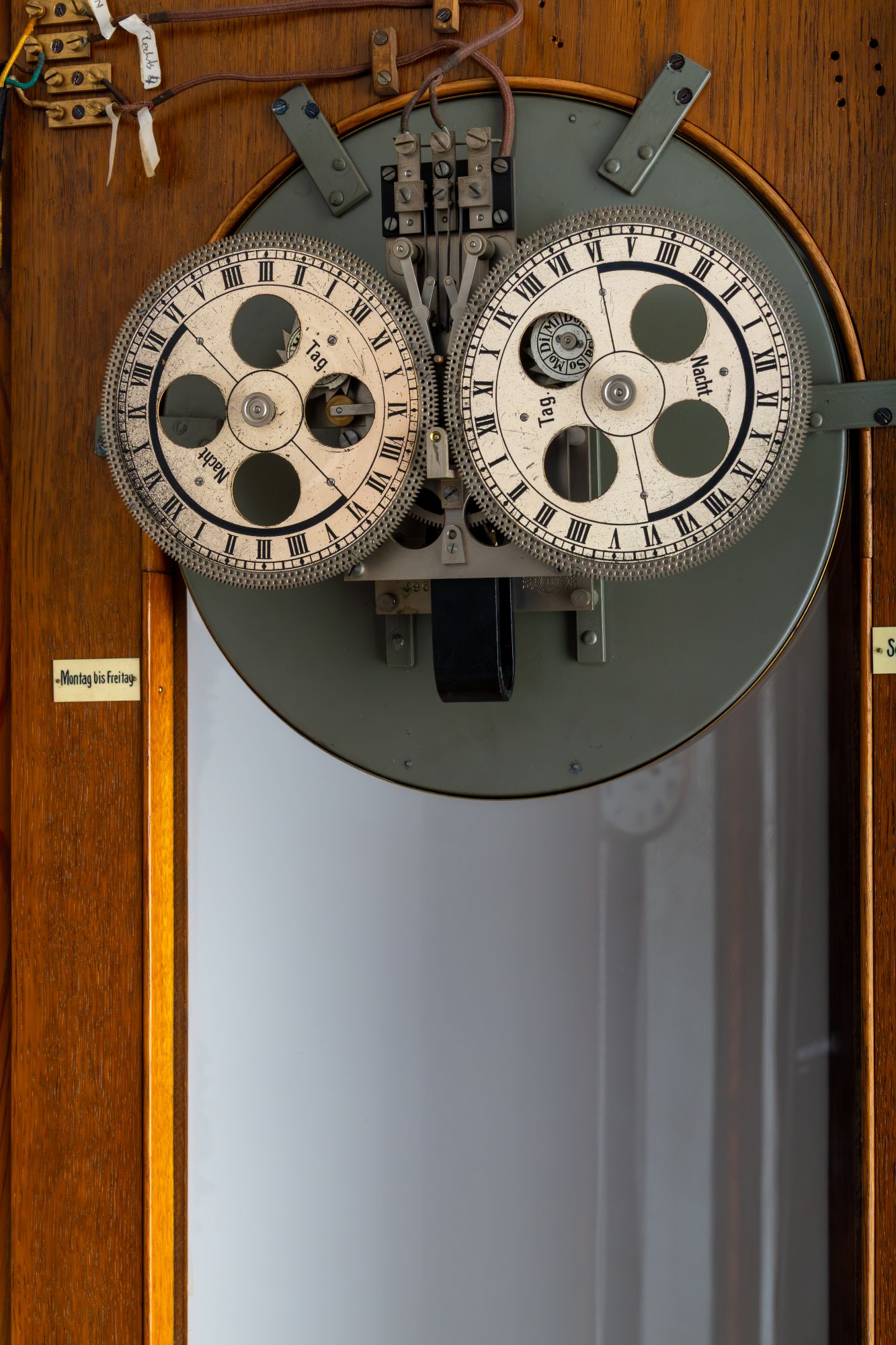
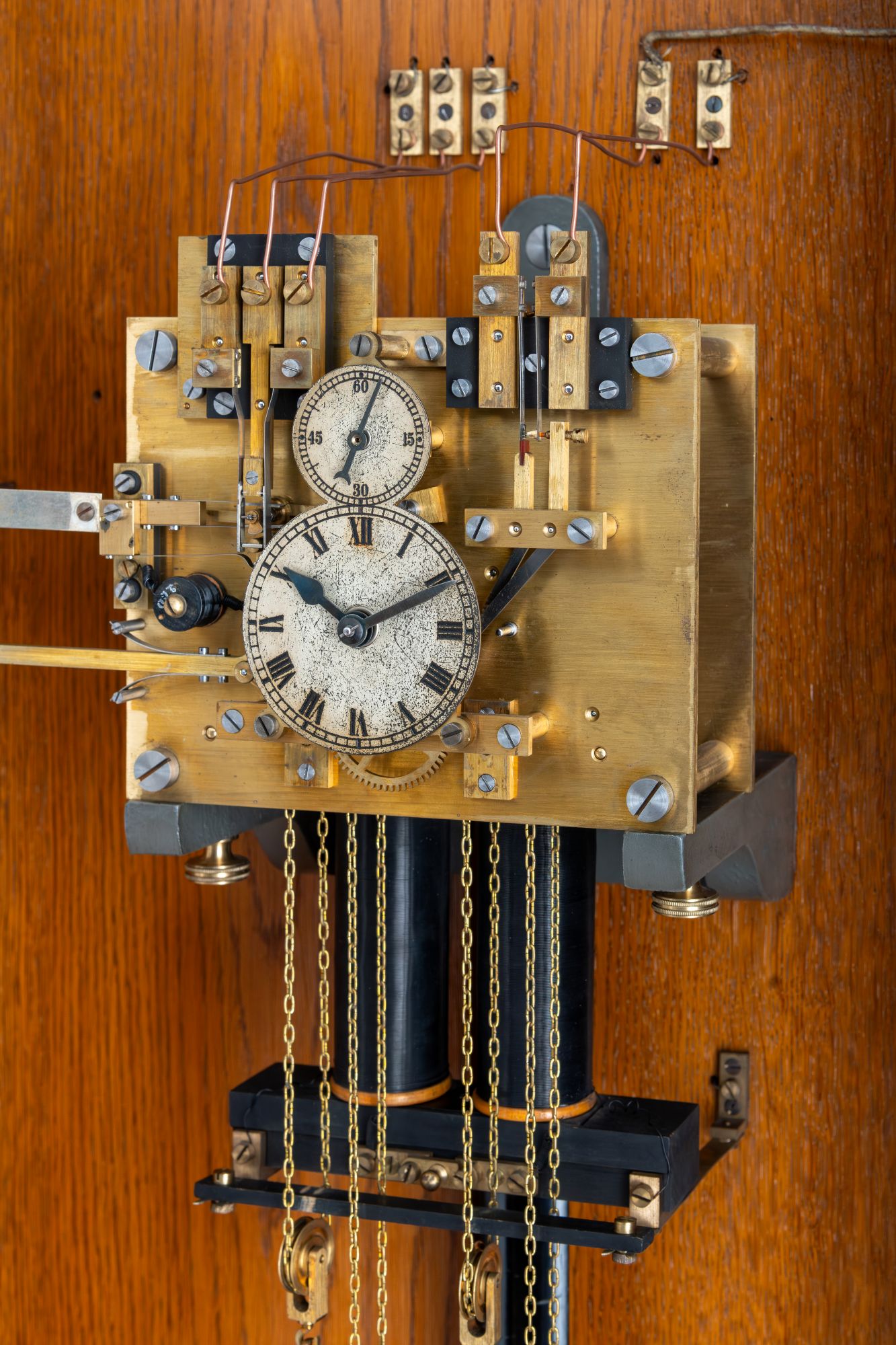
on dial: CW monogram. Plaque above dial: 'C. Theod. Wagner A.-G. | Elektrotechn Fabrik | Wiesbaden' sticker top left: 'VEB Leipziger Wollgarnfabrik | Leipzig | Inv. No. 10894. on wheel: '200 in white paint.
Provenance
Formerly installed in the Leipziger Wollgarnfabrik, and thought to have been in operation c.1952-1969.
In depth
This clock once controlled the running of a Leipzig yarn factory. It was manufactured by Wagner, founded by the eponymous Carl Theodor Wagner in 1852 and from 1863 based in Wiesbaden. Wagner was a successful manufacturer of electric clocks and time systems on into the twentieth century, most notably supplying the German railway system.
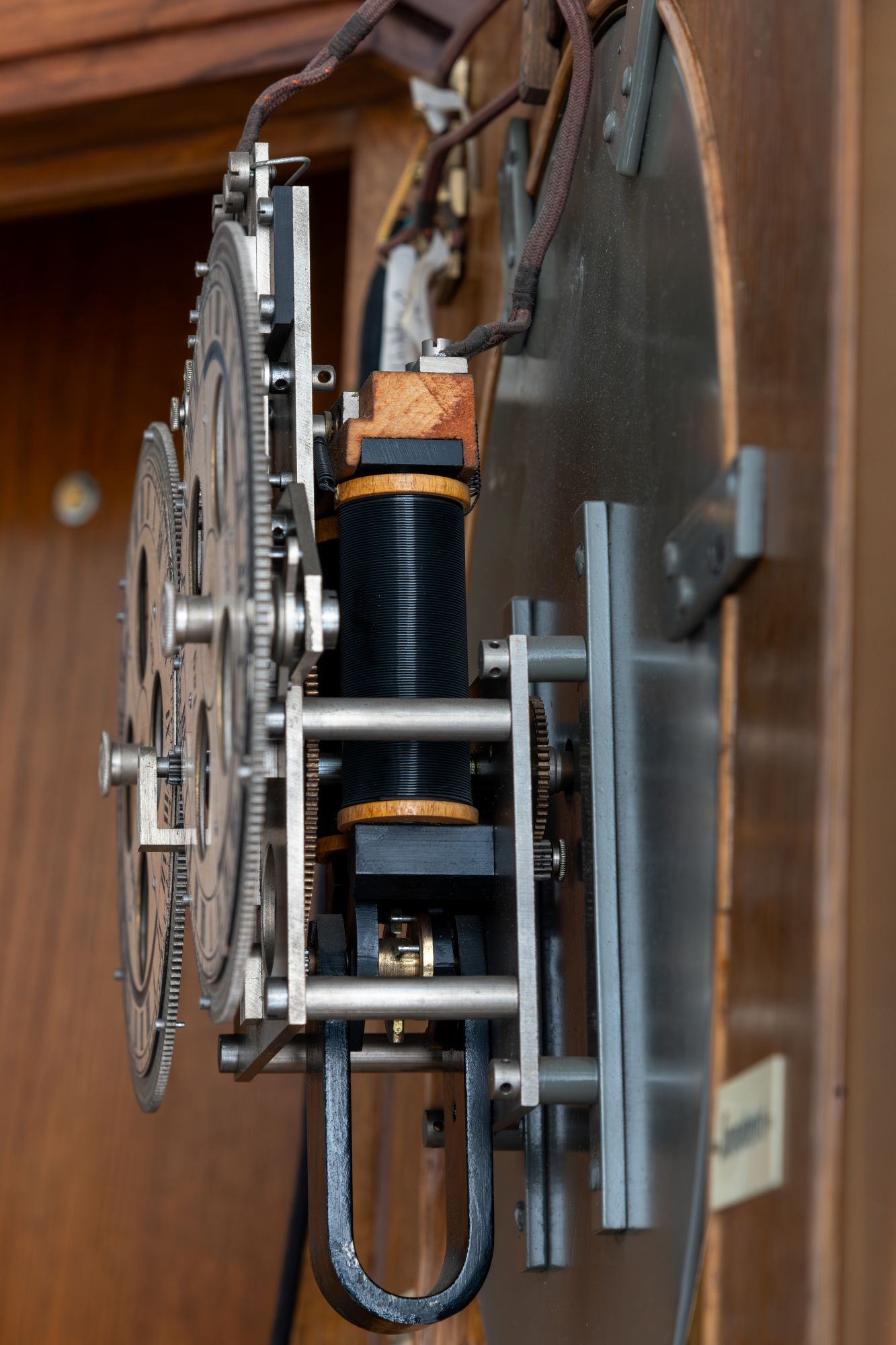
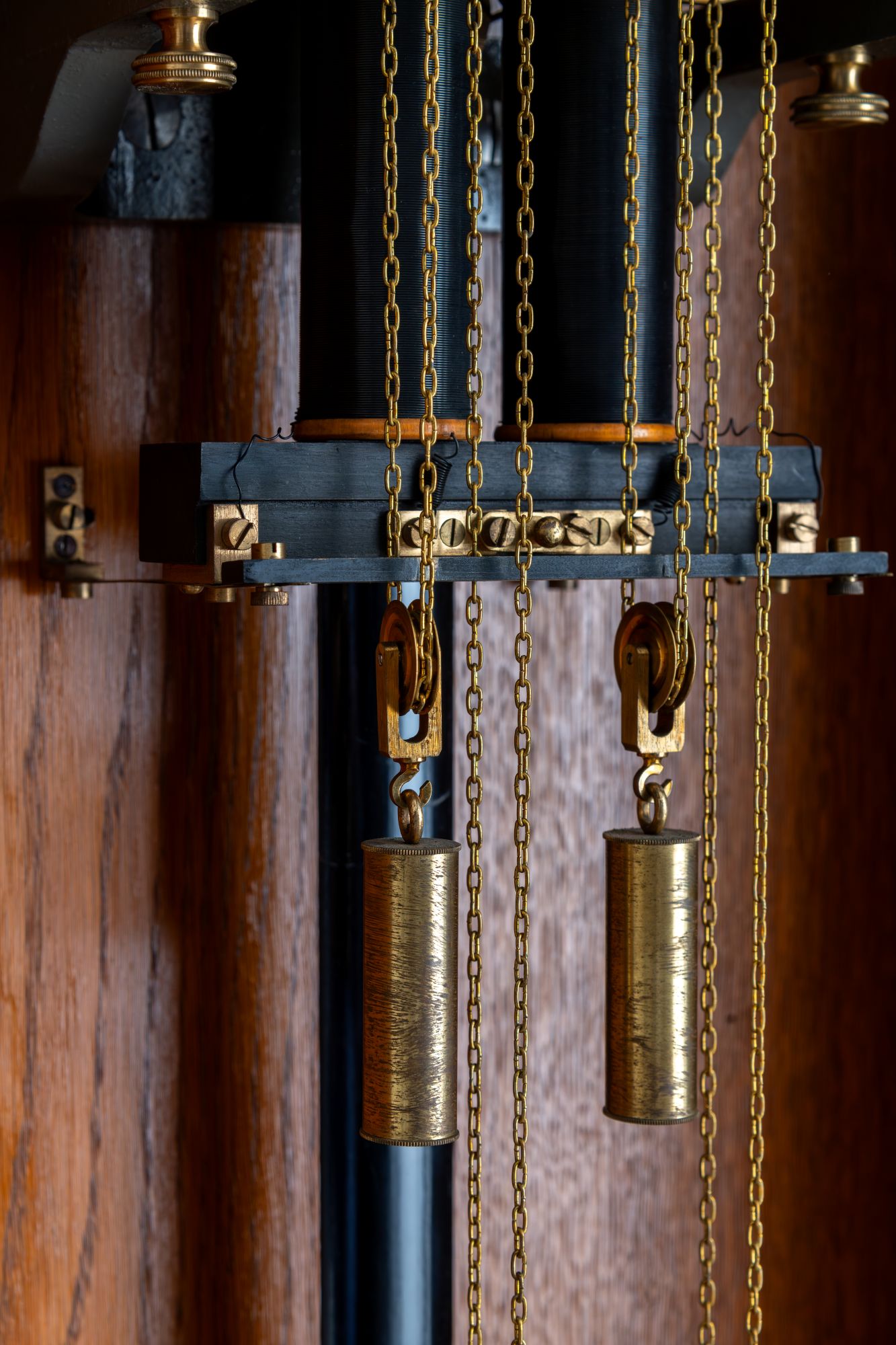
This movement is made to a traditional mechanical design, but incorporates an electric rewind for the small weights at the front, while an electrical contact made each minute sends a pulse around a time circuit, advancing all the dials connected in series. As well as advancing the hands on the dial, this contact also controls two timer switches mounted onto the reverse of the pilot dial, one labelled ‘Monday to Friday’ (‘Montag bis Freitag’), and the other ‘Sunday’ (‘Sonnabend’ – the nomenclature used in Northern and Eastern Germany, as well as officially in the GDR). Each of these dials is divided in turn into night and day (‘Nacht’ and ‘Tag’). This is thought to correspond to a system of lights and /or bells.
A sticker at the top left of the case identifies this clock as part of the ‘VEB Leipziger Wollgarnfabrik’, a spinning mill and wool yarn founded in Leipzig in 1875. By 1900, the site had expanded to 50,000 square metres, and included a celebrated group of purpose-built industrial buildings (with in-built electric lighting system) designed by local architectural firm Pfeifer & Handel. The name ‘VEB Leipziger Wollgarnfabrik’ suggests that this particular clock dates from a later period of operation, c.1952-69, when the company was in public ownership. Production ceased altogether in 1990.