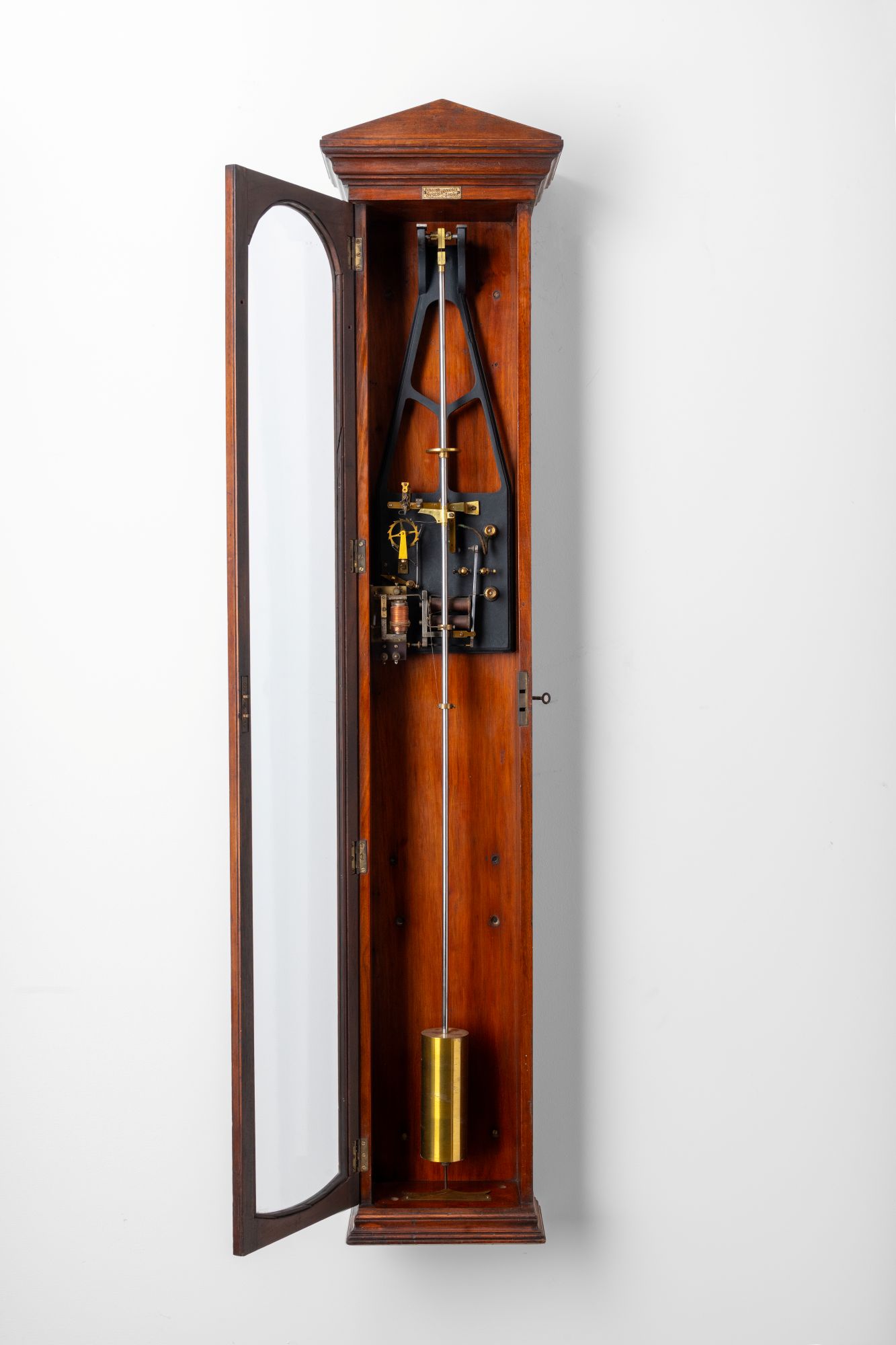
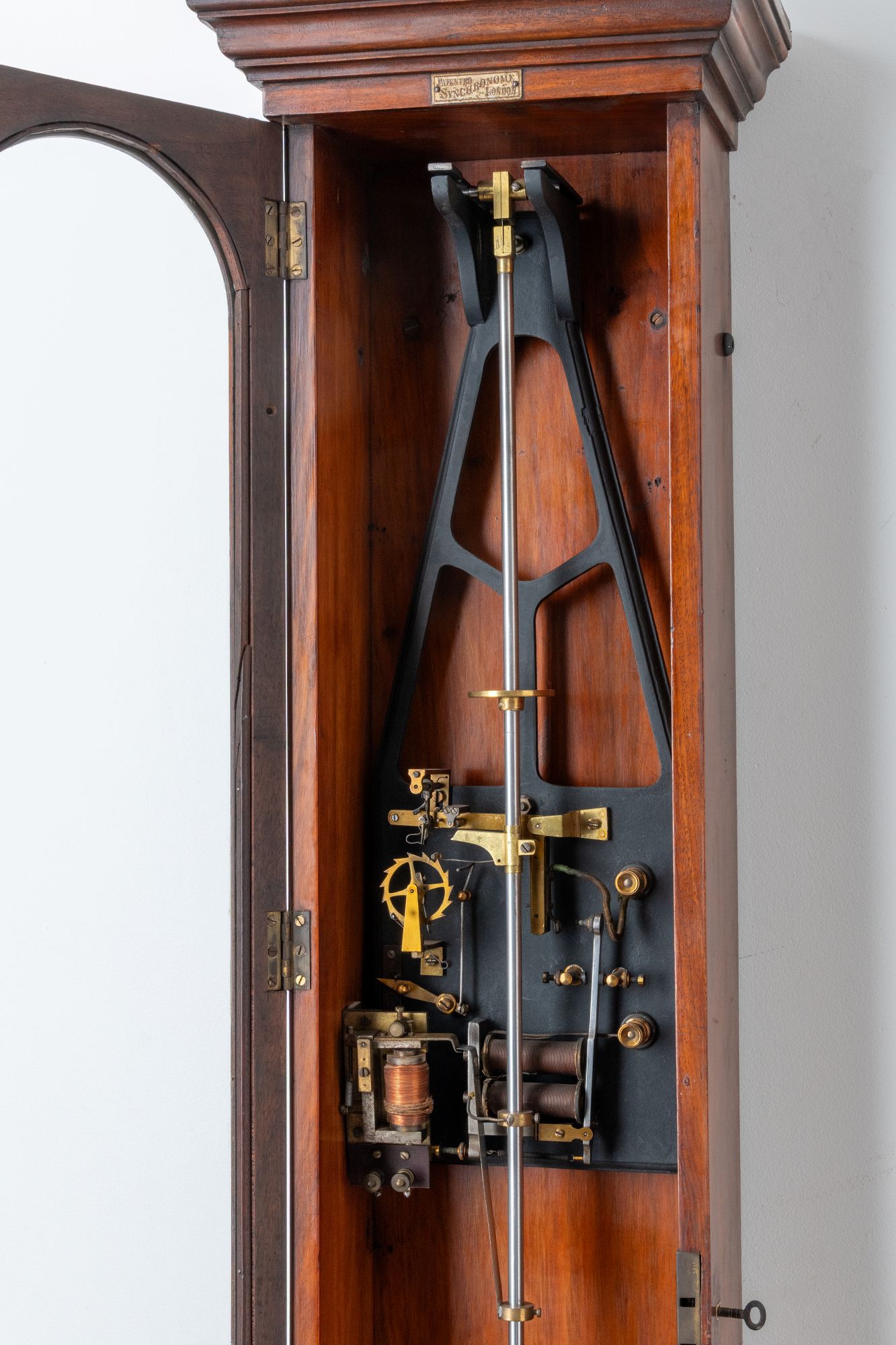
plaque on case: 'PATENT | SYNCHRONOME | LONDON'. Plaque in bottom of case 'F. HOPE JONES. M. I. E. E. LONDON'
In depth
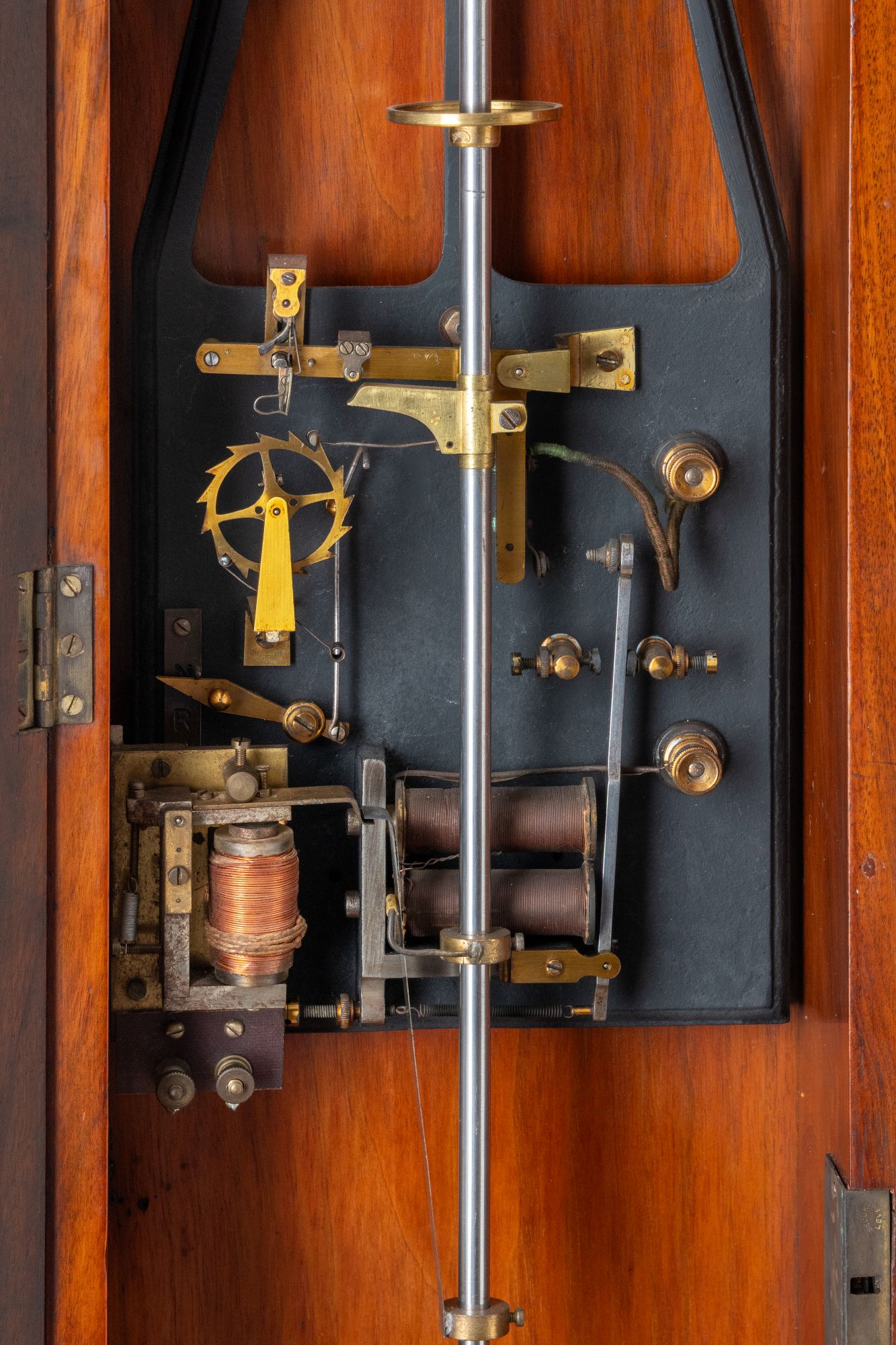
A Synchronome pendulum clock with a brass bob in a standard architectural wooden case, without a pilot dial. Numbered ‘4’, it is an early example of a Synchronome clock incorporating the iron casting that was introduced in 1908 and later became standard. However, it also includes a ‘hit and miss’ synchroniser as patented by William Hamilton Shortt in 1921, which has been retro-fitted to the clock. Under this system, the clock is set to run slightly slow, but an accelerator spring mounted on the pendulum. When a synchronising impulse is received, the electromagnet to the left is energised, attracting the armature above, which is thereby thrown in the path of the pendulum. If it catches (‘hits’) the accelerator spring it will shorten the arc, speeding the clock up; if it misses, the clock will continue to run slow. In normal operation the synchroniser will hit and miss on alternate 30 second pulses. Shortt later incorporated a ‘hit and miss’ synchroniser into his Free Pendulum (see TCW 1073).
Inventory number
TCW 1061
Date
c.1908-25
Bibliography
Robert Miles, Synchronome: Masters of Electrical Timekeeping (Ticehurst, 2011), pp.222-223, pp.171-2.