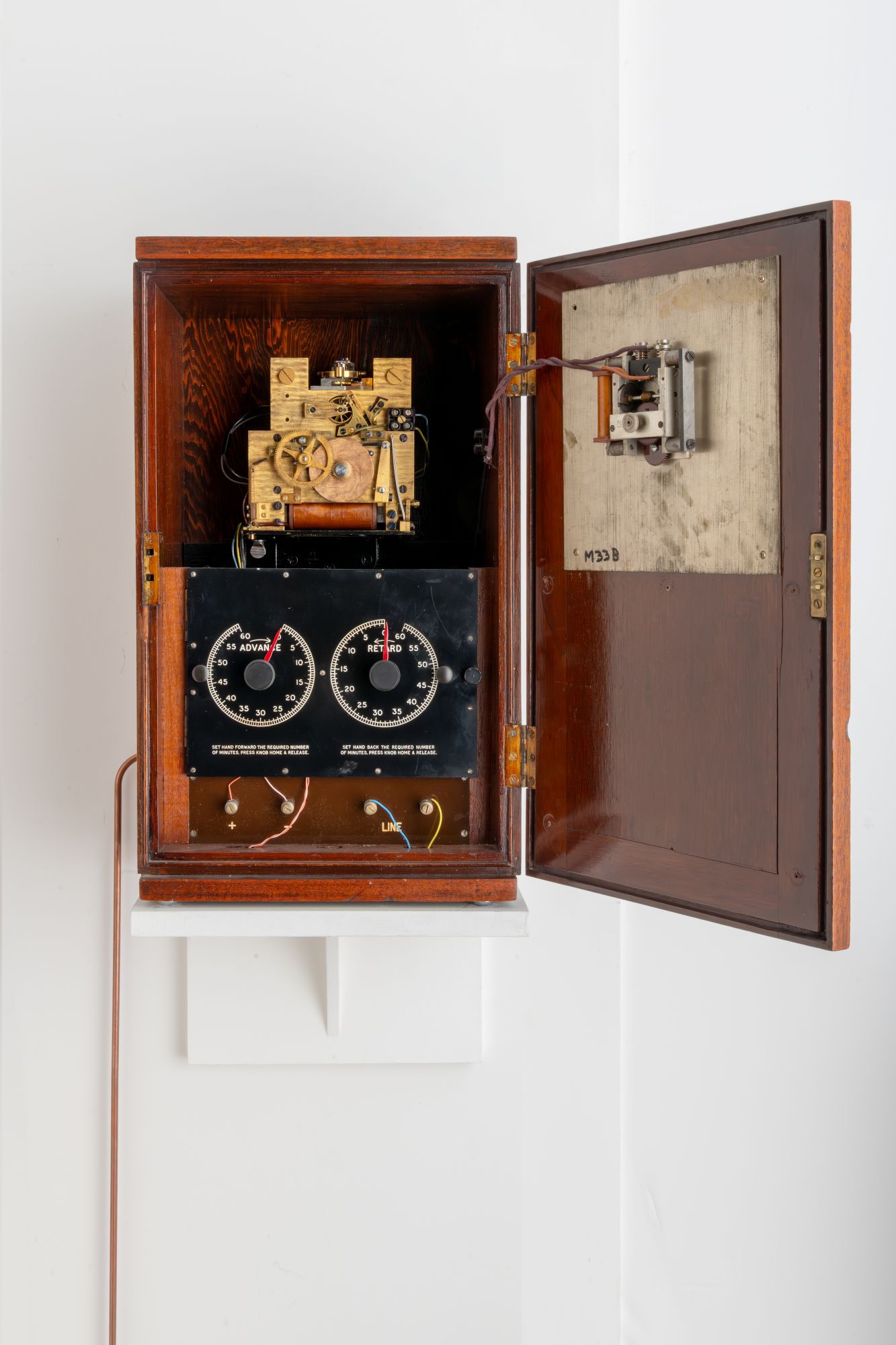
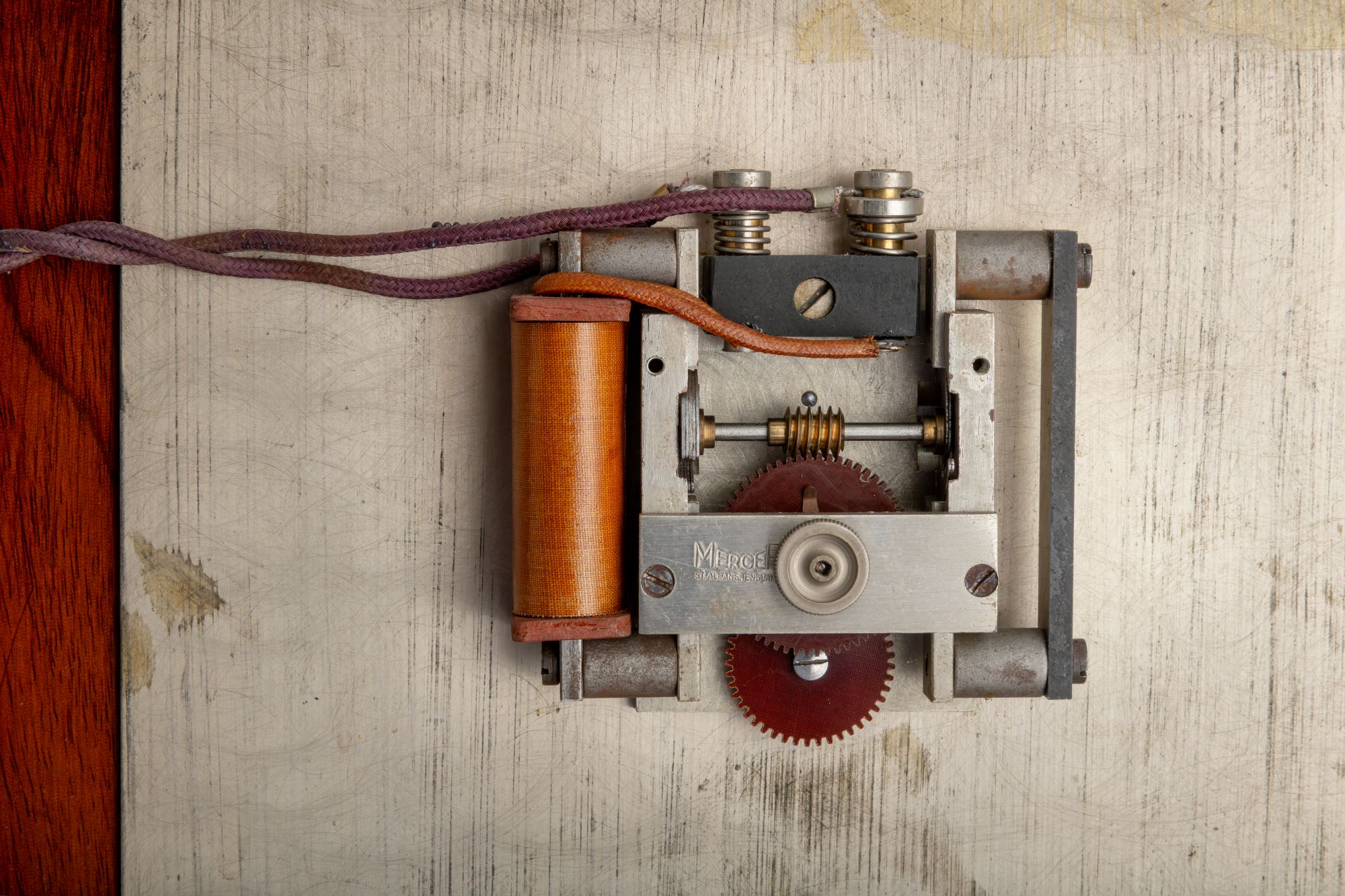
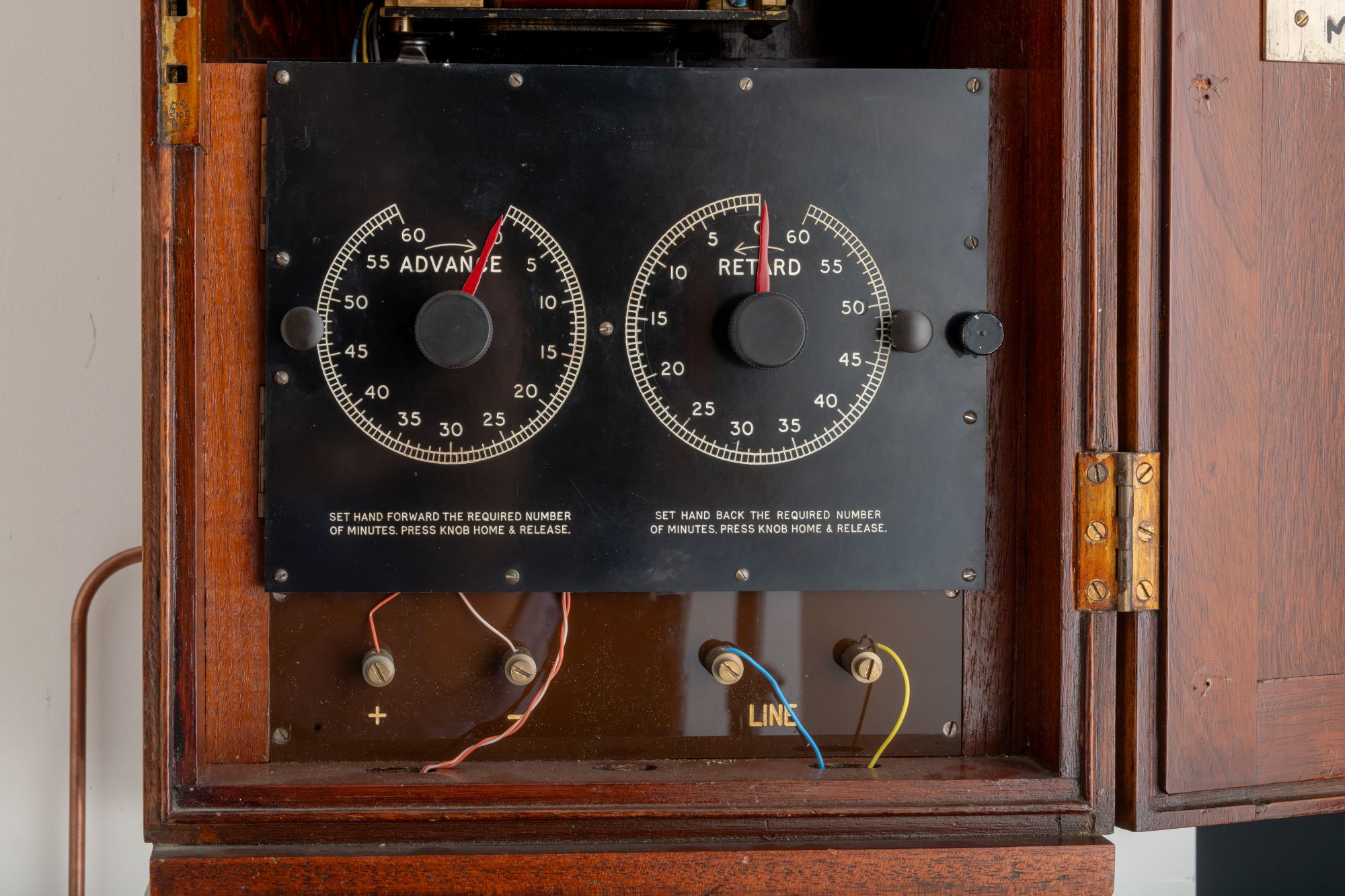
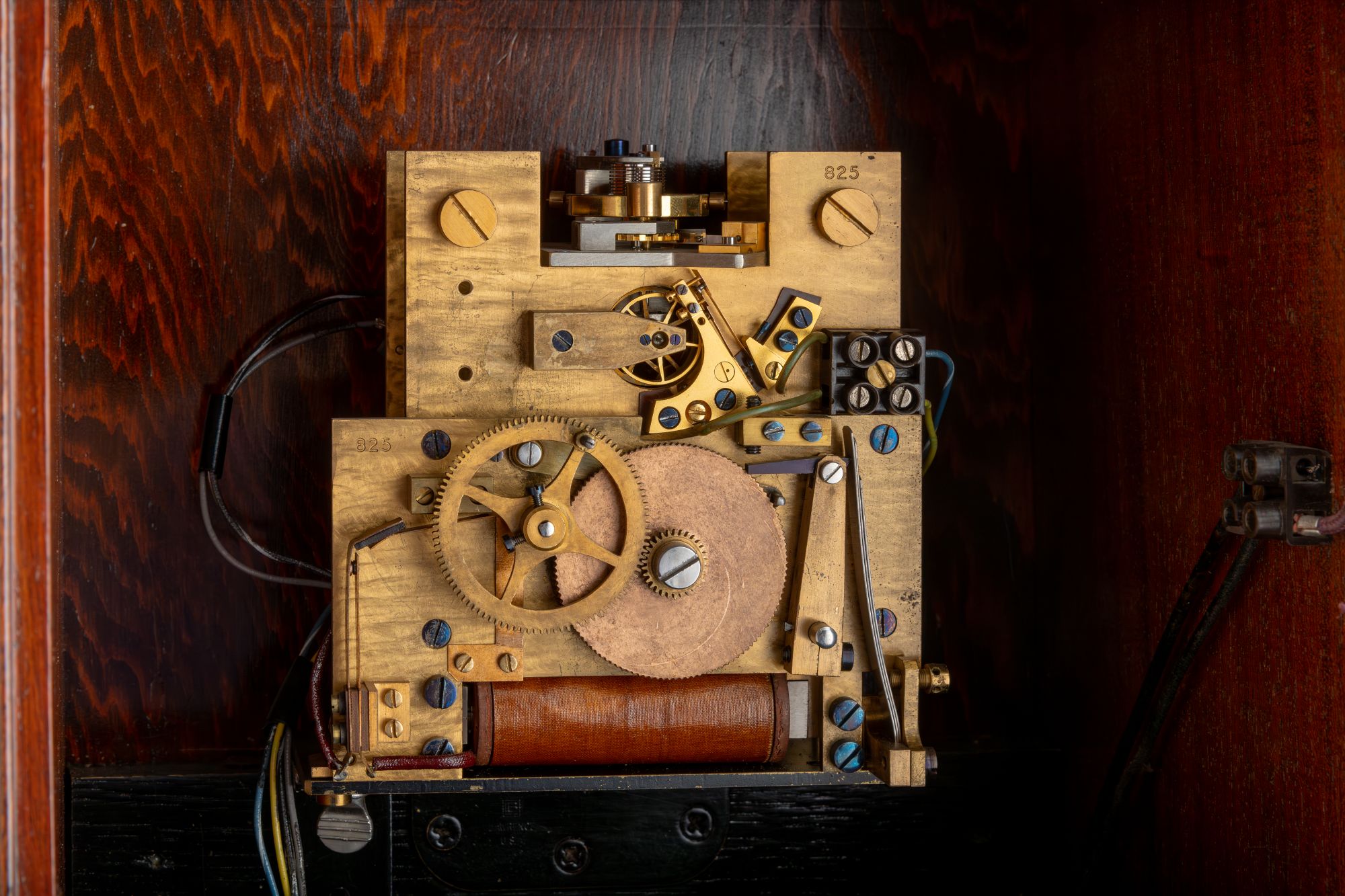
On dial: MERCER | ST. ALBANS ENGLAND. On advance / retard mechanism: ADVANCE | SET HANDS FORWARD THE REQUIRED NUMBER OF MINUTES. PRESS KNOB HOME & RELEASE | RETARD | SET HAND BACK THE REQUIRED NUMBER OF MINUTES. PRESS KNOB HOME & RELEASE | LINE. On each plate: 825. Inscribed at top left of back plate: WBY. On reverse of case, on plate (in felt tip pen) M33b. On movement on reverse of plate inside case: MERCER | ST ALBANS. ENGLAND.
Provenance
Robert Simon collection; purchased 2016.
Overview
Mercer’s marine ‘control panel’ was used on ships and ocean liners – including the Queen Mary and Queen Elizabeth – to distribute the time around a network of secondary clocks. Unlike many rival systems, the balance employs a jewelled spring detent escapement, reflecting Mercer’s heritage as manufacturers of marine chronometers. Below the movement, an automatic ‘advance / retard’ mechanism allowed the ship’s crew to change the clocks as the vessel travelled through time zones. This example is probably from a small passenger ship.
In depth
Mercer were already well established as marine chronometer makers when they began manufacturing marine impulse transmitters of this type. Sold as ‘control panels’, these transmitters could control the time across a network of clocks on board ship. Cases and movements varied in size and specification depending on the customer’s requirements.
This example was probably the controlling clock for a small passenger ship. It is mounted in a teak case with a pilot dial and has a horizontal spring detent platform escapement with 30-second impulse movement, and a spring-wound barrel that is electrically rewound every half minute by an impulse taken from the time circuit. Time impulses are sent to the clock operating relay as each of the two projections on the small wheel wipes against the catch. There is usually a limit to the loading of the contacts: in a large circuit, such as the system of 689 dials Mercer installed in the Queen Elizabeth c.1938, the contact was made every 10 seconds, with a selector switch directing the impulse to each of three main relays in turn.
Below the main movement, an automatic advance / retard unit is provided to allow staff to change the time on the subsidiary clocks as the ship moved through time zones. If the clocks needed to go forward, the number of minutes would be keyed into the advance dial which wound up a spring. As the spring wound down, it would actuate a contact maker, transmitting a series of rapid impulses to the subsidiary clocks, and advancing their hands, before returning to normal half-minute operation. If the clocks needed to go back, staff would set the pointer on the retard dial, activating a switch to divert impulses to the retarding mechanism – thus stopping all the clocks until the required number of minutes have passed.
Mercer’s ‘control panels’ were among the most successful marine time systems produced during the early twentieth century, at a time when transatlantic ocean travel was booming. This example is likely to date from after the mid-1930s, since it is badged ‘Mercer’ rather than ‘OCTO’. Mercer used the latter name for their marine products for a brief period from 1927, but were forced to abandon it after a legal dispute with an identically named watchmaker in Switzerland.
Dimensions
7.3 cm (w) x 22cm (d) x 47 cm (h)
Inventory number
TCW 1036
Date
c.1935
Bibliography
Robert Simon, ‘The Marine Master Clock’, National Association of Watch and Clock Collectors, NAWCC Bulletin (April 2008), 50:2, no. 373, pp.161-174
Robert Simon, private correspondence