
-
 Matthaus Hipp, Chronoscope, TCW 4019. Image available for non-commercial use via Creative Commons under a CC BY-NC 4.0 license. TCW_4019_02Download
 -
 Matthaus Hipp, Chronoscope, TCW 4019. Image available for non-commercial use via Creative Commons under a CC BY-NC 4.0 license. TCW_4019_03Download


-
 TCW_4019_01
 -
 Matthaus Hipp, Chronoscope, TCW 4019. Image available for non-commercial use via Creative Commons under a CC BY-NC 4.0 license. TCW_4019_02
 -
 Matthaus Hipp, Chronoscope, TCW 4019. Image available for non-commercial use via Creative Commons under a CC BY-NC 4.0 license. TCW_4019_03
Creator
Matthaus Hipp
Title
Chronoscope no. 17757
Category
Inscriptions and markings
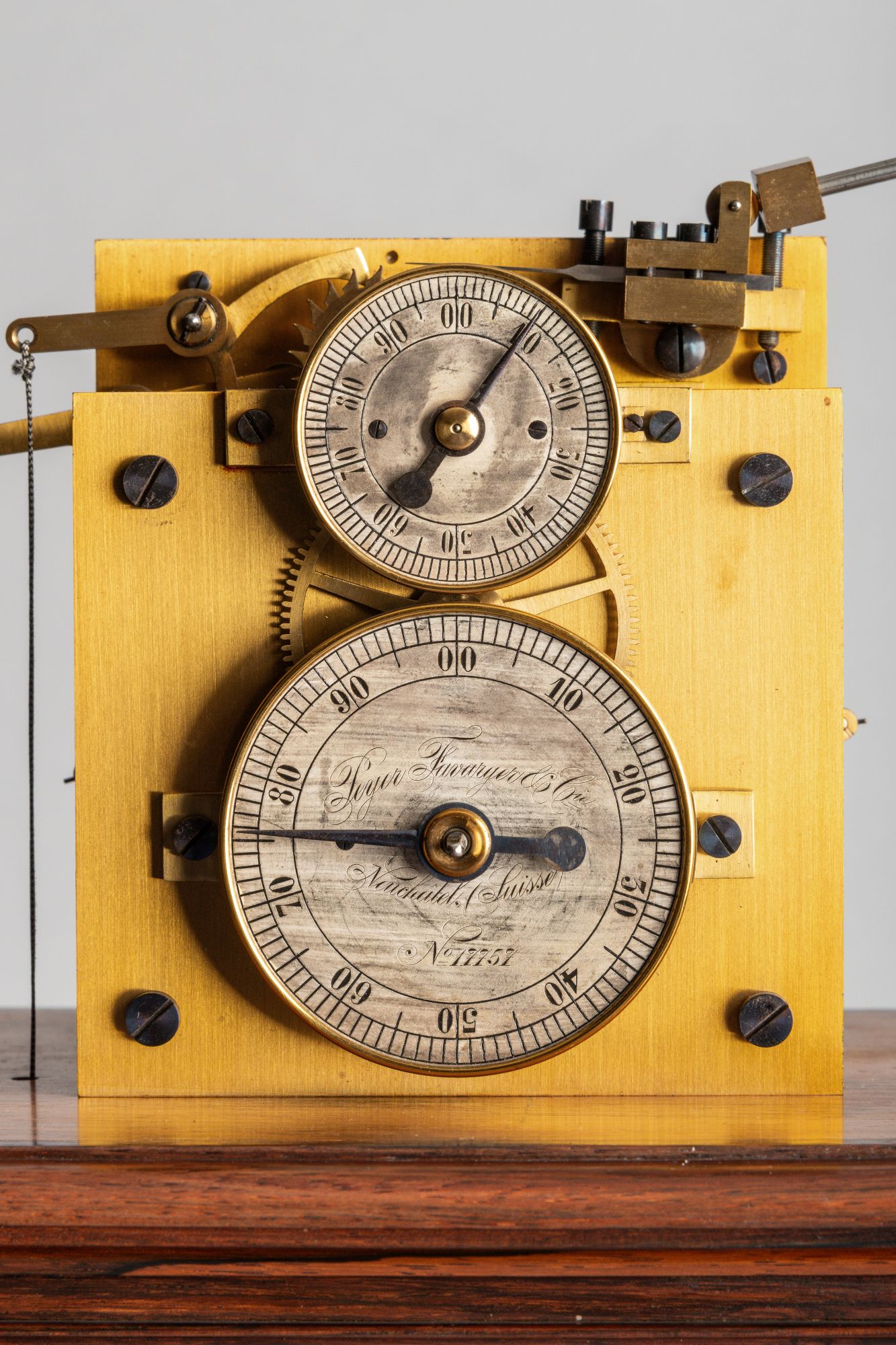
On dial: Peyer Favager & Co | Neuchatel Suisse | No. 17757 On top of plate: 17757
Overview
During the nineteenth century, scientists became increasingly interested in studying the nervous systems of humans and animals. However, only with the invention of a reliable short-duration timer was systematic experimentation possible. This electric chronoscope was designed by clockmaker and telegraph engineer Matthaus Hipp. With its fast-running train, it can time in thousandths of a second, and its development in the 1840s opened new frontiers for astronomy, psychology, physiology and ballistics.
In depth
Matthaus Hipp’s weight-driven electric chronoscope can measure intervals in thousandths of a second. First recorded in writing in 1848, Hipp’s design drew on and developed a model unveiled in 1840 by British engineer Sir Charles Wheatstone. However, Hipp’s design was more successful, partly because he accounted for the natural inertia of the clock movement: in the Hipp Chronoscope, since the train is started before the timer, the measurement is taken with a train of wheels already running at a constant velocity.
The Hipp Chronoscope had almost immediate scientific ramifications. Hipp lent an early model to the director of Neuchatel’s Astronomical Observatory, Adolph Hirsch (1830-1901), who used it to prove the concept of ‘physiological time’ (later ‘reaction time’) over a series of experiments (in some of which Hipp himself served as a subject). Hirsch observed several phenomena that are still accepted today, including differences in time for different sensory responses – audio, visual and tactile. His observations were initially used to correct for varying reaction times in the observation of star transits, but they also fed into contemporary developments in psychiatry and physiology.
Born in Blaureuren in 1813, the son of a baker, Hipp was apprenticed to a clockmaker in his teens, and began investigating electromagnetism in the 1840s. Like many pioneers within electrical horology, he worked across several burgeoning technologies. He also created a ‘writing telegraph’, and his ‘Hipp toggle’ was instrumental in the development of electric clocks [see TCW 1035]. Around 100 of his chronoscopes are known to have been made. Most of those that survive are in the collections of scientific institutions. This example is numbered ‘No. 17757’ and the dial is signed ‘Peyer Favarger & Co | Neuchatel Suisse’. Both suggest a date of c.1889-1908. In 1889, the ailing Hipp had entrusted the management of his company to the engineers von Peyer and Favarger; shortly afterwards, Hipp and his wife moved to Zurich, where Hipp died on 3 May 1893. Von Peyer and Favarger continued to iterate on the chronoscope over the following decades, first under the company name ‘Favarger’ and later ‘FAVAG’.
Technical description
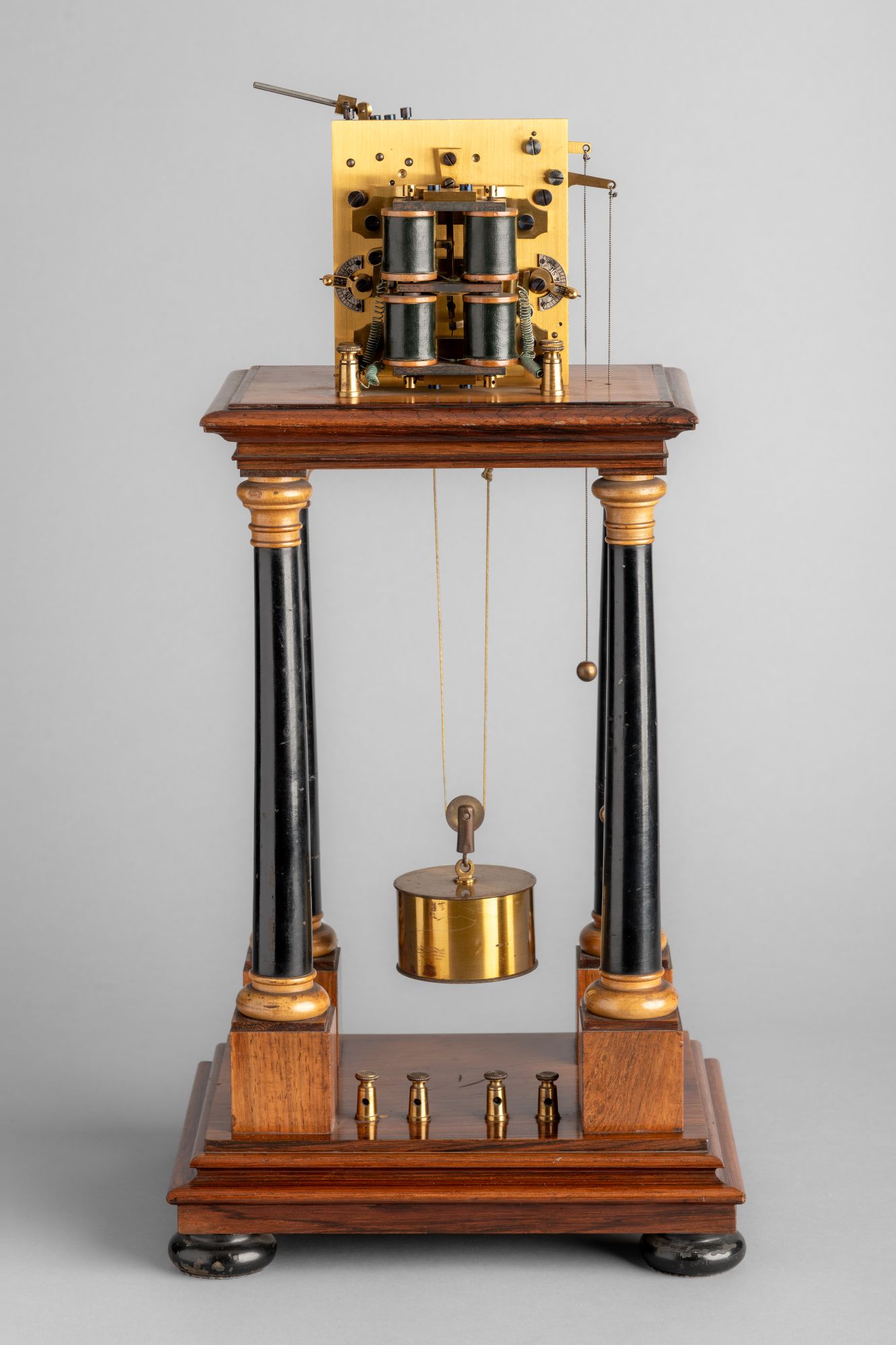
Clock movement with two silvered dials, mounted onto a seatboard supported on turned ebony architectural pillars set into a stepped wooden base resting on four bun feet. The clock movement is driven by a small cylindrical weight which falls through a slot cut into the seatboard, between the four pillars. The ‘escapement’ (more like a speed control device) comprises a steel lamella fixed at one side and a star wheel with twenty teeth. The loose end of the lamella rests on the star wheel. As the star wheel revolves at speed, each tooth in turn strikes the lamella, which therefore vibrates at a rate of 1000 vibrations per second. This can be set going or stopped by two levers connected by a rod and spiral spring, activated by tackle lines also running through holes in the seatboard.
The clock movement is distinct from the train for the hands, thus correcting for natural inertia – the chronoscope is started first, and measurement only begins once the clock has reached a constant velocity. The clock train has two dials, each going up to 100. The lower dial measures 10ths of a second (it turns once every ten seconds), while the hand of the upper dial indicates 1/1000th of a second (turning once every tenth of a second). Measurement starts or stops depending on whether the electromagnets on the reverse are used to advance or withdraw a pinion at the top (effectively acting as a clutch). Four brass terminals are set into the base between the back two pillar, and either side of the movement on the seatboard, to accommodate wires connected to a power source and to the instruments that will be used in a measurement. With the chronoscope running, the operator sets measurement in motion by interrupting the electrical current; as soon as the observer perceives the moment they are measuring, they turn the current back on and take the measurement recorded. Owing to the highly audible 1kHz frequency at which the lamella vibrates, it was common to use a piano tuner to fine tune the running speed of chronoscopes.
Dimensions
54 x 26 x 21 cm
Inventory number
TCW 4019
Date
c.1900
Bibliography
Helmut Kahlert, ‘Matthaus Hipp in Reutlingen: The Development Years of a Great Inventor (1813-1893)’, The Antiquarian Horological Society EHG Paper No. 57
Serge Nicolas, ‘On the speed of different senses and nerve transmission by Hirsch (1862)’, Psychological Research 59 (1997), pp.261-268
Thomas Schraven, ‘The Hipp Chronoscope’, The Virtual Laboratory (2004)